Alberta will vote on whether to remain part of Canada. What now?

 AFP via Getty Images
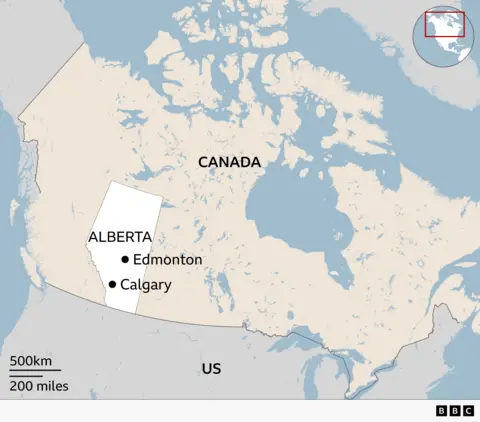
The western Canadian province of Alberta will ask its citizens this October whether they want to remain part of Canada or kick-start the process of holding a binding referendum on separation, marking a major test of the country's unity, the first in decades.
Alberta's leader, Premier Danielle Smith, announced the coming vote on 21 May in a televised address.
She said she herself supports a unified Canada.
There has been a growing separatist sentiment in the oil-rich province in recent years, and plebiscite comes after 300,000 people signed a petition asking that a referendum be held on the matter.
Here's why some Albertans are calling for independence — and what comes next.
What will the referendum question ask?
The question being put to voters won't be a simple "stay" or "leave".
Instead, Albertans will be asked: "Should Alberta remain a province of Canada or should the Government of Alberta commence the legal process required under the Canadian Constitution to hold a binding provincial referendum on whether or not Alberta should separate from Canada?"
The premier's office clarified to the BBC that voters will have a choice of checking two boxes — option A being to remain in Canada and option B being to commence the legal process to hold a binding separation referendum.
Why is this happening?
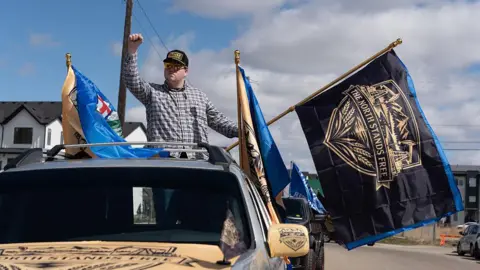
The referendum question is a result of a push by a group of Albertans who have been advocating for the province to be independent from Canada.
Over the past year, they held townhalls across the province to gauge interest from the public. They then launched a citizen-led petition to separate earlier this year, which garnered more than 300,000 signatures.
But the petition was blocked by an Alberta court earlier this month.
A judge ruled that Alberta, which authorised the gathering of signatures for a proposed independence referendum under a citizen petition law, failed to consult indigenous First Nations whose land would be affected should the province become an independent state.
Meanwhile, another group led by a former deputy premier of Alberta, Thomas Lukaszuk, collected signatures for an anti-separation petition called Forever Canadian. That was signed by more than 400,000 Albertans.
The province's population is slightly more than five million.
Smith said she was "deeply troubled" by the court decision, and will not let "a single judge silence the voices of hundreds of thousands of Albertans".
Her government has appealed the decision, she said. But in the meantime, "kicking the can down the road only prolongs a very emotional and important debate".
She has also faced pressure from separatist Albertans to hold a referendum on independence regardless of the legal decision.
 AFP via Getty Images
Who are the separatists, and what do they want?
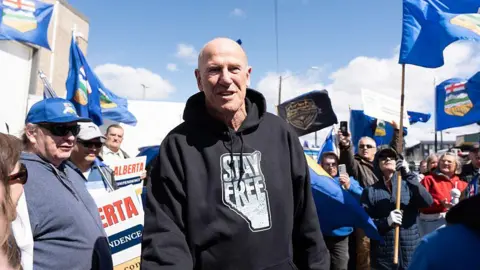
The separatist movement is led by Mitch Sylvestre, a gun shop owner from the town of Bonnyville, and Jeffrey Rath, a lawyer based in Calgary. It has been supported by other figures along the way.
Both Sylvestre and Rath are members of a group called the Alberta Prosperity Project, which argues that the province's economic growth has been hindered by years of Liberal party rule in Ottawa.
In particular, many in the movement are frustrated with environmental policies that they believe have stood in the way of building pipelines and unlocking resources from the oil-rich province, which traditionally leans conservative.
They also believe that Alberta contributes far more to the country than it receives, and that Ottawa has a disproportionate say in its internal matters.
The sentiment is rooted in "western alienation" — a term that has been used for decades to describe the sense by some in Canada's western provinces that they are often overlooked and underrepresented by federal politicians in Canada's capital.
But the movement is not uniform in its demands.
At a separatist townhall last year, some told the BBC that they wanted to use the threat of independence as a bargaining chip with Ottawa, while others said they would like to follow through with a provincial divorce.
A few said they would be open to Alberta joining the US.
Rath has told the BBC that he believes Alberta has more in common culturally with parts of the US than the rest of Canada.
He has also travelled to Washington several times on what he has described as a "fact-finding" mission, where he and other separatists met with Trump administration officials to see if the US government would support an independent Alberta with a line of credit.
Rath has not publicly named which Trump officials the group has met.
What happens next?
The launch of a referendum triggers a five-month campaign period for interested parties on both sides of the issue.
Smith said she will vote for Alberta to remain. She argues that, while some grievances raised by the separatists are legitimate, the province has recently been able to make significant inroads with Ottawa, including on developing a pipeline project.
Prime Minister Mark Carney, who has ambitions of making Canada an "energy superpower", has pressed the case for the province to stay.
"We're renovating the country as we go, and Alberta being at the centre of that is essential," Carney, who was raised in Edmonton, Alberta, said in May.
Opposition Conservative leader Pierre Poilievre, who enjoys significant support in Alberta and who was raised in Calgary, also said that his party will be advocating for unity.
Meanwhile, Rath, one of the most prominent separatist voices, has expressed disappointment in the referendum question put forward by Smith.
He has threatened to organise a vote against her leadership of Alberta's United Conservative Party, which could put Smith's political future in jeopardy.
"To hell with 301,620 Albertans who were promised a vote on their question," he wrote on social media following her announcement. "Danielle Smith just lost her base!"
First Nations in Alberta have also criticised Smith, calling her decision to hold a referendum despite the court ruling "undemocratic" and "authoritarian".
If Albertans vote to leave, Smith said that would kickstart a "legal process" to hold a binding referendum, adding there are a number of steps that would have to be taken to get there.
"I will accept the result of this referendum," she said. "That's why I'll be campaigning hard to try to convince Albertans of my position, which is to remain."
How many Albertans support independence?
Polls suggest that the majority of Albertans would vote to remain in Canada.
An Ipsos poll from January suggests that about 28% would vote 'yes' in an independence referendum. It also showed that among those who support separation, nearly 20% say their support is symbolic or conditional - meaning they are not committed to voting in favour.
An Abacus Data poll released in March also revealed similar results, with 26% saying they support independence.
And a CBC poll released in April shows that support for Alberta independence has remained flat over the last year.
