'I represent my community without being told how to vote'

 Amy Holmes/BBC
The success of Great Yarmouth First (GYF) in last month's local elections has drawn attention to the growing influence of independent councillors and local residents' groups in East of England politics.
GYF, which is aligned to Independent MP Rupert Lowe's Restore Britain movement but insists that it champions local issues, won nine seats on Norfolk County Council and has agreed to support the minority Reform UK administration.
It means councillors from what could be considered non-mainstream parties are either running or playing a key role in 15 authorities across the region. They also have a significant presence on four more councils where their votes can be key to whether the party in charge gets its legislation through.
They say it is a sign that voters are turning away from mainstream parties in local elections and choosing people who put their community first. The other parties say they also have good local councillors who benefit from being part of a bigger team.
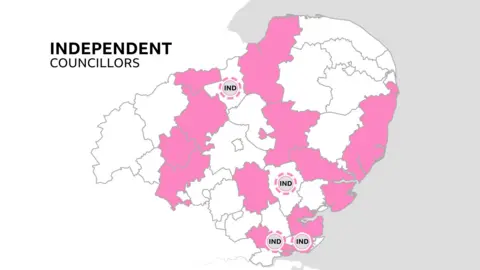
From the seven independents who could have the deciding votes on Conservative-led Basildon Council, where no party has a majority, to the independent members who have been running Central Bedfordshire as a minority administration for the past three years, independents are making their mark.
Some are individuals who want to champion a local cause. Others, such as Residents for Uttlesford and Peterborough First, have formed parties to represent their communities.
Great Yarmouth First appears to have agreed to support Reform on Norfolk County Council after one of its first promises in office was to launch an inquiry into three unpopular cycle lanes.
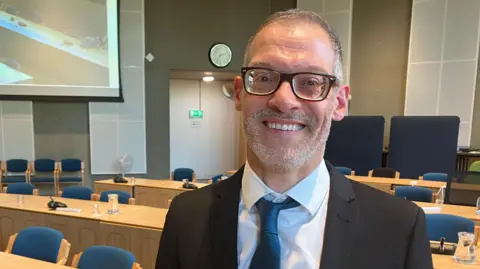
"Independents tend to be more engaged with their local communities," says Adam Zerny, the Independent leader of Central Bedfordshire Council.
"These are often people who have never had anything to do with political parties or, if they have, have become frustrated with the political party system where you have to abide by certain rules and the whip, where you are told what to do."
He points out that during this year's local election campaigns the main parties talked a lot about immigration and the cost of living – issues which councils have little control over.
'Residents trust me'
 Sue Dougan/BBC
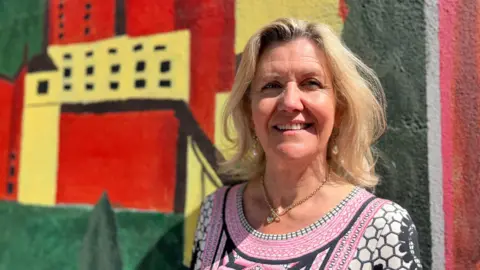
Julie Kerr is a councillor for St Ives and leads the Independent Group on Huntingdonshire District Council.
"The biggest advantage of being an independent is that no-one can tell me how to vote," she says.
She sometimes carries out local surveys to find out what people think on issues such as flood prevention and where to build new homes.
"They trust me and they know I'll do the right thing for them and not get whipped into supporting something I'm not happy with."
She is critical of so-called "paper candidates" who stand for a main party.
"They normally don't know or care about the local area," she says. "People want local people who they know and can trust.
"I don't think there's any need for party politics in local government. It's about dealing with local matters and caring for our town, district and county."
'You have to work harder'
 West Suffolk Council
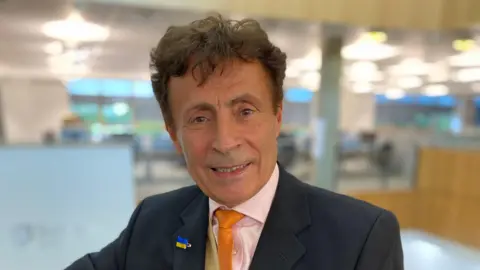
Victor Lukaniuk is an independent member who represents Brandon and is deputy leader of West Suffolk Council, sitting in a cabinet alongside other independent and Labour councillors.
"It is hard work being an independent. You have to finance your own election campaign. You have to club together with colleagues to get your leaflets delivered," he says.
"The Tories and Labour have lots of supporters who they can bring in and they can afford to use the postal service to deliver their leaflets."
A district councillor for the past 10 years, he has been fighting to get the railway station refurbished and for an HGV ban in the town.
"Now I have to think about the whole of West Suffolk, I can't have that parochial outlook anymore," he says.
"It's a steep learning curve helping to run a council.
"There's a lot of homework to understand the issues, and because my group is all independent and [we] don't have a party whip or a constitution I can never be sure that they will back me. But they have so far!"
'We have good councillors, too!'
 Nic Rigby/BBC
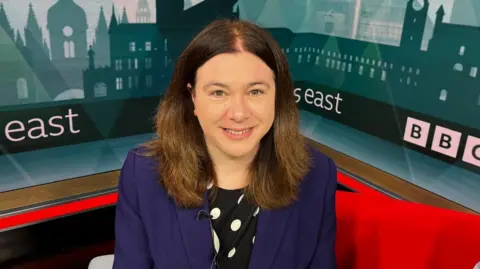
One of Central Bedfordshire's MPs, Alex Mayer, who represents Dunstable and Leighton Buzzard, accepts there are many good independent councillors, but she is quick to add: "There are also some well engaged and good local councillors from the main political parties."
Her main argument is that the big parties have the time and resources to research issues and come up with an agreed line, and then have the clout to get their councillors to vote through difficult issues.
"We need councillors who are able to make decisions," she says.
"Occasionally they may make a decision which is not absolutely the best answer for one street or area but it could be the best answer for people who live in the wider area, and that's what you need if you're going to make any progress."
Other parties point out that if a councillor is part of a "national brand" it is easier to discipline or remove them if they misbehave or fail to serve their community.
They also have access to expertise within their party when fighting campaigns and dealing with difficult issues.
Local elections are notorious for being used as protest votes, and it is likely that voters sometimes support independent candidates not because of what they stand for but because they are not from one of the main parties.
It is also worth noting that independents won fewer seats in the East in this year's local elections as many voters turned to Reform, which is seen by some as the new party of protest.
But independents are now more involved in local government here than ever before.
If voters are impressed when elections are next held, their influence may keep on growing.
Do you have a story suggestion? Contact us below.
Follow East of England news on X, Instagram and Facebook: BBC Beds, Herts & Bucks, BBC Cambridgeshire, BBC Essex, BBC Norfolk, BBC Northamptonshire or BBC Suffolk.
