Farm decides to slaughter 271 cattle after inspection found rule breach

 Getty Images
A farm in Fife has decided to slaughter 271 cattle after an inspection by the Scottish government found the animals were "unidentifiable and untraceable".
Owners are legally required to report births and movements of cattle using a system called ScotEID.
The Scottish government said these regulations had not been met by Falkland Estate, which meant the animals "cannot enter the food chain", adding that the business had "taken the difficult decision to slaughter the animals".
The BBC understands it could be one of the largest cattle slaughtering incidents of its kind in Scotland.
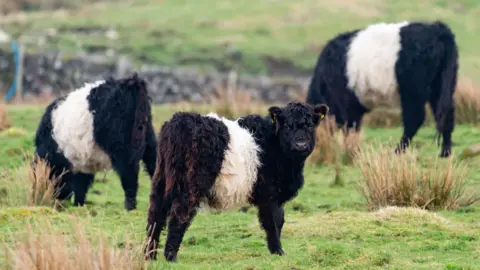
Falkland Estate, which is home to Aberdeen Angus and Belted Galloway cattle, has been approached for comment.
The Scottish Farmer reported that the business is not expected to receive compensation for the destroyed animals, which could be worth up to £500,000.
It added that the farm could also be liable for some of the costs connected to having the animals slaughtered and the severity of the breach could see them face a loss of farm support payments from the Scottish government.
A Scottish government spokesperson said "non-compliance with regulations" was found "while undertaking a cattle identification and traceability Inspection".
They said: "Identification and traceability regulations for livestock must be adhered with for disease prevention, control, eradication and the protection of public health.
"During the inspection 271 animals were found to be unidentifiable and untraceable which means they cannot enter the food chain and are placed under a permanent movement restriction.
"In this case the business has taken the difficult decision to slaughter the animals"
The spokesperson added that Scottish government inspectors will attend to "verify the slaughter".
A spokesperson for NFU Scotland said it was a "deeply sad situation" but they couldn't comment further on an "ongoing regulatory matter" that relates to the alleged actions of an individual business.
"More generally, livestock identification and traceability systems are fundamental to Scotland's livestock sector. They play a vital role in animal health and welfare, and disease prevention and control," they added.
"Scottish farmers and crofters understand the importance of these requirements and the vast majority work hard to comply with them.
"Scotland's traceability system is internationally recognised and is an important part of protecting the livestock."
What are the rules?
Strict rules govern how cattle are identified and tracked to protect public health and limit the spread of disease.
All animals must carry official ear tags and have a fully traceable history.
Farmers are required to record every movement on ScotEID, the national database used to monitor livestock.
Authorities rely on the system to trace animals quickly in the event of an outbreak.
Calves must be tagged within set deadlines, with tighter rules for dairy cattle than beef.
All livestock holdings must be registered, and every sale, transfer or slaughter reported.
Inspectors check records against ScotEID and carry out on‑farm inspections to ensure the rules are being followed.
Animals that cannot be properly identified or traced are classed as non‑compliant.
They cannot enter the food chain and are typically placed under strict movement restrictions, preventing them from being sold or moved.
In the most serious cases, keepers may have to slaughter animals that do not meet the legal requirements.
