The women building belonging in Bury St Edmunds

 Cad Taylor/ BBC
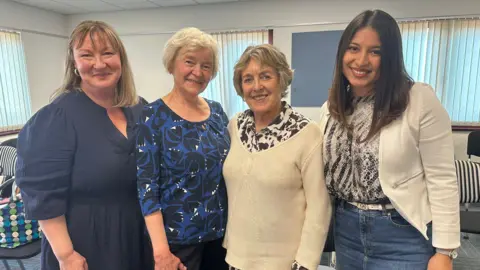
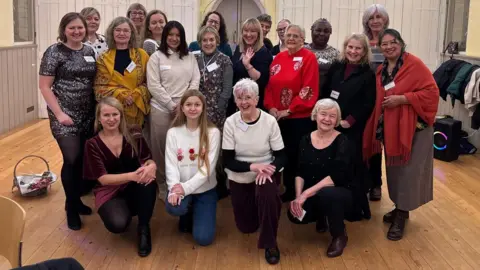
The community room in Bury St Edmunds library is still full after a presentation about the history and work of a women's group in the town.
Women from Honduras, Ukraine, Russia, Italy, Singapore and beyond sit around tables sharing food, stories and laughter.
Some arrived in the town decades ago. Others only a few months ago. Many did so without knowing anyone.
What connects them is the local Multicultural Women's Group — an important community that has helped newcomers trying to find their place in an unfamiliar town.
 Cad Taylor/BBC
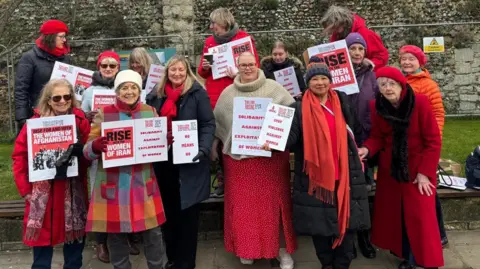
Faith Stadler, a founder of the group, explained that it all began at the town's Volunteer Centre in 2005 as part of an initiative to support women of all nationalities who were isolated and needed support.
"We linked into a range of needs like language, friendships and connections," she said.
"The group then developed and, in 2008, we realised that funding was becoming difficult, so some of us agreed to establish a separate group and named it 'The Multicultural Women's Group Bury St Edmunds'."
 Cad Taylor / BBC
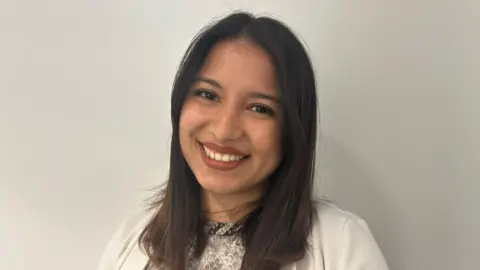
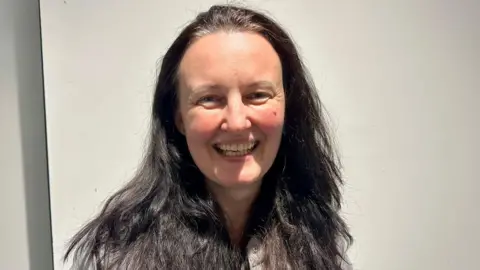
For Jenyfer Lainez, the journey to belonging began with fear.
"I came here in 2024 and I thought, 'It's impossible to speak English,'" she said. "It was very overwhelming. I barely understood anything."
Originally from Honduras, Lainez describes her home country with pride.
"Honduras is a very multicultural country. You can find beaches, mountains, beautiful food and wonderful people. When you try our food, you will fall in love for sure."
Food, unsurprisingly, became a theme throughout the gathering and the group regularly holds Taste of Culture events to sample different cuisines.
Lainez lights up while describing a beloved Honduran breakfast dish made with flour tortillas, beans, cheese and cream.
"Food brings us together," she said.
 Cad Taylor/BBC
Arriving in Suffolk was a culture shock for Lainez and her first instinct was to learn the language and to work out how daily life functioned.
"I searched everything online," she said. "I walked around town, learning the streets, so when people talked about places, I knew what they meant. I wanted to connect with people and understand British culture as soon as possible."
That search led her to local clubs, the library, and finally the women's group.
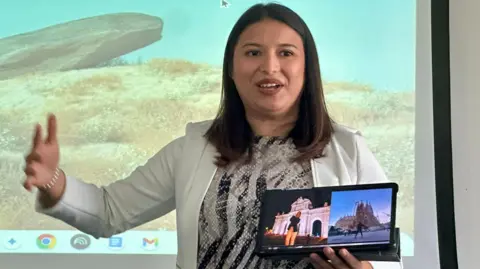
Lainez, who spoke fluently to the group for 20 minutes at the event, said she has gained something deeper than language skills.
"I had the opportunity to share all these cultures without leaving the country. I meet people from all parts of the world and they meet me too. That connection is very beautiful."
 Cad Taylor / BBC
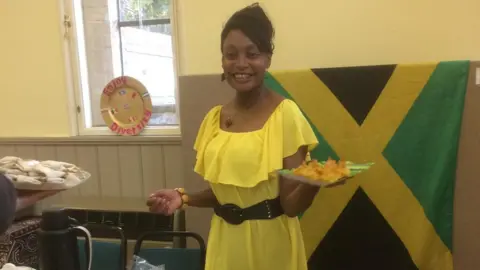
Vira Popova is Ukrainian and also a member of the group.
"We moved because of a very sad reason," she said. "But despite everything, we could find a peaceful and lovely place to live."
Coming from a large Ukrainian city to a much smaller Suffolk market town was a huge adjustment, yet Popova said the warmth she found here surprised her.
"This city is much smaller but much friendlier," she said.
Despite what she describes as her "very limited English", Popova was encouraged by the group to speak publicly about Ukraine, its culture and traditions.
"I gave a presentation about my country and our unique Ukrainian embroidery. People were very friendly, very interested and very involved."
 Cad Taylor/BBC
For Popova, the group also provides a source of emotional support during a difficult period in her life.
"Women in this group are absolutely amazing," she said. "Every single woman is so brave and so fantastic.
"I feel not alone with them. Sometimes we need to talk to somebody.
"Sometimes we just need to be in silence with somebody. This is a very special place."
 Cad Taylor/BBC
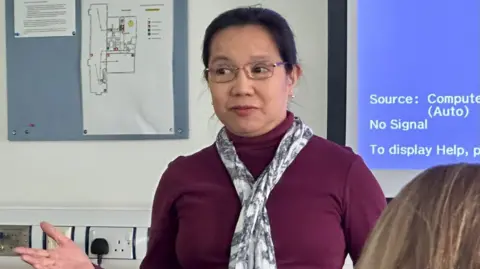
Marilyn Lee returned to England with her husband after spending 22 years living in Spain — only to realise they knew nobody in Bury St Edmunds.
"We decided we needed to join groups and do volunteering," she said. "The first group I found was the Multicultural Women's Group. They welcomed me in and they became my first friends in Bury."
Before her first meeting had even ended, members had invited Lee — a trained garden designer — to help create a community garden.
"It was a bit daunting because I didn't know where to go or what to do," she said. "But we made a really lovely garden."
 Cad Taylor/BBC
Other attendees at the event included Amy Berry, who originally came from Singapore, and Marina Kralina, who came from Russia in 2001.
Berry told the group about the kinship she had found with other women from different countries, while Kralina said the group supported one another without judgement.
"We started in 2008 with about eight women," she said. "So many people have come and gone through the years, but they all found support here."
She remembered one Romanian woman who was terrified to speak English publicly.
"She was scared of making mistakes. But in the group you are not scared. You can make mistakes and you will still be supported."
Victoria Ladbrook, who is English but of Italian descent, said: "You might walk into the room knowing nobody. But then suddenly you find common ground."
She said a chance conversation at a meeting changed everything.
"I ended up sitting next to a woman who spoke fluent Spanish and was learning Italian. We just hit it off."
Inside the group, the women feel that their global stories are not treated as unusual, rather they are part of modern Bury St Edmunds life.
"There's always food, conversation and stories to share," Lee said. "This group shows what community can look like.
"Women listening to one another, learning from one another, and quietly helping each other feel at home."
Do you have a story suggestion for Suffolk? Contact us below.
Follow Suffolk news on BBC Sounds, Facebook, Instagram and X.
