Warning 1976-style heatwave could become normal

 Getty Images
The heatwave of 1976 and hot weather this week "will become part of normal life" in coming decades if fossil fuel emissions are not cut and buildings are not adapted, experts have said.
Temperatures are expected to reach 39C in parts of the South and South East on Wednesday and Thursday, breaking the highest temperature previously recorded in June by more than 3C.
Reading, Oxford and Newcastle Universities have looked at the impact soaring temperatures could have.
The Met Office said it is plausible that temperatures for 23 June 2056 could see peaks of 45C in England, 41C in Wales, 38C in Scotland and 30C in Belfast.
UK Health Security Agency guidance says schools this week may need to close their windows later in the day if it becomes hotter outside than in, and that fans should not be used once temperatures pass 35C.
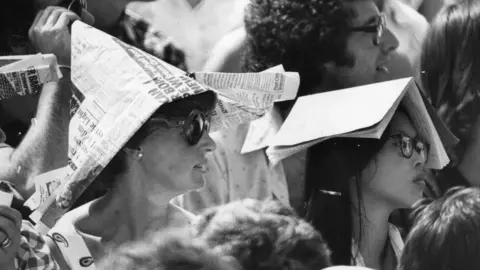
The 1976 heatwave, which saw 15 consecutive days of temperatures exceeding 32C, peaked on 3 July with a temperature of 35.9C in Cheltenham, Gloucestershire.
 Getty Images/Mirrorpix
Prof Ed Hawkins, professor of climate science at University of Reading, said the heatwave 50 years ago was "an extraordinary weather event, but it took place in a much cooler world."
He added: "Fifty years later, the world is much hotter, primarily due to burning fossil fuels, and 1976-style events will become more common over the coming decades.
"The future 2056 forecast from the Met Office shows that people born in 1976 could plausibly suffer 45C heat in their retirement years and children born today in 2026 will have to navigate such heatwaves in their 30s when they may be starting their own families."
An event, with a forecast for 2056, was held at The Lightroom in Kings Cross in London run in partnership with the University of Reading, Newcastle University, the Met Office, the Royal Meteorological Society, the Centre for Ecology and Hydrology and the Climate+ Co-Centre.
Prof Hayley Fowler, of Newcastle University, said the heatwave 50 years ago caused major disruption, which included failed harvests and extensive wildfires.
"On the 50th anniversary of this iconic event, we are showing the public that these impacts will become part of normal life in the coming decades if we don't rapidly reduce fossil fuel emissions and adapt our schools, homes, hospitals and workplaces to cope with the extreme heatwaves we face," she added.
Meanwhile Berkshire-based Prof Liz Bentley, chief executive of the Royal Meteorological Society, said: "I have no idea how my mother coped with three children and no running water in houses across Yorkshire in 1976.
"Mothers, pregnant women, children and the vulnerable will suffer immeasurably in the coming heatwaves if action isn't taken to protect them."
Prof Paul Behrens, from the University of Oxford, said: "British families will struggle to put food on the table as heatwaves escalate over the coming decades and cause multiple harvest failures in the UK and around the world.
"In the past, when harvests failed in the UK, as they did in 1976, we could rely on imports from elsewhere. In the future, extreme weather is likely to hit multiple food-producing regions at the same time, disrupting supplies and driving up costs."
