Starmer says UK will not join Trump's blockade of Iran's ports

 AFP via Getty Images
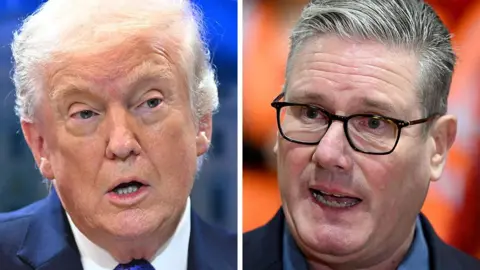
The UK will not be involved in enforcing the US military blockade of Iran, Sir Keir Starmer has said.
UK minesweepers and anti-drone capabilities will continue operating in the region but British naval ships and soldiers will not be used to block Iranian ports.
Speaking to BBC 5 Live, the prime minister said he was focused on getting the vital shipping channel of the Strait of Hormuz reopened in order to reduce energy prices "as quickly as possible".
The US announced its blockade after talks with Iran failed to secure a lasting peace deal to end hostilities in the Middle East.
Following a meeting between US and Iran negotiators in Pakistan's capital Islamabad, President Donald Trump said the US would start "BLOCKADING any and all Ships trying to enter, or leave, the Strait of Hormuz".
The US Central Command (Centcom) later confirmed its forces would enforce the blockade "impartially" on vessels leaving and entering Iranian ports, including those located in the Arabian Gulf and Gulf of Oman.
Centcom added that US forces would not impede the freedom of vessels transiting to and from non-Iranian ports, and that additional information would be provided to commercial mariners via a formal notice before the blockade starts.
Sir Keir, who has recently returned from a visit to the Gulf region, said he had been working with allies to "keep the Strait open, not shut".
"We're not supporting the blockade and all of the marshalling diplomatically, politically and capability... that's all focused, from our point of view, on getting the Strait fully open."
He said the UK did have mine-sweeping capability but "wouldn't go into operational matters".
Sir Keir has repeatedly ruled out direct UK military involvement in the conflict.
In his interview with the BBC, he said: "My decision has been very clearly that whatever the pressure - and there's been some considerable pressure - we're not getting dragged into the war.
"That's not in our national interest, because I'm not going to act unless there's a clear, lawful basis and a clear thought-through plan."
This week the UK and France will co-host a summit which Sir Keir said would "advance work on a coordinated, independent, multinational plan to safeguard international shipping when the conflict ends".
Trump has told Fox News that other countries would be involved in blockading the strait, but did not say which ones.
He added that Nato offered to help "clean out" the strait, adding that it would be free to use again "in not too long a distance".
Trump said the US would bring in minesweepers, and that the UK - a member of Nato - would too.
"I understand the UK and a couple of other countries are sending minesweepers," Trump said.
Around one-fifth of global oil and liquefied natural gas shipments pass through the Strait of Hormuz, with Iran effectively cutting off the waterway since US-Israeli strikes began on 28 February.
Global benchmark Brent crude oil rose above $US100 a barrel following the blockade announcement. Before the conflict oil had been trading at about $71.
The government is due to increase fuel duty in September, however opposition parties have urged the prime minister to scrap the rise.
Sir Keir said it was being "kept under review" adding "a lot will depend on what happens in the next few weeks".
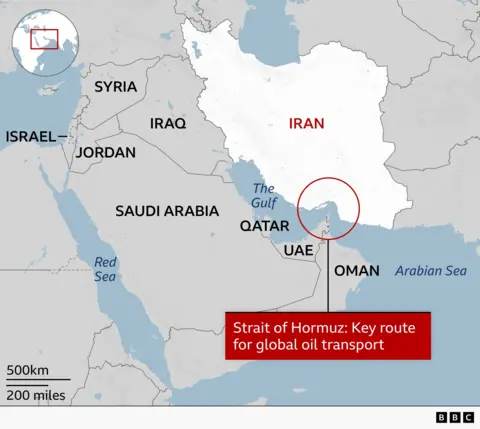
In an earlier call with French President Emmanuel Macron, Sir Keir underlined "the need to work with a wide coalition of partners to protect freedom of navigation" in the Strait of Hormuz".
"We are urgently working with France and other partners to put together a wide coalition to protect freedom of navigation," a UK government spokesperson said.
The spokesperson added that ships crossing through the Strait of Hormuz "must not be subject to tolling", after reports emerged that Iran has started demanding $2m (£1.5m) in transit fees for tankers passing through the Strait.
While the UK was not involved in the US-Iran talks in Pakistan, Sir Keir warned against "further escalation" in the Middle East after two sides failed to reach an agreement.
Chancellor Rachel Reeves plans to travel to Washington this week for the International Monetary Fund (IMF) meeting to advocate for re-opening the Hormuz shipping channel.

Sign up for our Politics Essential newsletter to keep up with the inner workings of Westminster and beyond.
