Ambulance delays contributed to man's death

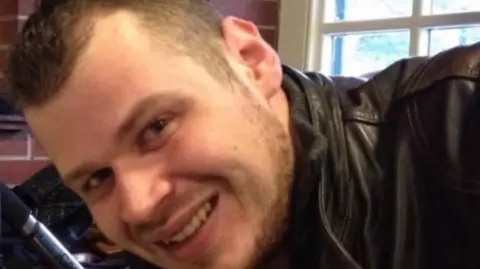 Family handout
Ambulance delays contributed to the death of a man who called 999 three times, an inquest has found.
Andrew Watson, 32, was struggling to breathe in October 2019, when he called for help and was told an ambulance would get there within 18 minutes. He was dead when it arrived 67 minutes later.
Following a five-day hearing at Crook Coroner's Court the coroner ruled he died from a "critical medical condition requiring emergency treatment for survival", which was not delivered in time due to delays in the ambulance response.
The North East Ambulance Service (NEAS) said it was truly sorry for his death and it had taken significant steps to reduce delays.
The 32-year-old, who lived at a supported living complex in Langley Moor, County Durham, had been suffering from a complication of tonsillitis called Quinsy.
An inquest in 2020 initially ruled he died of natural causes.
However, internal NEAS investigations into the handling of his emergency calls, were not disclosed to his family and only emerged after a whistle-blower came forward.
His family learned of the reviews in 2023 after being contacted by journalists, leading to the original inquest being quashed.
The inquest examined NEAS's handling of three 999 calls in which Watson repeatedly said he was struggling to breathe, and heard expert evidence which suggested he may have survived had he reached hospital 10 to 20 minutes earlier for emergency airway surgery.
It also scrutinised NEAS's actions after his death, with internal reviews raising concerns about the prioritisation of his calls and delays in handling his final 999 call.
Paramedic Catherine Wilson, told the inquest his death was preventable and said she felt "nobody was listening to us" when she argued the incident should have been graded as the highest level of harm.
'Baffling'
NEAS manager Donna Hay said she felt "under pressure" during the review process and believed those leading it had "a conclusion in mind".
Because he had been choking due to a medical condition, and not due to a foreign object, his call was categorised as a category two emergency rather than category one had he been choking on an object.
Coroner Crispin Oliver, who returned a narrative verdict, described this difference as "baffling".
A Regulation 28 report to prevent future deaths will be issued to NHS England about the different ways choking is categorised by ambulance services.
After the inquest, Andrew's mother, Liz Watson, said the family had endured "almost seven years" of grief and uncertainty.
She said: "Nothing can bring Andrew back, he brought warmth, laughter and energy wherever he went.
"We are grateful that the inquest has finally been able to establish the facts surrounding his death.
"It has been acknowledged that the delay in getting an ambulance to Andrew contributed to his death.
"We also acknowledge the apology that has now been offered to our family, which came after many years of unanswered questions, and after we had to fight for this inquest to be reopened."
Karen O'Brien, deputy chief executive of NEAS, said: "We are truly sorry for Andrew's death and the distress caused to his family.
"We did not respond as quickly as we should have when he called us, and we have always acknowledged that this delay likely contributed to his death.
"We have taken significant steps since 2019 to reduce delays to ambulance responses, including substantial investment in more paramedics and more ambulances."
