Ambulance boss 'pressured to downgrade report'

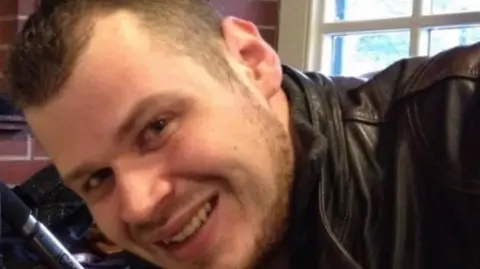 Family picture
An ambulance boss said there was "pressure" to downgrade the seriousness of the death of a 32-year-old, who died waiting for paramedics.
Andrew Watson, from Middlesbrough, had been suffering from a rare complication of tonsillitis called Quinsy in a supported living facility in Langley Moor, County Durham, in October 2019.
An ambulance arrived to the home 62 minutes after being called, but he died at the scene.
At an inquest at Crook Coroner's Court, coroner Crispin Oliver said an initial inquest was discontinued and it looked like a "natural, tragic death", but more details had since emerged. The North East Ambulance Service (NEAS) said the organisation was "very different now".
An internal report previously said Andrew Watson would have benefitted from "early treatment" if paramedics on the category two call had arrived sooner, and his chances of survival would have increased.
The court heard there had been a disagreement within staff at NEAS over the findings of an initial review following his death.
Donna Hay, deputy head of emergency preparedness, resilience and response at NEAS, said a root cause analysis (RCA) meeting had been chaired "autocratically" and appeared to have a pre-determined conclusion on how the death would be categorised.
"There was a feeling to reduce it to a lower harm", she told the court, which also heard how moderate cases and above are reported to NHS England.
'Sincerely very sorry'
Hay said there had been pressure from the trust's former head of patient safety, Shelley Dyson, who also chaired the RCA, to avoid classifying the harm as moderate.
Hay said "she [Dyson] wanted me to drop the harm level to low" but as the investigating officer, it "didn't match the conclusion or summary of my findings".
The death was later classified as "severe" by a more senior board who were part of a clinical review group.
When asked by Oliver as to why she had initially classed the death as moderate, and not more severe, Hay said she felt "reassured there would be another process" to look at the case.
She added that her condolences were with the family, and she was "sincerely very sorry".
'Lessons learnt'
The inquest also heard how a nurse practitioner had seen Andrew before he died of Quinsy, but he was not showing any symptoms of disease at the time.
Jacqueline Griffiths, from The Medical Group, said he had been complaining of a sore throat, and had "enlarged tonsils".
However, she said there were no signs of the disease, which can lead to a build up of pus between the tonsil and the throat.
He had "no shortness of breath", could swallow medication and could "tolerate a diet", she said.
When asked by Oliver if he had been checked for symptoms of Quinsy, she said yes but concluded, at the time, it was "bad tonsilitis".
A statement provided to the inquest from Julia Young, executive director of quality and safety at NEAS, said it started making changes to the management of its patient safety team in 2021 with a "view of improving matters".
"I had some awareness of NEAS as an outlier when I was at the Integrated Care Board, it was well known the organisation had problems with delays of handovers, and responding to calls."
She said NEAS had adopted "greater openness" and taken "significant steps to improve ambulance response time and performance".
Young added: "We were not there for Mr Watson in his hour of need.
"The organisation is very different now - this service is much more responsive, and lessons have been learnt."
The inquest continues.
