Track defect found near derailment site - report

 BBC / Oliver Whitfield-Miocic
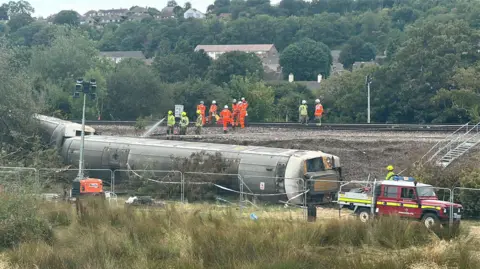
A defect was found on railway tracks in East Sussex at the site where a train derailed leaving 30 injured, a report says.
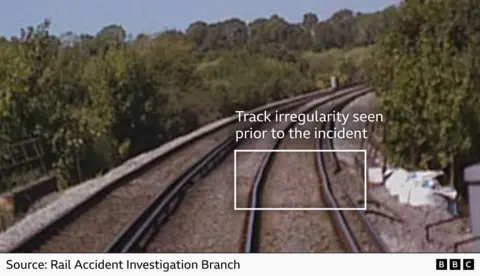
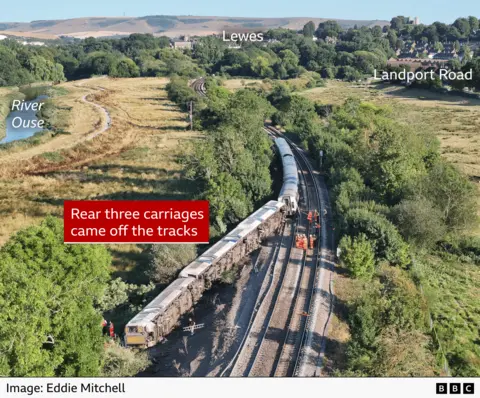
Initial findings from the Rail Accident Investigation Branch (RAIB) found an "irregularity" with the tracks near Lewes where three carriages tumbled down an embankment last Thursday.
The RAIB, which is continuing to investigate the derailment, said it had received "several reports of rough riding at the location of the derailment from passengers on other trains".
Network Rail and Greater Thameslink Railway, whose Southern Rail train was involved in the crash, said in a joint statement they were "sorry this happened on our railway".
Investigators from the RAIB have said CCTV from a train which passed through the crash site at 14:04 BST showed the "irregularity" with the track geometry just before the point where the train came off the tracks.
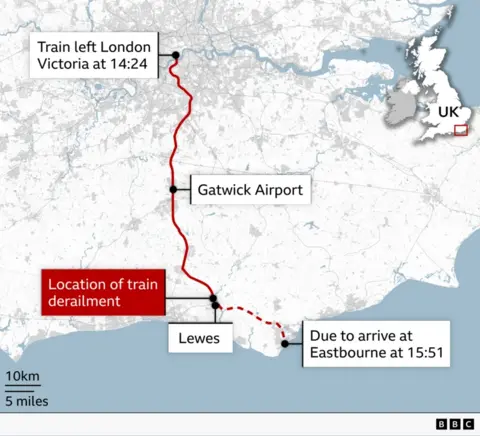
The 14:24 service from London Victoria to Eastbourne derailed in the Landport area of Lewes at about 15:54 BST.
The derailment left two people seriously injured, and 18 were taken to hospital with less serious injuries. The 18 have since left hospital.
The eight-carriage train was travelling at about 65 mph when it derailed - within the 70mph speed limit - and the driver had begun to brake as the train approached the site.
The RAIB update also highlighted that the accident took place during a sustained period of hot and dry weather.
Temperatures as high as 33°C (91.4°F) were registered shortly before the crash.
The RAIB says the clay embankment and the material underneath it are sensitive to changes in moisture content, and may move as moisture levels change.
The continuing investigation will now consider elements including how that section of track was inspected and maintained, the condition and maintenance of the embankment, the weather conditions and how effective any hot weather mitigation measures were.
In a joint statement, Lucy McAuliffe, Network Rail's route director for Sussex, and John Whitehurst, chief executive of Greater Thameslink Railway, apologised for the derailment.
They added: "We will carefully consider any recommendations arising from the investigation and work across the industry to implement them, with the shared goal of making an already safe railway even safer for our customers, colleagues and the communities we serve."
Last Friday, Network Rail's group safety and engineering director Martin Frobisher told the BBC speed restrictions were not in place along the section of track when the derailment happened.
He insisted the railway was safe, and that Network Rail took various measures to manage the impact of weather on tracks and other railway equipment.
The Department for Transport released a statement saying "safety remains the absolute priority across our rail network".
The statement added: "The UK's railways remain among the safest in the world, with the number of delays caused by track faults falling by 45% since the late 2000s."
Follow BBC Sussex on Facebook, X, and on Instagram and listen to BBC Radio Sussex on Sounds. Send your story ideas to southeasttoday@bbc.co.uk or WhatsApp us on 08081 002250.
