Orbán's era was over in a flash and Hungary's next PM is a man in a hurry

 SOPA Images/LightRocket via Getty Images
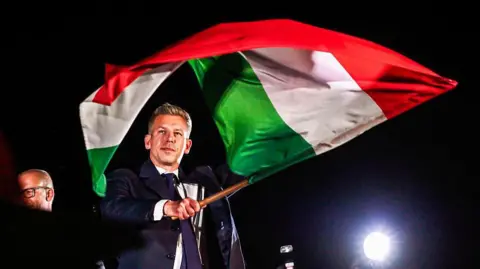
Péter Magyar and his victorious Tisza party have wasted no time preparing for the transfer of power in Hungary after their dramatic landslide defeat of Viktor Orbán last Sunday.
They won 53% of the vote to put an end to his party's 16 years of continuous rule, and ended up with 141 seats in the 199-seat National Assembly.
Orbán's Fidesz have slumped from 135 to 52 seats.
The count was finalised on Saturday - including recounts in closely tied constituencies, and votes cast abroad.
Magyar has won a pledge from President Tamás Sulyok to bring forward the formation of the new parliament to the week beginning 4 May. Parliament can then elect the new government.
He also gave combative interviews to public service TV and radio, which have largely ignored or attacked him for the past two years.
He has promised to pass laws to suspend their news programmes, until impartial editors can be appointed.
All this will take time.
Armed with a so-called super-majority of more than two-thirds of seats in parliament, he also plans retroactively to limit the number of terms a prime minister can serve to two.
Viktor Orbán has already served five. If that goes through, Magyar could slam the door on Orbán's return.
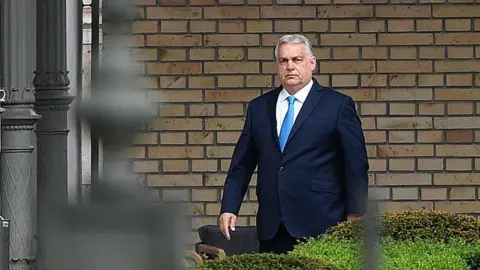
It was not until late on Thursday that Orbán finally broke his silence after Sunday's defeat, in an interview on the Patrióta YouTube channel.
"This is the end of an era," said Hungary's beaten leader. "We must bear this defeat with dignity."
 Ferenc Isza/AFP via Getty Images
He spoke of feeling "pain and emptiness" about the defeat, taking full personal responsibility for what happened. But he offered no analysis of the main mistakes of his campaign, other than the failure to finish the Russian-designed Paks 2 nuclear power station, which is running six years behind schedule.
A meeting of the top leadership of Fidesz is scheduled for 28 April, ahead of a party congress in June.
In the interview, Orbán said he would continue to lead Fidesz if he was re-elected, but added the party needed "a complete renewal".
Of the rump of 52 seats Fidesz will occupy in the new Parliament, only 10 are from individual constituencies, and the rest are from the party lists.
Many of the new deputies on the party lists should be replaced, as they were not suited to working in opposition, he said. There have already been some calls for change, in a party where dissent is rarely expressed in public.
"I think [Orbán] does not have to resign at the moment," said András Cser-Palkovics, Fidesz mayor of the western city of Székesfehérvár. "He should wait for the national caucus and then start assessing [the result]. Then we should have a leadership election."
 NurPhoto via Getty Images
There is no obvious successor to Orbán in the party, and none with his skill or charm at integrating different opinions and ambitions.
US and British advisers criticised the main Fidesz campaign slogan "the safe choice", because it would alienate young voters.
But it was hard for a party in power for so long, to present itself to the voters as the party of change, one source told the BBC.
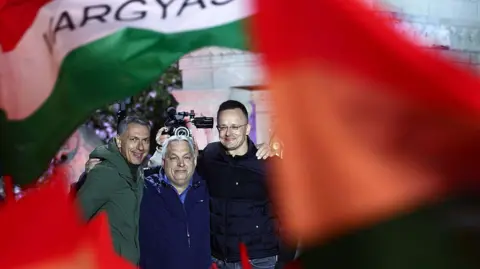
In response, two younger politicians, Foreign Minister Péter Szijjártó, 47, and Transport Minister János Lázár, 51, often appeared at Orbán's rallies. But rather than reinvigorating the party, their dynamism just made its leader seem old and tired.
Orbán will be 63 next month, but the wear and tear of 38 years in frontline politics are obvious to even his hardcore supporters.
There is a mood of fear and recrimination in the governing party.
Rumours of imminent arrests for corruption swirl around Budapest. On social media, Tisza supporters are impatient for those who grew rich illegally under the previous government to be held to account.
Péter Magyar is leading the chorus.
"My message to Fidesz leaders and their stooges: It's no use playing the innocent little ballet girl now, and acting as if nothing happened," he posted on Facebook. "We know what you've done to our beloved homeland and the Hungarian people. And don't doubt for a single moment that 'you will reap what you sow'."
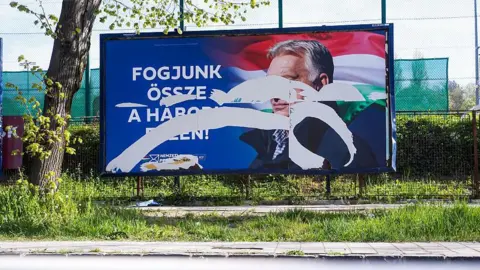
In downtown Budapest, just about every single Fidesz poster has been defaced. On many, the word, Vége - the end - has been spray-painted. Others have been ripped, and redecorated with expletives.
The party's sudden fall from grace in the eyes of the population, even of some erstwhile supporters, has been spectacular.
 SOPA Images/LightRocket via Getty Images
The tough tone of the incoming Tisza leaders appears to be both emotional and tactical.
They are taking revenge for the campaign of demonisation which the government-controlled Central European Press and Media Foundation (Kesma) has orchestrated against them and against Magyar personally. Kesma includes 476 titles, of which around 50 are primarily news outlets.
One of the first problems Tisza faces is to stop money being taken out of the country by businessmen close to the ruling party. Dubai is a favourite destination of Hungarian oligarchs.
Another is to prevent the destruction of evidence of corruption, for example in government ministries.
While papers are shredded in some offices, two Tisza insiders told the BBC, officials are offering Tisza pen drives with digital copies, in exchange for keeping their jobs, or immunity from prosecution.
In the week before the election, as opinion polls consistently predicted a big opposition majority, Tisza claims dozens of contracts were signed with favoured companies, committing the state to future IT, research, construction and other projects.
 NurPhoto via Getty Images
With their new, two-thirds majority, they will be able to pass laws to restore checks and balances eroded or destroyed by Fidesz in the past 16 years.
In his campaign, Magyar promised to establish an office to recover stolen state assets.
This week, he repeated his promise to join the Luxembourg-based European Public Prosecutor's Office (EPPO). That would help prove to the EU that he is eager to fight corruption, but it only has the power to investigate the misuse of EU funds.
He has also held talks with Zsolt Hernádi, CEO of MOL, the Hungarian energy giant, which operates two refineries in Hungary and Slovakia, on which both countries depend.
The urgent restoration of oil supplies through the Druzhba (Friendship) pipeline from Russia across Ukraine, is one of the few subjects on which Magyar and Viktor Orbán agree. It has been closed down since late January, but Ukrainian President Volodymyr Zelensky said this week the oil could start flowing by the end of the month.
Hungary's incoming prime minister says he wants to diversify Hungary's oil supplies, especially by making better use of an alternative pipeline from the Croatian island of Krk.
 Reuters
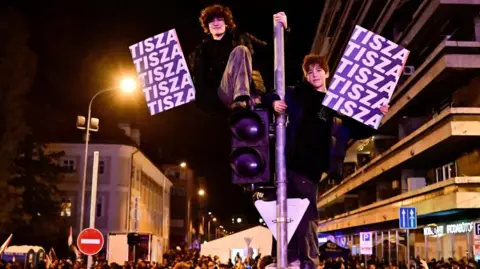
Almost three-quarters of 18-29 year-olds are estimated to have backed Tisza, and a former Hungarian ambassador to the US under Orbán, Réka Szemerkényi, told the BBC she was impressed by the messages that Hungary's younger generation had conveyed to their new leaders.
"'Ria, Ria Hungaria', meaning we love our country," was one, said Szemerkényi, now at the Equilibrium Institute in Budapest. "Then the chants of 'Europa', and the third I heard repeatedly was 'Russians go home'. These three together are like a foreign policy agenda."
On Friday, a high level delegation from European Commission President Ursula von der Leyen's office arrived in Budapest for informal talks with Tisza officials, led by Péter Magyar.
To access €17bn (£15bn) in EU funds, withheld from the Orbán government, his new government will need to meet 27 criteria - on independence of the judiciary, tackling corruption, and liberating the media from government control.
Hungary's economy is in a deep slump, and Magyar and his team know they will have to hit the ground running.
