Hungary's next PM would pick up if Putin calls and tell him to stop Ukraine war

 Léa Guedj/BBC
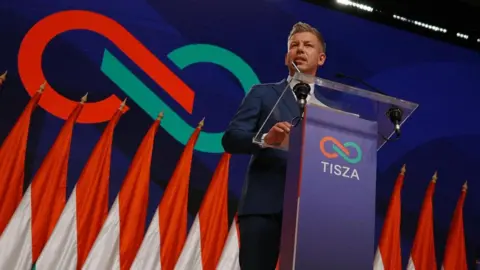
Péter Magyar has said he has already spoken to 10 European leaders, a day after his landslide victory brought an end to Viktor Orbán's 16-year continuous rule in Hungary.
But he said he would not be calling Vladimir Putin, a close partner of Orbán, even though he would speak to him if the Russian leader rang.
"If Vladimir Putin calls I'll pick up the phone," he told reporters during a three-hour marathon press conference to mark his Tisza party's election success on Sunday.
"I don't think it'll happen," he stressed, "but if we did talk I'd tell him to please, after four years, put an end to the killing and end this war."
Moscow has said it respects Magyar's victory and expects to retain "pragmatic" relations with Budapest.
Orbán has also been a key ally of US President Donald Trump, who backed him to win Sunday's election, and Vice-President JD Vance reinforced that with a two-day campaign visit last week.
Magyar told journalists that he would not be phoning Trump either, but if Trump phoned him, he would say he was glad as they were "strong allies in Nato", and he would invite him to attend the 70th anniversary of the Hungarian uprising against Soviet occupation next October.
A former insider from Orbán's own Fidesz party, Magyar launched a grassroots movement to put an end to corruption and cronyism in the government.
Latest preliminary results give Tisza 136 seats, down from an earlier figure of 138 but still a comfortable "super majority" of two-thirds of the seats in parliament, enabling the party to change the constitution.
Magyar said some 400,000 votes had yet to be counted and he was optimistic his party would gain some of the remaining seats.
He said Hungarian voters had not voted just for a change of government but for "complete regime change".
Magyar was clearly a man in demand among European leaders on Monday, after voters had swung behind his party in dramatic fashion on Sunday.
"Hungary has chosen Europe," was the assessment of Ursula von der Leyen the European Commission president. Von der Leyen was one of the leaders he had already spoken to, he told assembled Hungarian and international journalists.
Hungary belonged in the EU no matter what the outgoing government was planning, Magyar stressed, adding that it was his country's interests to join the eurozone. He has already mapped out his first diplomatic visits, to Poland, Austria and Germany, countries that he emphasised Hungary's close affinity to.
The 45-year-old Tisza leader struck a very different tone from Hungary's defeated prime minister, who had long pinned the blame on the EU and Ukraine's Volodymyr Zelensky for the continuing war in Ukraine.
Orbán's campaign claimed they were prolonging Russia's full-scale war in Ukraine, and he blocked a €90bn (£78bn) EU loan of aid to Kyiv last month, prompting European accusations of disloyalty.
Magyar told reporters that every Hungarian knew that Ukraine was the victim of the war with Russia.
The war made no sense from a Russian perspective too, he said, "as tens of thousands of Russians have lost their lives, and tens or even hundreds of thousands of Russian families have been destroyed", including Russian-speaking people living in Ukraine.
"It would probably be a short phone call [with Putin], and I don't think he'd end the war on my advice."
Although Orbán did have allies in the EU, he was the only leader who sought to veto a loan that he had previously agreed to, after Hungary, Slovakia and the Czech Republic secured an opt-out at a December summit.
His government's ties to Russia came under increasing scrutiny after Foreign Minister Péter Szijjártó admitted sharing information with Russian officials before and after EU meetings on sanctions.
At one point Szijjártó is alleged to have told his Russian counterpart Sergei Lavrov "I am at your service", a leak that prompted Orbán to order a wiretapping investigation.
Hungary's prime minister-elect was handed a note during Monday's press conference and went on to allege that the outgoing foreign minister had been shredding confidential documents relating to sanctions with Russia in the ministry building that day.
There was no comment from the ministry.
