The church at the centre of a royal mystery

 Getty Images
A church in West Sussex, which is depicted in the Bayeux Tapestry, is at the heart of one of the county's most intriguing mysteries.
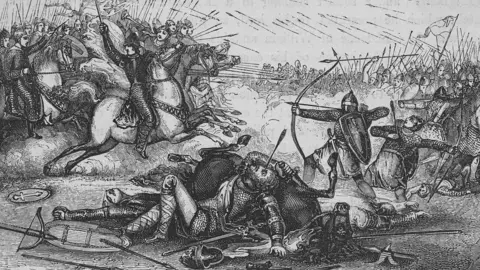
Holy Trinity Church, in Bosham, is believed by some to be the burial place of King Harold, who died at the Battle of Hastings.
Reverend Canon Martin Lane told Secret Sussex some people make "special pilgrimages" to see if they can find him.
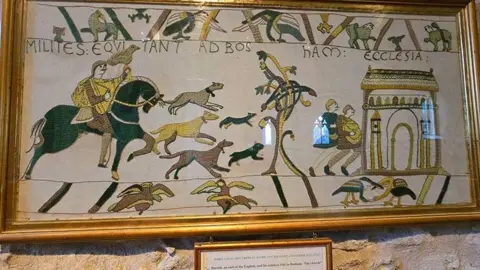
The Bayeux Tapestry shows King Harold praying at the site before setting off to Normandy in 1064.
 Fiona McCarthy
Lane said there had been various theories put forward about the monarch's burial place since his remains were never found.
He added there had been previous excavations at the church.
The first, carried out in the mid-19th Century, discovered the remains of a child.
It is believed to be the daughter of King Cnut, who ruled England from 1016 to 1035.
The second took place in the 1950s and another grave was found. However, there was no conclusive proof the remains belonged to King Harold.
In 2026, the Parochial Church Council applied for permission to reopen the grave and conduct DNA analysis.
However, experts pointed out identification may be difficult because the remains may be too degraded.
While the vicar said he would like to know the answer to the mystery, but added it would be "sad" if the King was not buried at the church.
Some historians believed Harold was buried in Waltham Abbey in Essex, a site which he had patronised.
The debate remains open but for now Lane says he is still being asked by many visitors if the last crowned Anglo-Saxon king was indeed buried at the Bosham church.
Follow BBC Sussex on Facebook, on X, and on Instagram. Send your story ideas to southeasttoday@bbc.co.uk or WhatsApp us on 08081 002250.
