Stormont emails reveal paramilitaries 'toxic' role in flags decisions

 BBC
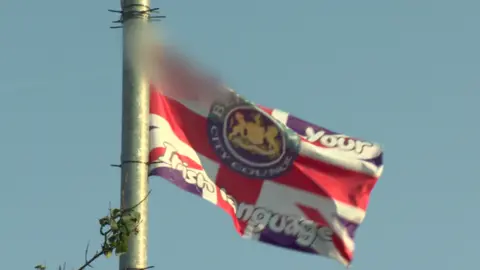
BBCA contentious flag in Belfast stayed up for several months after Stormont contractors said support was needed from "community representatives with the authority to order the removal".
The remarks over a flag opposing the Irish language were made in Department for Infrastructure (DfI) emails seen by BBC News NI.
An Alliance Party assembly member said it showed the "toxic" impact of paramilitaries in some decisions over flags.
DfI said alternative private contractors were later secured, but the flag was taken down in recent days before a planned "removal operation" could be carried out.
The controversial display involved a union flag and a city council logo alongside a message with a swear word opposing the Irish language.
It was erected in recent months on a lamp post on Lisburn Road near its junction with Malone Place and Sandy Row.
Concerns were raised ahead of Belfast's hosting in August of Fleadh Cheoil na hÉireann - the all-Ireland Fleadh - a major festival of Irish music and culture.
Stormont's Irish language commissioner Pól Deeds wrote to DfI urging the department and police to intervene, saying there was "no place in our society for displays that express aggression towards the Irish language".
Some politicians had also called for the flag to be removed, while the council said they "do not condone the use of our logo in this way".
'Clear community support'
DfI officials discussed the flag with the Police Service of Northern Ireland (PSNI) in June as they considered their response.
Police advised Stormont officials that removing the flag presented a "low risk" of public disorder.
They offered to "assist and reassure" any contractors taking it down, according to internal emails released by DfI following a Freedom of Information (FoI) request.
However, a departmental official said their private contractor "would not be willing to assist unless there is clear community support".
They added their contractor needed the operation to be "carried out under the supervision of both the PSNI and local community representatives with the authority to order the removal of the flags".

Alliance Party assembly member Paula Bradshaw said the language pointed to the "toxic, controlling element" of paramilitary organisations in some areas.
"There's only one section of society that would be creating those tensions, and let's call it what it is - the paramilitary organisations that control some of these areas," she told BBC News NI.
Bradshaw, a representative for the South Belfast constituency, has tabled a bill in the Northern Ireland Assembly aimed at addressing concerns over unauthorised flags on public property.
She said this case was a "prime example as to why we need a new regulatory framework to ensure those flags come down".

Green Party councillor Áine Groogan said she was "perturbed" by the correspondence.
"We are well past the point where we should be beholden to anyone putting up offensive flags under the cover of darkness, or unnamed actors who get to decide what is and isn't a threat," she said.
"It's a perverse situation to be in and statutory agencies need to look at their own procedures that legitimise this."
'Undue attention'

In one email, police said a staff member at a community organisation on Sandy Row had raised the flag issue with a Democratic Unionist Party (DUP) councillor.
"They do not know who has put the flag up, and believe that raising the issue with the community will only bring it to their attention, unduly," the email added.
Background briefing notes for Infrastructure Minister Liz Kimmins contained similar comments.
The DfI papers read: "PSNI considered the risk of removal to be low however they also spoke to local reps who did not know who put the flag up and believed that raising the issue with the community would only bring it to their attention, unduly."
A DUP spokesperson said: ""We support the peaceful and lawful erection of flags to mark celebrations during the summer months and do not believe the union flag should be defaced or disrespected in such a way.
"Any decision to remove the flag remains a matter for the relevant statutory agencies."
The party added that rules on the erection of Irish language street signs have had "a negative impact on community relations within many parts of Belfast".
"If the union flag was given its proper place, including on public buildings, then communities may be more willing to engage in such discussions," the DUP argued.
A PSNI spokesman said that "police did not remove this flag" and referred further questions to the Department for Infrastructure.
In a statement a DfI spokesperson said: "The minister instructed officials to engage with other contractors and to secure the removal.
"However, the flags were removed ahead of the agreed removal operation."

Flags disputes
The display of flags and emblems has long been a contentious issue in some parts of Northern Ireland.
An £800,000 Stormont report aimed at addressing divisions over different cultural disputes was published in 2021, but it did not reach agreement on many issues over flags.
The report by the Commission on Flags, Identity, Culture and Tradition (FICT) said there was no consensus on whether changes should be made to legislation on placing flags on lamp-posts and other street furniture.
But it said there was "widespread agreement" on elements of a possible "code of practice", such as keeping flags away from community interfaces.
Stormont's Executive Office has previously said the FICT report's recommendations would be considered as part of a review of its community relations strategy.
