The Mayflower Pilgrims and their escape from the Humber

 BBC/Josh Gorroño Chapman
The Mayflower Pilgrims are famed for founding Plymouth Colony, Massachusetts, after landing in 1620. They later celebrated the first "Thanksgiving", which has become an enduring American tradition.
But one of the earliest chapters in their story begins on the banks of the Humber estuary in northern Lincolnshire.
Framed by trees in Pilgrim Park, Immingham, a 20ft monolith towers above visitors.
Carved into the stone are the words that link this peaceful spot to a much bigger story.
The words read: "From this creek the Pilgrim Fathers first left England in 1608 in search of religious liberty."
John Trevitt, the co‑curator of Immingham Museum, picks up the story for the latest episode of the Secret Lincolnshire podcast.
"The Pilgrims were in some ways early day fundamentalists," he explains. "They had a very strict interpretation of the Bible and didn't want any of the artifice and accouterments that went along with the church in their day.
"They wanted to go back to the absolute basic belief that God lives within you, rather than within an institution or a building."
The museum tells the story of the Pilgrims – many hailing from across northern Nottinghamshire and Lincolnshire – and why they gathered at this place.
In the early 17th Century, the idea of separating from the established church was controversial, as worship was mandated under the Act of Uniformity 1558, and all people had to attend weekly Anglican services or risk being fined.
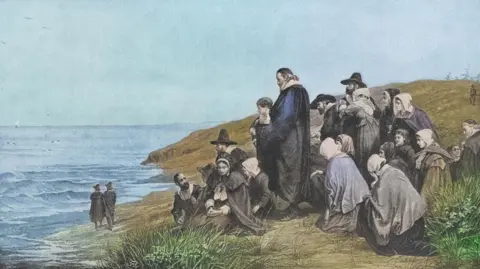
In 1608, a "persecuted" group decided to move to Leiden, in the Netherlands, in search of greater freedom and they needed somewhere isolated where they could board a boat, John says.
Today, Immingham is a thriving port with a busy dock, but at that time it would have been fairly remote.
Sadly for them, the authorities became aware of their plans and they were discovered, John says.
Only some of the men managed to get aboard before the ship was forced to sail, leaving the women, children and possessions behind.
Caught in a violent storm, the passengers faced a gruelling journey, with the ship blown up the Norwegian coast before getting back on course to Holland.
 Getty Images
They settled in Leiden and eventually some members of the group would make another perilous journey, this time across the Atlantic to America aboard the famous ship Mayflower.
John says: "On that voyage to America in the Mayflower, there were several people who were on the original flight to Leiden from Immingham."
Their journey would play an important part in the early history of what would become the United States.
Along with replica Pilgrim costumes and a model Mayflower, Immingham Museum shows an hour-long film telling the story.
John says the locally produced documentary is also shown at the Plymouth Rock Centre in the US.
The producers even received a letter from Bill Clinton, the 42nd US president, telling them how much he enjoyed it, John adds.
Today, the Pilgrims' escape from Immingham might sound like ancient history, but its legacy can still be seen across the town.
Streets are named after passengers on the ships, such as Brewster Avenue, named after William Brewster, while the Mayflower Pub is named after the historic voyage.
And of course, there is Pilgrim Park with its memorial.
Built in 1924 by the Anglo‑American Society of Hull, the monument contains granite from the site where the Pilgrim Fathers first landed in America.
Today, it sits far from the water's edge, relocated inland as Immingham grew and industry reshaped the coastline in 1970.
 BBC/Josh Gorroño Chapman
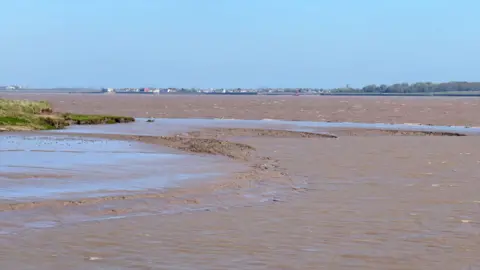
But a little way along the Humber bank is an untouched stretch of bank that resembles what Immingham must have looked like in 1608.
The water is brown and the wind unrelenting and cold, even on a bright, sunny day.
It is easy to imagine what it might have been like for the people who waited to embark back then.
They were about to set out on a journey that would reach far beyond the Humber and echo across the Atlantic centuries later.
Listen to highlights from Hull and East YorkshireorLincolnshireon BBC Sounds, watch thelatest episode of Look North.
Download the BBC News app from the App Storefor iPhone and iPad orGoogle Play for Android devices
