'It's like having an amusement park and not opening it' - algae closures take toll

 BBC
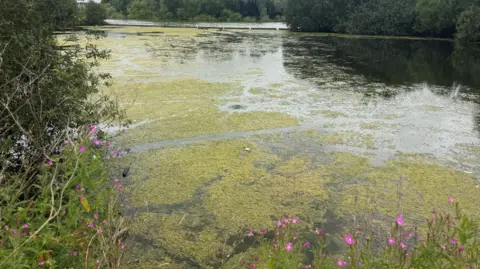
BBCAs locals and visitors make the trip to Northern Ireland's lakes in search of summer sunshine, they are once again facing an unwelcome sight: blue-green algae.
The toxic bacteria, which can cause skin irritation and sickness in people and animals who come into contact with it, has become an unwelcome feature of recent summers.
There are currently 248 algae blooms across Lough Neagh and Northern Ireland's water systems, according to the UK Centre for Ecology and Hydrology. Eighty have been confirmed in June and July alone.
The Department of Agriculture, Environment and Rural Affairs (Daera) said two of the areas affected were Camlough Lake near Newry and Craigavon Lakes.
For one business owner based at Camlough Lake, the return of blue-green algae has had an immediate impact.
Karl Toner, who owns a coffee cart on the shore as well as a nearby glamping site and paddleboard hire business, said visitor numbers had fallen sharply since the warning was issued on 13 July.
"In the summertime this place really goes off, now the algae has just completely killed it," he said.
Toner explained how warm weather would normally bring visitors from across Northern Ireland and beyond to the area, providing a trade boost.
"On a good day, there would be hundreds of people here from the morning right through until midnight, swimming and enjoying the lake, but now the place is empty," he said.

Toner said algae warnings in previous years meant visitor numbers suffered, but now the timing was particularly damaging for footfall during one of the best spells of summer weather.
"When the weather gets good, the lake is closed. It's like having an amusement park and not opening it," he said.
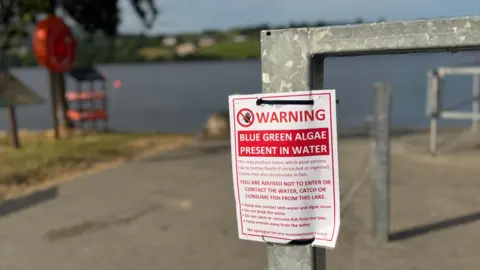
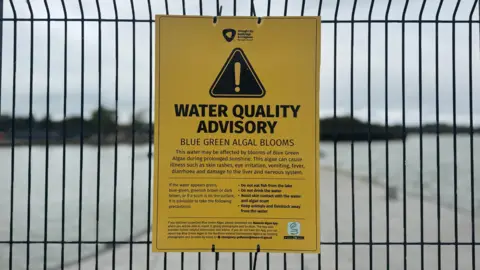
Newry, Mourne and Down District Council said it was notified by Daera on 13 July of the presence of blue-green algae at Camlough Lake, and erected warning signs immediately to alert the public to the potential health risks.
The council said it was carrying out regular visual monitoring of the lake and arranging toxin testing, adding that warning signs will remain in place until the required safety criteria under the protocol is met.
A Daera spokesperson said that while there were "no quick fixes", restoring and protecting the ecological health of water bodies was "possible by respecting the science and supporting the difficult decisions needed".
'The lake is about much more than swimming'
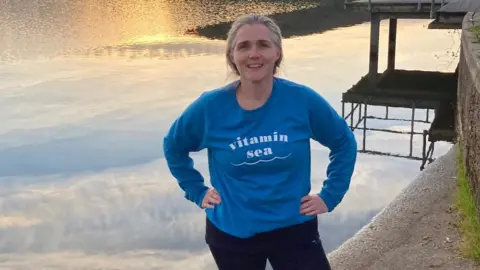
Joanne Callan, a holistic therapist from Bessbrook, began swimming at Camlough Lake occasionally in 2018 before becoming a regular open-water swimmer during the Covid-19 pandemic.
Since then, she said a community of swimmers and cold-water dippers had grown to more than 100 people and many friendships had been formed through a "shared love of the lake".
She said Camlough Lake was usually a hive of activity during the summer months, with young people gathering, families playing in the shallow water, paddleboarders taking to the lake and athletes using it as a training space during triathlon season.
She added that keeping the lake closed or restricting access during the height of summer would "impact many people, physically, emotionally and socially".
Blooms spotted at Craigavon Lakes
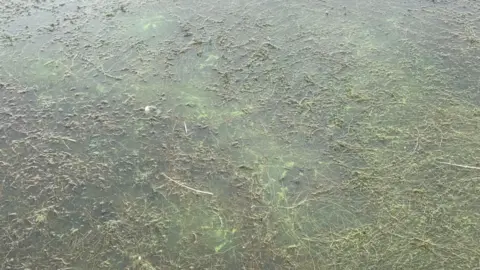
A spokesperson for Armagh City, Banbridge and Craigavon Borough Council said watersports activities and open-water swimming at Craigavon Lakes were suspended on 21 July due to the presence of blue-green algae.
The council said the situation was being "monitored daily", with "regular assessments of water conditions carried out in line with safety procedures".
It added that restrictions would remain in place until conditions were considered safe, with activities resuming "as soon as possible".

Rachel and Tilly Turkington, from Derrytrasna, County Armagh, regularly visit Craigavon Lakes for walks and trips to the café, but said they had avoided entering the water because of concerns over its quality.
The family are interested in watersports and recently bought a paddleboard, but Rachel said they would only consider using the lake if those concerns were addressed.
"If this water was cleaner and there wasn't the algae issues, we would definitely bring the paddleboard here," she said.
On a recent walk, the pair said they noticed areas where the water appeared stagnant, with green patches and visible blooms.
Despite living close to the shores of Lough Neagh, they said recent concerns around water quality had made them more cautious around local waterways.
"We take extra care and I wouldn't let the dog drink the water just in case," Rachel said.
Analysis
Any spell of sunny, settled weather will bring blue-green algae out in force, although the blooms have felt a little slow to start this year. That has been due to the weather.
Algal spores may have turned the water green in places across Northern Ireland, but strong winds and heavy rain have kept surfaces too agitated for the formation of the very large-scale mats we've seen before. And we will see them again.
Take Lough Neagh – by scientists' estimation, approximately four decades' worth of phosphorus, the nutrient that stimulates growth, are stored in its sediment.
And even as algae consumes that phosphorus, it is being topped up in the water by agriculture, wastewater, un-maintained septic tanks, industry and every household in the catchment that puts phosphorus-containing detergent into the system.
That is why addressing nutrient pollution at source is the first point of action in tackling the problem, and why the big contributors – farming and water treatment – are the first port of call.
Policies like the Nutrient Action Programme play an important role. But there is no quick fix, and few cheap or easy ones.
