Woman, 92, first in UK for new cancer treatment

 Leeds Teaching Hospitals
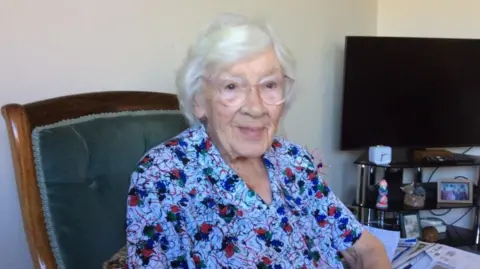
A 92-year-old great-grandmother who was told her cancer was inoperable has become the first person in the UK to receive a "pioneering" treatment that has shrunk her tumour by about 80%.
Brenda Iveson, from Harrogate, was diagnosed with a 2.3in (6cm) tumour in her liver, but because of its location and her frailty, doctors said surgery, chemotherapy and radiotherapy "were not suitable".
However, specialists at Leeds Teaching Hospitals NHS Trust instead offered her a "minimally invasive procedure", using robotic-guided electrochemotherapy.
Mrs Iveson said: "I had been told there was nothing that could be done. I'm so glad I went ahead, it wasn't painful or debilitating and I feel very well."
The technique combined a low dose of chemotherapy with targeted electrical pulses to destroy cancer cells.
During the UK-first procedure, clinicians used robotic needle guidance to position electrodes around the tumour.
'No other options'
A spokesperson for Leeds Teaching Hospitals NHS Trust said the treatment, carried out under general anaesthetic, did not use heat, meaning "it could be used safely near vital structures such as blood vessels and bile ducts".
Professor Tze Min Wah, from the interventional oncology programme at the trust, said the approach offered an option where none had previously existed.
"The addition of robotic guidance improves precision and opens up new possibilities, particularly for patients with tumours in difficult locations or who are not suitable for other treatments," she said.
The trust said it was currently the only hospital in the UK providing liver electrochemotherapy as part of a European research study examining its safety, effectiveness and impact on survival and quality of life.
Mrs Iveson said she hoped her treatment would help others.
"Research may offer real results when there are no other options," she said.
"If it helps me and future patients, then it's worth it.
"It seems to be a very effective treatment and particularly useful in older patients who are frail."
Scans show her tumour is now stable and she continues to be monitored by specialists, the trust said.
Listen to highlights from North Yorkshire on BBC Sounds, catch up with the latest episode of Look North.
