'Ear wax removal shouldn't be a taboo subject'

 BBC
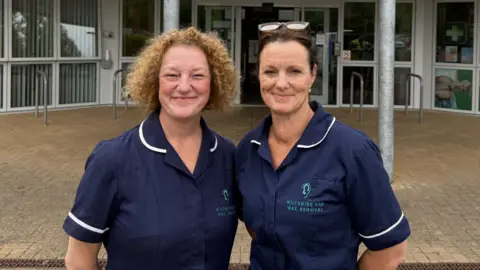
BBCTwo former midwives have said they get "almost as much joy" giving people their hearing back by removing ear wax as they did delivering babies.
Emma Pursey and Kirstin Appleton fear there has been a rise in "unregulated" care since the NHS stopped ear wax removal as a free GP service in 2019.
Appleton and Pursey, from Trowbridge in Wiltshire, run a new weekly in-clinic service at the White Horse Health Centre in Westbury, and said they still have to convince people it isn't a taboo subject.
"We pulled a load of stuff out of one woman's ear and she was mortified," Appleton said. "She burst into tears and said she felt 'dirty.' We had to explain 'no, this is just what your body does'."
What causes ear wax?
Some people have narrow ear canals which are more prone to blocked ears.
Using hearing aids can also increase your chance of wax build up, as well as earphones or ear plugs.
"People produce ear wax and sometimes it builds up," said Appleton. "But there are also people who never have a problem with ear wax in their life."
 Getty Images
John Sheehan, 86, said he had an "extra large" blockage in his ear which had built up over several months.
"I had tried things before, like putting things down there and trying to use olive oil," he said. "I had this contraption filled with warm water which I tried to use to 'suck' the wax out, which also didn't work. I later found out this method is actually quite dangerous."
Sheehan, who used to work in the merchant navy, had struggled to hear and had been left "uncomfortable" at the lack of understanding he had when people spoke.
In May, his wife found Pursey and Appleton's service and spent £60 to get the blockage removed.
"It opened up a new world," Sheehan, from Trowbridge, said. "The world is no longer muffled to me. I can hear things properly - including what my wife is saying now - so she appreciates that."
'Unregulated' removal techniques
The RNID, a charity for people who are deaf or have hearing issues, said an estimated 2.2 million people a year struggle with issues related to ear wax.
Attempting self-removal can lead to serious complications, such as infections, permanent damage to the ear or hearing loss.
Pursey said: "There are people online who buy a kit online and call themselves 'specialists,' when really they are not regulated."
The RNID has called on NHS England to work with Integrated Care Boards (ICBs) to provide free ear wax removal services.
This is because the charity said it has found that two in five people cannot afford private ear wax removal, which can typically cost between £55 and £100.
How is wax removed safely?
 Getty Images
Treatments include microsuction - where a small vacuum is used to suck wax out the ear - and warm water irrigation - which flushes out excess earwax.
The NHS suggests people contact their pharmacist in the first instance for ear wax help.
A spokesperson told the BBC: "Patients assessed as clinically appropriate with more complex needs can be referred to ear nose and throat services via the clinical pathway to receive ear micro-suction, a more effective and safer alternative to ear irrigation.
"For less complex needs, patients can also consider self-help options."
It can take anywhere between five minutes and 40 minutes to complete the procedure.
Wiltshire Ear Wax Removal's weekly service launched this month in Westbury's White Horse GP surgery.
Pursey and Appleton said their oldest client so far was 106.
"Both Emma and I were both midwives and we get as much job satisfaction as giving their hearing back as delivering their babies," said Pursey.
'Suffering for a year'
Pursey said there is a "real need" for safe removal options in the county.
She added: "When we realised it wasn't part of the NHS anymore, we realised how many people had been struggling without treatment.
"We had a clinic yesterday and I spoke to a chap who had probably been suffering for a year."
While the pair do have to charge, they said they have left costs "as low as possible".
Pursey added: "We both are ex-NHS, we would ideally do this and not charge. Asking for money is uncomfortable. But we're not being paid by anyone else, so we have to charge something and we want the best care for everyone."
Follow BBC Wiltshire on Facebook, X and Instagram. Send your story ideas to us on email or via WhatsApp on 0800 313 4630.
