Givan's rejection of integrated bid 'lawful', court rules
 PA Media
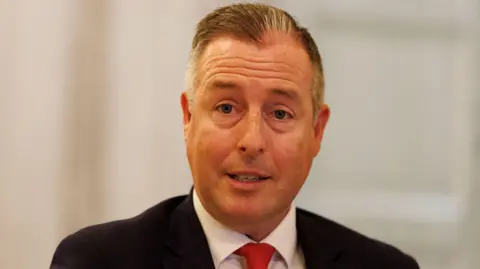
Stormont's education minister acted lawfully when he rejected attempts by two north Down schools to become integrated, the court of appeal has ruled.
In January 2025 Paul Givan turned down bids by Bangor Academy and Rathmore Primary School who were seeking to provide integrated education, where children from different religions - or none - are educated together.
His decisions were challenged in the courts on behalf of pupils at the two schools.
On Tuesday, the court of appeal upheld an earlier high court decision to refuse leave to apply for a judicial review.
"The minister's decisions were rational and lawful, and that no ground of challenge disclosed an arguable case with a realistic prospect of success," the court concluded.
Speaking after the court's ruling, Givan said the judgement "reaffirmed the legal duties placed on the Department (of Education) when considering proposals for school transformations".
"In particular, it confirms that the requirement to demonstrate that a school is likely to achieve 'reasonable numbers' of both Protestant and Catholic pupils is a central and binding element of the legislation and one which must be supported by clear and credible evidence," the minister said.
The judgement, Givan said, "confirms the integrity of my decision-making process".
It also "underlines the importance of realistic planning, robust evidence and demonstrable cross-community demand when bringing forward transformation proposals," he said.
 Google Maps
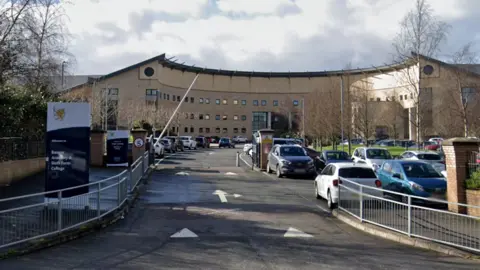
In 2023 a clear majority of parents of pupils had backed the change at Northern Ireland's largest school, Bangor Academy, which has about 1,850 pupils.
In a ballot, almost 80% of parents and guardians at Bangor Academy who voted backed the change.
Rathmore Primary School's plans to make the switch received a similar level of backing.
Rejecting the bids in January 2025, Givan said there was insufficient evidence that enough Catholic pupils would attend the schools for the provision of integrated education.
Citing legislation about having reasonable numbers of both Protestant and Catholic children in integrated schools, those targets were assessed as highly unlikely to be met.
Catholic enrolment levels at both Bangor Academy and Rathmore Primary in recent years were said to be about 3%.
In the High Court in October last year, lawyers representing pupils at the two schools claimed Givan's decisions breached Article 64 of the Education Reform (Northern Ireland) Order 1989 which imposes a duty to encourage and facilitate the development of integrated education.
At that time Mr Justice McAlinden rejected all grounds of challenge – a ruling subsequently challenged in the court of appeal.
'Reasonable numbers'
Now in a a written judgement, the Court of Appeal said the central issue on appeal was the relationship between Article 64 and Article 92 of the same legislation.
It states that the department shall not approve a bid unless the school "would be likely to provide integrated education including reasonable numbers of both Protestant and Roman Catholic pupils".
The Court of Appeal said it "was accepted that if the Minister lawfully concluded that Article 92(6) was not satisfied, he was obliged to refuse approval.
"In short, if there is not a reasonable number of Catholic and Protestant pupils attending a school then it is not an integrated school as defined by the legislation."
What is integrated education?
A law requiring the Department of Education to give more support to integrated education was passed by assembly members in April 2022.
It defined an integrated school as one that "intentionally supports, protects and advances an ethos of diversity, respect and understanding between those of different cultures and religious beliefs and of none".
But the commitments contained in the new law led some schools, education bodies and church representatives to claim it would "elevate integrated schools" above other types of school.
About 70 out of more than 1,000 primary and post-primary schools in Northern Ireland are integrated.
They aim to mix pupils of different cultures, socio-economic backgrounds and religious beliefs, including "reasonable" numbers of both Protestant and Roman Catholic children and young people.
The first integrated school in Northern Ireland, Lagan College, opened in 1981.
But while the numbers of integrated schools in Northern Ireland have grown in recent years, only about 8% of pupils attend formally integrated schools.
