The ornate bridges of Surrey's industrial past

 Ken Bare
Tucked away in a Surrey woodland, a collection of bridges stands as a subtle reminder to the county's architectural past.
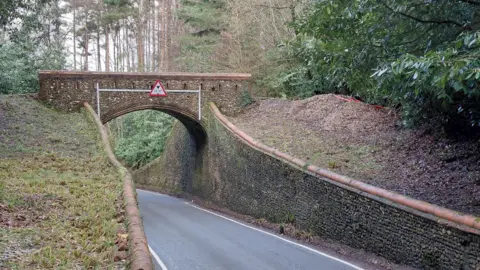
Just 10 of the 15 Lovelace Bridges survive today between East and West Horsley, but those that do are a legacy for their creator and namesake William King, the 1st Earl of Lovelace.
Now, the mid-19th Century bridges remain in good condition thanks to the work of the Horsley Countryside Preservation Society and provide a reminder of the ornate yet industrial drive of the Victorian earl.
Robert Taylor, of the preservation society, which is now called the Horsley Heritage Group, told Secret Surrey: "What really strikes me in this area is the woods are very quiet. You get a sense of being someplace remote."
Taylor added: "I think he [Lord Lovelace] would be pleased that his work is still being looked at and admired.
"He would also be pleased that people are taking some effort to try and preserve the bridges and see them."
With almost all those that survived being listed structures, the bridges feature stylistic flourishes such as the "moorish" arches inspired by the architecture prevalent in North Africa and the south of Spain, Taylor said.
Built in the 1860s, the bridges vary significantly in size, with the smallest at 6ft (1.82m) wide. The longest, the 18ft (5.48m) Dorking Arch, can still be seen across Crocknorth Road.
Despite their beauty, each of the bridges were built for their function too. Lord Lovelace's estate included a sawmill, with the bridges used to haul timber across the Surrey countryside.
While five of the bridges have been lost to time, their remnants remain, marked by scattered flint and brickwork which would once have held the structure in place.
More than 150 years after they were built, the Lovelace Bridges remain a striking example of Victorian ingenuity; structures created for industry but remembered for their beauty.
As interest in local heritage grows, these quiet woodland arches continue to offer a glimpse into the ambitions of the man who built them – and the landscape he helped to shape.
Follow BBC Surrey on Facebook, on X, and on Instagram and listen to BBC Radio Surrey on Sounds. Send your story ideas to southeasttoday@bbc.co.uk or WhatsApp us on 08081 002250.
