Kim Jong Un was meant to be their only idol - then North Koreans discovered K-pop
On a sunny Saturday in June, Lee Yeon-su took the day off from work and hopped on a train from Seoul to Busan for yet another concert by pop supergroup BTS.
It was her third time in as many months.
She had been in the crowds that poured into central Seoul in March, when the septet launched their comeback - but the stage was too far away. In April, on the first day of their world tour, the rain poured down, drowning out the singers' voices. But this time in Busan, it was "incredible".
"Every time I come to a BTS concert, I realise how happy I am that I can like and support someone of my own free will," Yeon-su, which is not her real name, says. "That would have been unimaginable in North Korea."
That's where she was born, in the so-called Hermit Kingdom, just north of the heavily fortified border with South Korea. The outside world was out of reach, cut off by a regime built on fear, surveillance and loyalty.
"You had to be selected to attend events and if you weren't, you had to stay home with your curtains closed."
Now in South Korea, she can decide who to cheer for and how. In Busan, alongside a vast fandom, she screamed, jumped and sang at the top of her lungs, especially for her old favourites, the high-octane Fire and hip-hop hit Mic Drop.

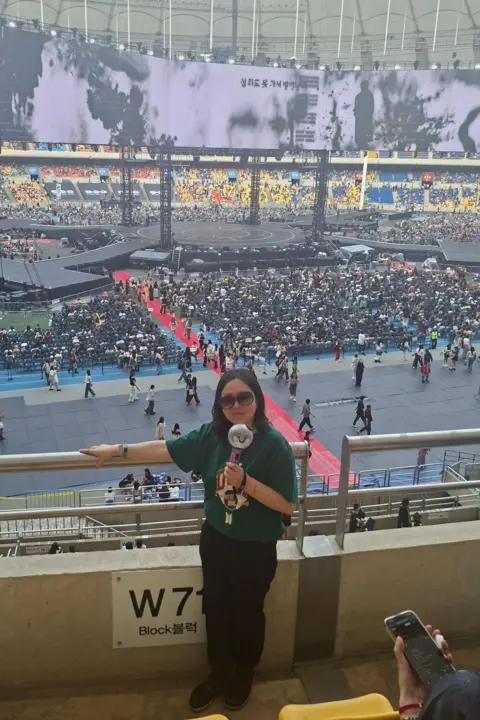 Lee Yeon-su
Growing up in a military family, Yeon-su was taught the South was the enemy. When she escaped, she tried to keep her distance from South Korean culture. But music found its way into her life.
She made it out in 2011, before BTS debuted, before K-pop became a global sensation. Now, even listening to it, or watching shows from the South, is a crime in North Korea that can land people in jail or worse.
Some like Yeon-su say they had never heard South Korean music until they crossed the border. When they did, it opened up a whole world of freedom and fun, helping them adjust to a strange, new life that was now completely their own.
But other defectors tell the BBC that despite the restrictions, K-pop has cut through in Kim Jong Un's stifling dictatorship.
They say they used to listen to songs in secret, often not knowing who they were listening to, but clinging to the mysterious and hopeful lyrics. Some even managed to watch K-pop performances, shocked by the blue-haired idols wearing make-up: "Why do men look like that?"
"North Korea is a place where the whole system is set up so that there can only be one celebrity, one idol - Kim Jong Un," says Hannah Oh, a 25-year-old defector.
But as it turns out, North Koreans have discovered other idols, like BTS and Blackpink, and before them, Girls' Generation, Teen Top and 2PM.
BTS's Korean name Bangtan Sonyeondan has even become a part of everyday slang in the North, one defector says: "People say things like, 'Have you tried on a Bangtan vest?' or 'Have you worn a Bangtan backpack?'"
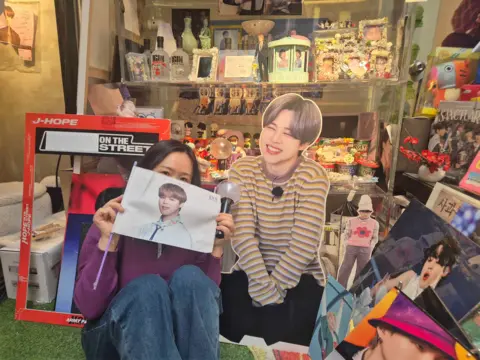
'Korean like us, but different'
For Kang Gyu-ri, who fled North Korea in 2023, there is one BTS hit that stands out: Dynamite.
BTS blew up streaming records when it dropped Dynamite in 2020 - a disco-flecked track to cheer up a Covid-weary world, the band said. It caught North Korea's ear despite being the group's first fully English single.
"I didn't understand the lyrics, but the melody was so good, it made you feel excited. Everyone followed along," Gyu-ri, 26, says.
At that time, she was living in Kyongsong, a coastal county in the North, where families could pick up TV signals across the water with an antenna. When reception was good, they watched weekend shows in which K-pop idols competed, all colourful hair and slick moves.
"Everything was shocking. I thought they were Korean like us, but they looked very different."
The rap was a novelty. "At first, I thought, 'Is this even a song?' But they looked so cool dancing while they rapped that boys started copying them."
Learning a song's signature dance move became a trend among teens, she says. Those who liked dancing looked to BTS and, before them, Teen Top, popular in the 2010s for its electro-pop dance tracks.
As she talks, Gyu-ri reaches for her phone and pulls up an old YouTube clip of Teen Top performing No More Perfume on You. "Like this," she says, laughing as she mimes the song's signature perfume-spraying move. "Soon, all the boys around me were doing it. Pssht, pssht. It was so much fun. Once you saw it, you couldn't forget it."
Because they listened to so many songs secretly, she cannot recall titles. She heard Girls' Generation, South Korea's biggest and most iconic girl group, and later became a fan of Blackpink star Jennie: "It's hard to explain, but there's something very driven and powerful about her music."
She says she cannot compare it to North Korean songs, which "felt like they were hitting my ears. Most of the songs I heard growing up were about revolution or politics. We had to keep the state broadcasts on, even inside the house".
Gyu-ri found out about popular songs quickly as she often caught them on TV. But many North Koreans used MP3 players or tiny SD cards. Music was spreading more easily than dramas but slowly.
In the mid-to-late 2010s, as K-pop was going global, new music sat alongside decades-old ballads on SD cards circulating in North Korea. File names were usually corrupted, so Hannah Oh rarely knew the title, singer or release date.
"Knowing wouldn't have meant anything to me back then. So I paid more attention to the lyrics," says the 25-year-old who defected in 2019.
One song really stayed with her. She listened to it over and over, writing down each Korean word. Years later, after arriving in the South, she discovered it was It's Not Too Late by Green Zone, or Noksaek Jidae, a popular male duo from the 1990s, when sentimental ballads dominated Korean music charts.
"It was all in Korean, so it was much easier to understand than the K-pop I was listening to," she says. "It was the first time I thought, 'so this is how people express love.'"
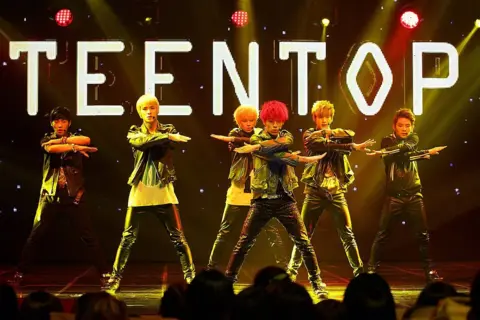 Getty Images
A window to the outside world
Listening to South Korean music was always risky. As a teen, Hannah carried two SD cards. "One had South Korean music. The other was an empty card I could hand over if I was caught."
Whenever students were caught watching South Korean content, schools across the city would come together for "public criticism sessions", Hannah says.
"They would announce exactly what South Korean videos that person had watched and publicly declare that they would be sent to a juvenile detention centre. It was meant to show everyone else what would happen if they were caught."
And yet Hannah continued listening and watching: "Once you've seen that world, it's hard to turn away."
Isolating North Koreans from the outside world has always been central to the Kim family's survival. Their propaganda has one message: Pyongyang excels at everything, from the economy to the arts, so nothing can beat life under the Kims. Any hint that freedom beckons just across the southern border is dangerous.
With K-culture now a soft-power giant, Kim Jong Un has cracked down harder. In 2022, three teenagers were reportedly publicly executed for distributing South Korean content.
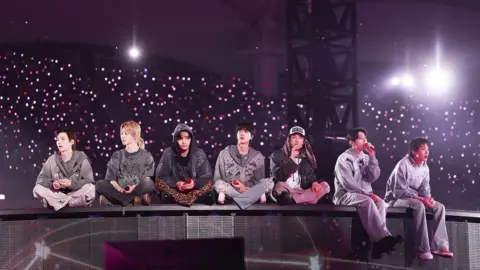 Big Hit / BTS
Still, a 2023 survey found that 98% of defectors said they had watched South Korean dramas or films back home. About 80% said it increased their curiosity about the South and influenced habits such as speech and fashion.
Hannah believes this is exactly what the regime fears.
"Some start wearing shorter skirts or dyeing their hair. Once people begin expressing themselves, it affects a system where everyone is supposed to think and move together."
That's what happened to Gyu-ri. She says she did not leave North Korea because life was hard. Rather, exposure to South Korean music and TV made the contrast impossible to ignore.
"I couldn't stand it whenever I watched TV and then went outside," where surveillance officers watched people for signs of foreign influence.
Gyu-ri says there was a time when knowing about South Korean content was a source of pride. "It made you look a bit stylish. People would say 'they know how to have fun'. But after the laws became stricter, people became much more careful."
First you would hear someone had been caught, she says. Then you would hear reports of executions. The information was deliberately spread as a warning, she adds.
"I heard that two boys I knew were executed. One was around my age, and the other was younger, about 19."
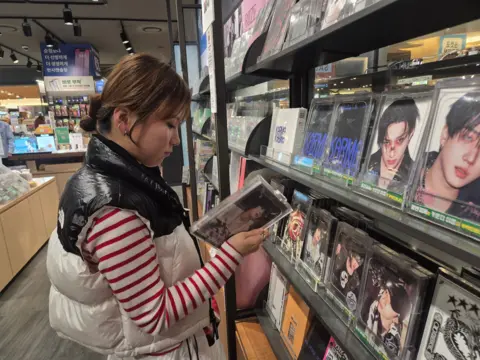
But they didn't stop consuming this forbidden content, she continues. "It was our breathing hole, our window to the outside world. People risk their lives for it because they gain hope to endure another day."
That is a risk North Koreans have been taking for years.
"Do you know why the people I met in prison were there? Caught for watching South Korean dramas, or helping someone escape to South Korea," says Yeon-su who defected in the 2000s.
On her first attempt, she ended up in prison after Chinese authorities arrested her as she fled across the border and forcibly repatriated her to North Korea.
Even in prison, she says a South Korean song kept her going. "Get up. Don't let yourself be broken," she would keep singing under her breath. "I thought, I have to survive. I have to make it to South Korea."
'The courage to stop running'
And she did. But adjusting to life there was not easy. At job interviews, employers asked whether she was North Korean or an ethnic Korean from China. She says she rarely heard back afterwards.
Then one day, she stumbled across a video of BTS performing Idol, a punchy 2018 hit, and fell for them. She joined their fandom, known as ARMY, went to meetings, started a fan account, voted in K-pop contests and posted religiously.
But the biggest change was that she no longer felt the need to hide where she came from. "When I told my close ARMY friends I was from North Korea, nobody treated me differently. Just as there were fans from Brazil or Japan, I was from North Korea."
For the first time she felt like she belonged in South Korea, and the music slowly changed how she saw herself.
BTS's Love Yourself album trilogy's focus on acceptance and healing - and the group leader RM's plea to "use us, use BTS to love yourself"- resonated with fans around the world, and with Yeon-su.
One particular song, Answer: Love Myself, sung by her favourite member Jimin, really hit home: "Why do you keep trying to hide behind your mask? Even the scars left behind by mistakes are part of my constellation."
"I found the courage to stop running and face that part of myself," Yeon-su says. "As I understood myself, I found I had more room in my heart to embrace others."
Hana Kang, who arrived in South Korea 20 years ago, says she became a BTS fan because she was drawn to something which she had never known in the North: the freedom to express what you are feeling.
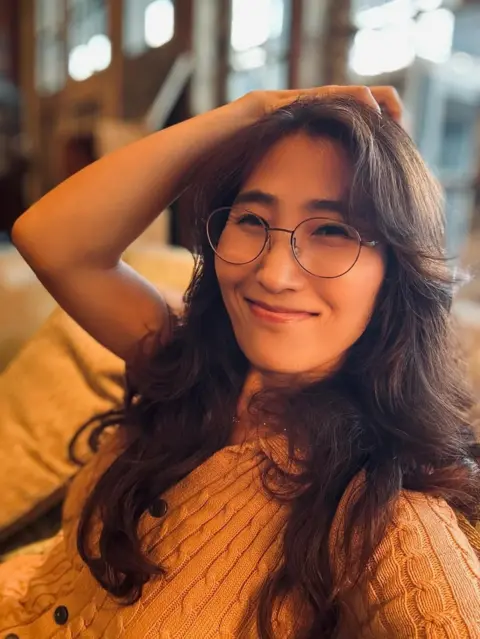 Hana Kang
The song that touched her was Spring Day, a haunting yet hopeful 2017 release about separation and longing. It reminded her of the hometown and family she had left behind in North Korea. "I missed them, and they felt increasingly distant, like they belonged to another world."
Hana and Yeon-su discovered BTS as they rose to global stardom, but the women felt a kinship with them as they learned of their struggles - something the group spoke and sang about candidly.
For Yeon-su, supporting BTS a was a way of "cheering [herself] on". For Hana, the group became a mirror: "Looking at them made me think, 'If they can keep trying like that, maybe I can too."
It's different for defectors in more recent years.
They arrive in an era where Korean music is a global powerhouse, and BTS its biggest poster child. There is far more to choose from.
Hannah Oh, who arrived in 2019, says she'd imagined spending much of her time catching up on the music and dramas she had once watched in secret. Instead, she was confronted with something new: choices.
"There were so many other things I could do," she says. "In a way, I'm now living in the kind of world I used to only see in dramas."