Why eels are being reintroduced to British waterways

 Getty Images
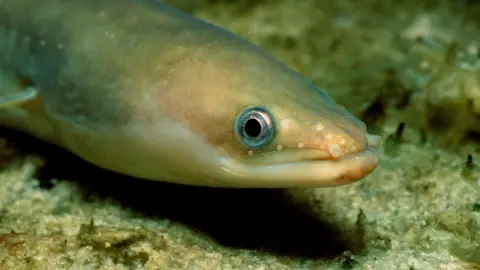
They are seen as "a little bit unusual" and "unknown" to many due to their slimy disposition, but eels are having something of a rebrand in Britain's waterways.
Their numbers dwindled by 94% in the 1980s due to pollution, parasites and several other barriers faced on the riverways.
But they are now being reintroduced across the country in a bid to boost numbers and restore balance to ecosystems.
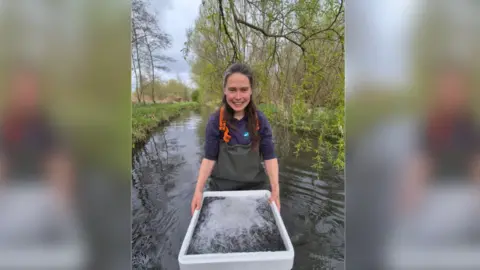
Dr Emily Best has been involved in placing eel mops - artificial, synthetic rope habitats - in the River Kennet, which runs through Wiltshire and Berkshire.
She said the eel mops provided habitats for the aquatic animals, which she described as "fascinating creatures."
Eels are born in the Sargasso Sea in the North Atlantic Ocean and then swim thousands of miles across ocean currents to reach the freshwater of estuaries and coastlines.
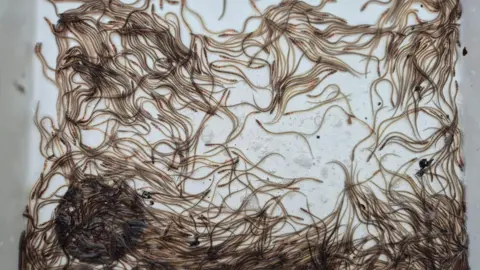
There, they turn into small, transparent glass eels.
An eel mop - which looks just like a mop used to clean floors - mimics suitable habitat for the wriggly animals to swim inside for a safe haven from the open waters.
Best told BBC Radio Wiltshire: "We are really excited that we are supporting the European eel reintroduction on the Kennet by using citizen scientists to help monitor these mop sites.
"We are hoping to monitor six sites across the River Kennet, some in Wiltshire and some over the border in Berkshire, we are looking for volunteers who can help us with this."
 Action for the River Kennet
Eels need to swim freely along rivers to find places to hide and food to eat in order to successfully grow before they return to the Atlantic to breed.
Best acknowledged some people saw eels as "a little bit unusual" and "unknown" but says the endangered animals were "absolutely amazing".
She added: "They are really fascinating creatures."
 Action for the River Kennet
Best is working with Action for the River Kennet (ARK) on the eel reintroduction project, which is being led by the Thames Rivers Trust and funded by the National Lottery.
Anna Forbes, ARK education and outreach manager, said: "This project is a fantastic opportunity for ARK to train up new eel volunteers and pilot a new citizen science to help us and the Environment Agency collect new data on eel in the Kennet.
"The European eel is a really important fish that spends the majority of its life in our rivers, yet it is now critically endangered. The aim of the project is to connect communities to their local rivers and eels; whilst improving the future for this special fish."
ARK is also developing school and community eel themed events and workshops to educate the local area.
Follow BBC Wiltshire on Facebook, X and Instagram. Send your story ideas to us on email or via WhatsApp on 0800 313 4630.
