Urban parks help cities cool off, study finds

 EPA/Shutterstock
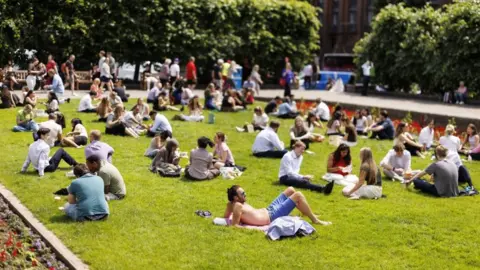
Parks in towns, cities and urban areas can help protect residents from high temperatures and pollution, a study has found.
Research from the University of Surrey has shown temperatures in urban parks can consistently stay cooler than in surrounding built up areas.
The study, which involved tests in Guildford's Stoke Park, also found noise levels decreased by more than five decibels in park areas compared to parts of the town.
Prof Prashant Kumar, founding director of the Global Centre for Clean Air Research, said the findings would help policymakers to design "healthier and more climate-resilient towns and cities".
The research comes as parts of south-east England continue to experience a heatwave and an amber heat warning issued by the Met Office remains in force for Monday and Tuesday.
During the study tests were carried out in Stoke Park and nearby built up areas throughout the day.
Pollution levels during the morning were over 11% lower in park areas, while morning temperatures were also 6.5% lower, researchers said.
'Benefits extend beyond parks'
For every 100m (109 yards) researchers travelled away from the park edge and into the town temperatures warmed by more than 0.5°C, peaking at 300m (128 yards) away from the park, the study added.
Other findings include tree cover and grassland areas which can also reduce how hot conditions feel to humans by as much as 8.5°C, compared to nearby streets.
Researcher Soheila Khalili said: "This is proof that the benefits of parks extend far beyond their boundaries. Shaded areas with trees particularly improved thermal comfort during hotter periods of the day.
"Cities are having to adapt more and more as the climate continues to warm, so understanding exactly how parks improve environmental conditions can help guide more effective urban design."
Follow BBC Surrey on Facebook, on X, and on Instagram and listen to BBC Radio Surrey on Sounds. Send your story ideas to southeasttoday@bbc.co.uk or WhatsApp us on 08081 002250.
