'He was always in the right spot': How Brazil is betting on 'smart vests' in its bid for World Cup glory

 Getty Images
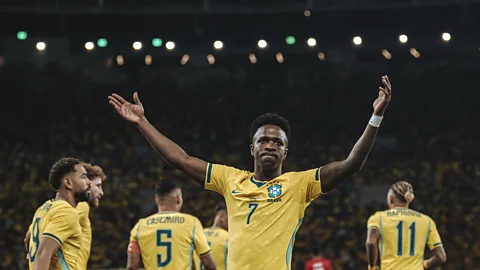
Player tracking technology has helped the Brazilian football team gather years of data on its stars in the run up to the 2026 World Cup.
Brazil has won the men's World Cup more times than any other nation.
Five titles and generations of footballing legends have cemented Brazil's reputation as one of the big teams to beat when the Fifa World Cup comes around every four years.
But after disappointment in the past five tournaments, the Brazilian team has sought some additional technical help to find an edge in 2026. (Read more about the bid to revive Brazil's World Cup fortunes.)
Behind the scenes, sports scientists have been tracking its players using wearable technology to monitor everything from sprint speeds and heart rates to fatigue levels and injury recovery.
The aim is simple: to provide Brazil's head coach Carlo Ancelotti and his team with as much information as possible before making career-defining World Cup decisions. With Brazil's first match of the 2026 World Cup against Morocco taking place on Saturday 23 June, we look at how the data has helped the team build up to this moment.
Tracking vests
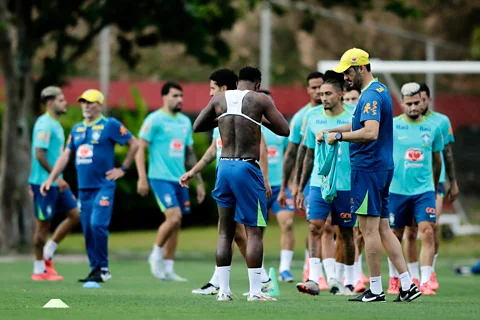
Across Brazil, most professional players wear sensor-laden "smart vests", which look a little like a sports bra, under their strip. They wear these vests as they train and play matches at their clubs throughout the season, generating detailed data about how they move, how hard they are working and how well they are recovering.
Such tracking technology has advanced rapidly over the past decade, and the majority the teams at the World Cup are now using these electronic performance and tracking systems.
Brazil, however, has integrated the monitoring of its players extensively across all of its men's, women's and youth league teams.
The information gathered by individual clubs on their players is then relayed to the national team's sports science department. This allows coaches to monitor players throughout the season as they prepare for international duty.
"On a daily basis, when we are not with the players, we communicate with the clubs and they send us the players information from the tracking system," says Guilherme Passos, head of sports science for the Brazil national team. "So it's easy to integrate in our database and to analyse the players when they are not with us."
For an international side, this helps with a unique challenge. Unlike club coaches, national team staff spend only limited time with their star players. Many members of the squad play not only in different leagues but on different continents. It makes comparing the performance and assessing the talents needed to build a team with the potential of winning the World Cup even harder.
The player tracking technology, however, allows Brazil's staff to effectively keep tabs on players even when they are thousands of miles away. "We know exactly where the players are in this transition process," says Passos.
That visibility is an asset before major tournaments.
Selecting who plays
Selecting players, their positions and tactical roles is informed by much of this data gathered through the year. Some players also arrive carrying injuries or returning from rehabilitation programmes. Others may be experiencing unusually high workloads at club level.
One of the most important applications for these monitoring systems involves managing the rehabilitation of hamstring injuries, a common problem in elite football.
By keeping an eye on metrics such as how much players are sprinting and running at high speeds, sports scientists can assess whether a player able to recover safely, says Passos. "If the player's a high speed player, it's very important to devote to this metric, small steps to guarantee that the muscle is well recovered."
 Getty Images
The data can also influence tactical decisions. A particularly fast player, may be a strong winger, while recovery metrics may help determine whether a player should start a match or be used as an impact substitute later in the game.
"If you have a very, very fast player, the coach can maybe think about using that player in a style where you can counter-attack," Passos says.
This is not just about preparation. The tracking vests will continue to be worn throughout the World Cup, providing live data across matches, often separated by only a few days. And monitoring fatigue and recovery will help coaching staff decide who is ready to play and who may need additional rest.
Testing the tech in Boston
We've been filming in the USA for the BBC TechXplore World Cup series, where we've been exploring the cutting-edge technologies used by professional footballers, host stadia and fans.
Paul was invited to test a tracking vest made by sports technology company Catapult, which is working with many World Cup sides including Brazil. The lightweight vest contains heart-rate electrodes inside its seams and a GPS tracking device inside a pocket.
To put him through his paces, Paul joined a training session with the National Women's Soccer League side Boston Legacy. After a series of drills and sprint exercises, Paul's performance was analysed. As his heart rate reached 177 beats per minute, the numbers were humbling.
Most striking was the metric known as "player load", which revealed how much physical stress he had generated during the session. Compared with an elite footballer, he was producing significantly more load for the distance he covered. In other words, Paul was working much harder and moving much less efficiently.
A professional career is most definitely off the cards.
Dan Jones, director of health and performance at Boston Legacy FC, says that the tracking helps staff both push their players to their limits during training, but also protect them from injury.
"There are moments within training sessions when we see we aren't getting as much volume or fitness as we planned," he says. In those cases, sports science staff may quietly recommend extending a drill to achieve the desired training effect.
During a recent game, Boston Legacy were monitoring a player returning from injury. Staff had calculated a safe amount of running and high-speed activity for her rehabilitation programme. Throughout the match, those numbers were tracked in real time.
"When she hit those numbers, we spoke with the coaches and said we should be thinking about a substitution in the near future," the coach says. "We brought her off."
World Cup coaches make the final call
Despite football's growing reliance on technology, one of the biggest misconceptions about modern analytics is that more data automatically leads to better decisions. The reality is much more complicated.
Brazil's Passos says one example remains stuck in his memory.
Using tracking data, he identified a player who was covering only around 6km (3.7 miles) during matches. Many teammates were running roughly double that distance. Viewed purely through the numbers, the player appeared to be underperforming. But when coaches reviewed the footage, they discovered something entirely different.
"This specific player was always in the right spot in the perfect tactical position," says Passos. "He was a very efficient player." He kept the identity of the player a secret, however, to avoid giving away crucial tactical information ahead of the World Cup.
The lesson is one that sports scientists increasingly emphasise: football is not athletics, and running further does not necessarily mean playing better. A player with excellent physical metrics may still be the wrong choice for a particular tactical system. Exceptional positioning, decision-making or leadership qualities may be what defines a player's career.
There is also the psychology of the game to consider.
"Sometimes we can be surprised about having very good data from one player regarding the physical side," says Passos. "But the coach decides not to select them because technically and mentally he doesn't believe they can perform under his playing style."
 Getty Images
As artificial intelligence and performance analytics continue to develop, the amount of information available to coaches is only likely to increase.
At this World Cup, an AI-powered football club assistant developed by Fifa and Lenovo is also being used to provide national coaches and players with instant feedback. Called Football AI Pro, it uses machine learning and natural language processing to analyse millions of data points.
But despite football's technological revolution, Brazil's leaders believe the decisive factor remains unchanged – human judgement. "The main difference is the specialised people behind the technology analysing the data and translating it into practical decisions," says Passos.
For the world's most successful football nation, wearable technology may help its coaches put what they believe to be their best side onto the World Cup pitches. Glory, however, will still be decided by how those players perform.
* Paul Carter is the presenter of TechXplore: World Cup, which was broadcast on BBC News on 6 June 2026.
--
For more technology news and analysis from the BBC, sign up to Tech Decoded. This twice‑weekly newsletter, written by North America tech correspondent Lily Jamali and senior technology journalist Thomas Germain, decodes the biggest developments in global tech and helps you live a better digital life. Sign up for free here.
