The devil worm is the deepest-living animal. It's redefining life at its limits

 Gaetan Borgonie et al., Nature, 2011
When a single worm was discovered in the depths of our planet's crust, it began an extraordinarily lucky series of events that transformed our understanding of life at extreme depth.
If you could drill into the ground beneath you and descend into Earth's crust, you'd be uncomfortable pretty quickly. As sunlight vanishes and you sink a little closer towards the planet's molten core, the temperature and pressure mounts, while deep groundwater fills the cracks and holes in the rock. At torrid depths of 0.8 miles down (1.3km), you'd be forgiven for thinking nothing could be alive down here.
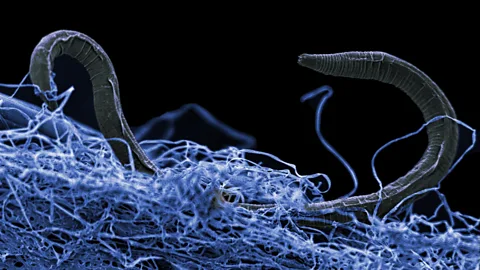
But if you're lucky, you might see them: billions upon billions of bacteria, sometimes forming bright orange or white mats – and if you could whisk out a microscope, maybe even a tiny worm using appendages on its mouth to hoist itself along the rock.
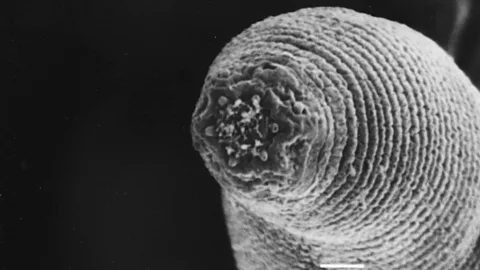
This is Halicephalobus mephisto, the devil worm, on the prowl for microbes. Though miniscule – only as long as the width of several human hairs – it's a whale in this Lilliputian ecosystem. When it dies in the snot-like microbial film growing on the rock, scientists imagine, its body is consumed by bacteria and other life forms, helping to fuel this strange, Hadean cycle of life.
Before the 1980s, most biologists didn't think that life existed more than 30cm (1ft) or so below the ground. The detection of deep-dwelling bacteria – and the 2011 discovery of the devil worm – represented a seismic shift in our understanding of the Earth's depths.
The worm's story demonstrates how life, even animal life, finds a way without the Sun's energy or an oxygen-rich atmosphere, radically expanding what scientists thought was possible for living things and sparking new ideas about life's origins and future.
"If you can find a worm down there, what else are we missing?" marvels geomicrobiologist Karen Lloyd of the University of Southern California. "It's just full of possibilities."
Thanks to an extraordinarily lucky series of events, scientists managed to produce offspring from that single devil worm and have been avidly studying its descendants to understand how the species survives in the hot, dark Earth.
 Gaetan Borgonie, Extreme Life Isyensya, Belgium
Enter the deep biosphere
The first convincing reports of deep-subsurface life emerged in the 1990s. In 1997, for instance, bacteria were found as deep as 2.8km (1.7 miles) deep inside a gas borehole.
In the early 2000s, the worm biologist Gaetan Borgonie, who founded the non-profit research institute Extreme Life Isyensya in Belgium, wondered whether a group of small worms called roundworms, or nematodes, might also exist deep underground.
Borgonie recalls older scientists scoffing at the idea that more complex life might exist in the depths. But Borgonie, knowing how tough the little animals are, felt it was worth exploring. After all, when the space shuttle Columbia catastrophically disintegrated into the atmosphere in 2003, and an on-board experiment with nematodes fell 64km (40 miles) to the ground, the animals survived – and were found happily multiplying.
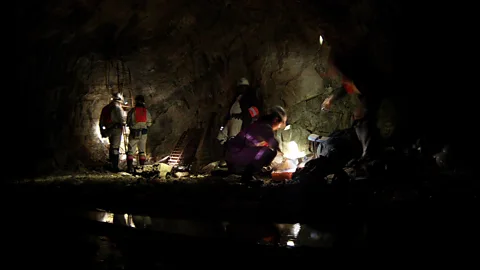
In 2008, Borgonie teamed up with other experts in extreme life to visit the Beatrix gold mine in South Africa. At 0.8 miles (1.3km) down, the team accessed holes that had been drilled into the mine's walls to tap the roughly 37C (99F) water inside the rock and let it run through filters designed to catch small life forms, Borgonie recalls. After filtering more than 6,000 litres (1,300 gallons) of water, they caught one tiny worm.
At two other South African mines, they filtered even larger amounts of water – more than 12 million litres at one of them – and found a handful of different species of roundworms, along with some other invertebrates, fungi, and several microscopic life forms.
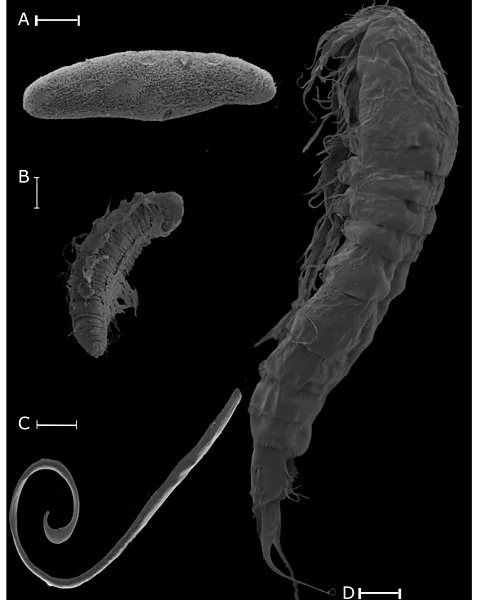
"I had never expected to find an entire zoo," Borgonie says. Most of the species are also known from surface environments, but the worm from the Beatrix mine – whose tail was broken from the filtering process – was a species Borgonie didn't recognise. In 2011, they reported that it was new to science and gave it a name: Halicephalobus mephisto.
 Gaetan Borgonie, Extreme Life Isyensya, Belgium
A broken tail is a death sentence for a nematode. But fortunately, the individual was a female, and it was parthenogenetic – meaning it can reproduce by itself without having to mate – and laid eight viable eggs before it died. "We were very, very lucky" that the individual survived, says Borgonie; he's never found another devil worm.
"It was the worm that lived. Like Harry Potter," marvels John Bracht, a genomics researcher at American University in Washington, DC.
Some of the worm's descendants have ended up in Bracht's lab, where they're raised in petri dishes under similar conditions as the devil worm's cousin, Caenorhabditis elegans, an intensively studied nematode species that lives on rotting fruit. There are some differences; mephisto doesn't swim in water and instead clings to the sides of a plastic tube, an ability that probably helps it latch onto underground rocks.
Evidently not a fan of eating Caenorhabditis elegans' food – the bacterium E. coli – devil worms wriggle towards other bacteria that land and establish colonies in the dishes. Importantly, mephisto does poorly at room temperatures; at 20C (68F) where its growth slows down and takes eight days to complete its life cycle. It prefers temperatures of 37C (99F) – conditions that usually kill Caenorhabditis elegans but where mephisto happily reproduces every two days.
Adaptations for resilience
It's challenging to study a species by only examining the descendants of a single individual, especially ones that have been away from their native habitat for a long time. But Bracht has found clues as to how the worm survives deep underground.
When he and his colleagues sequenced mephisto's DNA in 2019, they discovered unusually high numbers of genes that produce heat-shock proteins, molecules that protect other proteins from damage caused by extreme temperatures.
More recently, in 2024, Bracht's team took a close look at another molecule called cytochrome oxidase c, a key component in the process of consuming oxygen and using it to make the energy required to sustain life.
Through a series of experiments, Bracht learned that mephisto's cytochrome oxidase c only performs at high temperatures; at room temperature, the molecule shuts off, slowing down energy generation – explaining why the worms are so sluggish in these conditions.
Bracht hypothesizes that that off-switch could be a survival tactic. "They're ensuring that they reproduce more in the better environment, which would be the warmer one," he says.
 Gaetan Borgonie, Extreme Life Isyensya, Belgium
Bracht is currently studying whether the devil worm's parthenogenetic reproduction strategy is also a survival tool. Because devil worms may not often encounter others of their kind in the vast expanses of the underworld, this kind of asexual reproduction may sometimes be their only way to make offspring.
Asexual reproduction is thought to come at a cost, however, as it doesn't create the healthy genetic diversity that comes from the mixing of genetic material when males and females mate – which is why many scientists consider asexually reproducing species to be doomed to extinction. (Read more about the surprising success of some all-female species.)
Perhaps devil worm males do exist – allowing for some sexual reproduction when individuals encounter one another – but they just haven't been discovered yet, Bracht speculates. In any case, the worms showcase just how adaptable nematodes are. "Any place you find a food source, and there's a possibility for animals to get there, nematodes will evolve to land in that niche."
Resilience in the depths
It's a mystery how these life forms got here. Research by Borgonie and geobiologist Cara Magnabosco at ETH Zürich in Switzerland suggests that at least some nematodes move down from surface environments through water, perhaps helped along by the shudders of earthquake activity; some species survive whereas others perish.
"There must be some connectivity and transport of them from the surface to this deep environment," Magnabosco says.
In all, Magnabosco and others have estimated that microbes of the deep biosphere make up a considerable chunk of life on the planet, accounting for 12 to 20% of the total biomass of Earth's microbes. These underground bacteria – which have evolved sophisticated strategies to source carbon and energy from the dark world around them – probably play an important role in supporting more complex life forms like nematodes.
They not only provide food, but may also produce small amounts of oxygen that deep nematodes need, Lloyd says. And by influencing the acidity levels inside deep watery caverns, "they can help create a clement environment for larger things to grow in", Lloyd says. The invertebrates, in turn, provide food for microbes: nitrogen when they defecate, and carbon from their bodies when they die, Borgonie adds.
More like this:
Such underworld ecosystems may have been thriving for aeons. Research by Maggie Lau of China's Institute of Deep-Sea Science and Engineering and her colleagues has found evidence that one species of deep-dwelling bacterium may have been in the Earth's crust since the fragmentation of the supercontinent Pangea, which began about 165 million years ago, back when dinosaurs roamed the world.
The devil worm and its subterranean brethren may well be some of the most enduring kind of life on Earth. Studying the deep biosphere, experts say, could help us better understand the conditions under which living things first came into existence, and even help inform searches for extraterrestrial life; if there is life on Mars, it's probably lurking under the surface.
And should a life-killing asteroid hit Earth and sterilise its surface, life could arise again from the critters that dwell underneath.
"As humans, we think we rule the world, but we don't," says biochemist Esta van Heerden, a lead environmental scientist at the South African bioremediation company iWater, who was part of the team who discovered the devil worm. "That has been extremely humbling for me – to understand they have been here for millions, if not billions, of years and they will remain here long, long after we've gone."
--
For essential climate news and hopeful developments to your inbox, sign up to the Future Earth newsletter, while The Essential List delivers a handpicked selection of features and insights twice a week.
