Why is the film industry hypocritical about strippers?

 AF Archive/Alamy
While films such as Magic Mike XXL and The Full Monty play erotic dancing for laughs, cinema tends to cast female strippers in a far less positive light. Nicholas Barber asks why.
One theme that runs through Magic Mike XXL is the question of what Mike (Channing Tatum) and his fellow strippers – sorry, “male entertainers” – will do once they’ve hung up their sequinned posing pouches and left the dollar bill-strewn world of hen parties behind them. Mike himself is returning to the hand-crafted furniture business he set up in the first film, but his fellow Kings of Tampa aren’t so sure. One of them hopes to make it as an actor, the others talk vaguely about painting, music and “artisanal” frozen yoghurt. The strange thing is that not one of them suggests the obvious alternative: they could just carry on stripping. After all, when they’re on stage, crowds of women scream with deafening delight, and when they’re off stage they never stop saying how much they love each other, so why is Mike rushing back to his hammer and lathe? As Owen Gleiberman says in his BBC Culture review, “this man may be more of an artist when he’s doing a strip number than when he’s building a cabinet”. If you ask me, there’s no “may be” about it.
 Warner Bros
The advertising for Magic Mike XXL promises an unequivocal celebration of stripping, so it’s curious that the film itself pushes its characters into other lines of work. It’s also typical of Hollywood. On the one hand, the movies can’t stay away from strip clubs: apart from primary school teacher, pole dancer is probably the most common cinematic job for women, just as assassin is the most common job for men. But on the other hand, no film can visit a strip club without a frown of disapproval on its face.
It’s an attitude which is apparent in even the cheeriest films on the subject, such as 1962’s Gypsy. Near the end of Mervyn LeRoy’s classic musical, Gypsy Rose Lee (Natalie Wood) rhapsodises about being a burlesque sensation – but not until the film has established that she is classier than all of the croaky-voiced, gone-to-seed strippers who were on the circuit before her. And not until her mother’s fiancé (Karl Malden) has walked out on the family in disgust. “You want your daughter to bump and grind and take her clothes off,” he roars, “in front of a lot of hooting savages?”
 Pictorial Press Ltd/Alamy
It’s an interesting question. There are a few films which take it seriously, such as Dancing at the Blue Iguana (2000), an improvised ensemble drama, and Darren Aronofsky’s The Wrestler (2008) with Marisa Tomei. But most Hollywood films answer the question with a hypocritical “yes and no”; that is, they offer viewers the titillation of some semi-nude shimmying, but they reassure us that we aren’t “hooting savages”. Not that American movies are alone in hedging their bets in this way. Vic Pratt, a curator of the British Film Institute’s National Archive, considers one English film, Beat Girl, released in the US as Wild for Kicks (1960), to be particularly duplicitous. “It’s about a girl from a middle-class family who suddenly decides she wants to be a stripper,” says Pratt, “and is lured towards the world of vice by Christopher Lee. There is a sense that stripping is alluring, but also that it’s a terrible threat to good middle-class values. The film is keen to excite us with the quite explicit striptease routines, but we can watch them in the safety of the cinema and then go back to our safe, sensible marriages.”
 AF Archive/Alamy
Leave your hat on
More recently, the film industry’s ambivalence towards stripping is exemplified by the many big-screen ecdysiasts – to use the technical term – who keep their underwear on, from Salma Hayek in Dogma to Natalie Portman in Closer to Jessica Biel in Sin City to Jennifer Aniston in We’re The Millers. It’s a having-your-cake-and-eating-it scenario. Viewers are given the opportunity to gawp at gorgeous, gyrating actresses, but the fact that those actresses never actually get naked implies two things: first, that they are superior to the characters they are playing, and second, that we are superior to the “hooting savages” slavering over them. The downside, of course, is that the scenes are so blatantly bogus. Burlesque (2010), starring Cher and Christina Aguilera, is especially silly. It was released to cash in on the neo-burlesque craze, but the costumes were more demure than those in Aguilera’s pop videos.
 AF Archive/Alamy
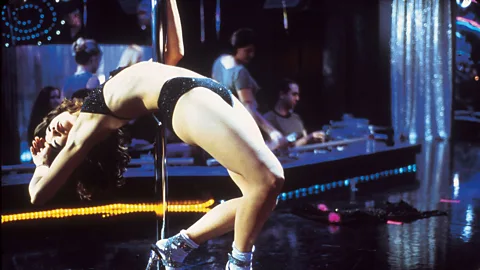
Still, Burlesque is one of the rare films to present exotic dancing in a broadly positive light, as opposed to a depressingly dingy one. Most Hollywood movies maintain that the strip-club experience is demeaning to all concerned – at least, it’s demeaning if the dancers are female. Magic Mike and The Full Monty (1997), in contrast, may have their doubts about male stripping as a long-term career, but both of them depict the shows themselves as a blast for audience and performers alike. It’s also notable that Magic Mike was sufficiently well-received to garner a sequel, and The Full Monty stands as one of the most successful British films ever made. Compare that with Showgirls (1995) and Striptease (1996), the two most famous films about women who get their kits off in public. Both were despised by critics, and both painted bleak pictures of their settings. In films, as in society, female strip shows are regarded as being inherently sleazy, while their male equivalents are seen as harmless fun.
 Alamy
The Full Monica?
“The difference is that the female body has been objectified for so much longer than the male body,” argues Uberto Pasolini, producer of The Full Monty. “Women are tired of it. The idea of the male body as something to be ogled is still quite new and fresh, so that’s why it’s acceptable. In 20 years or 50 years, people will probably protest about men being objectified, but at the moment there are buses all over London with five six-packed bodies on them to advertise Magic Mike XXL. You couldn’t do that with five female bodies. You’d be killed. Literally.” In short, don’t expect Pasolini to produce The Full Monica or Magic Michelle any time soon.
Julian Marsh, the founder of Britain’s Erotic Film Society, believes that when directors stage a scene in a strip club, they’re in a lose-lose situation. “Whenever Hollywood doesn’t show nudity in this context, it’s criticised,” he says. “Striptease, for instance, was ridiculed for being too chaste. But whenever Hollywood does go the distance, and shows performances in a fairly uncompromising fashion, the result is decried as filth. Looking back at the reviews of Showgirls, it seems that people couldn’t see past the sex and nudity, so they didn’t realise it was a dark and very sharp satire. Maybe they would have been happier with Merchant Ivory.”
Marsh could be on to something. There is one sanctioned way for a mainstream movie to be enthusiastic about women stripping, it seems, and that is to put those women at a safe historical distance from the viewer. Stephen Frears’ Mrs Henderson Presents (2005) is a twinkly period drama starring Judi Dench and Bob Hoskins. In telling the true-ish story of Soho’s Windmill Theatre in the 1930s and ’40s, Frears’ film asserts that the Windmill’s nude revues were not only daringly taboo-busting, but also stirringly patriotic: theatre kept up British spirits during the Blitz, and gave young soldiers an inspiring eyeful of skin before they were shipped off to fight the Hun. No film about a 21st-Century strip club would ever dare to be as positive.
 AF Archive/Alamy
Even if someone wanted to make The Full Monica, says Pasolini, they would fall foul of the ratings system. “You can’t have women stripping in a film for too long without showing a pair of breasts,” he says, “and according to the censors in the UK and the US, a pair of breasts is a problem. Chopping someone’s head off or riddling someone with bullets, that is not a problem. Showing parts of the anatomy that you can see on every beach in the south of France, that is a problem. But hopefully that will change. There is nothing more beautiful than the female body, or the male body, if that’s what you like. It’s all nature, after all.”
