The 'psychedelics coach' with drug-fuelled career advice

 Colleen Hagerty
Following the popularity of 'microdosing' psychedelics to improve productivity, some are turning to these substances for career clarity.
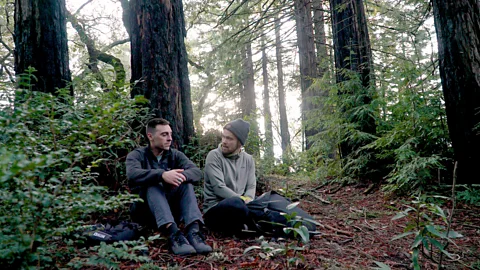
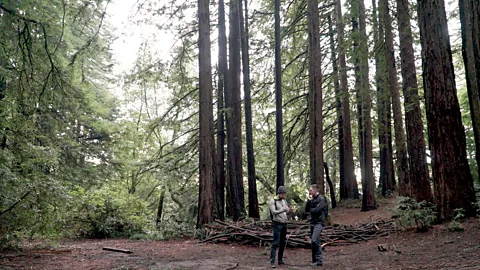
Paul Austin and Matt Gillespie are trying to retrace their steps along a path shrouded by redwood trees.
All things considered, the conditions for being lost in the forest are pretty ideal: there’s still about an hour of daylight left, and the weather is unusually pleasant for December in Oakland, California.
Plus, the two 29-year-olds are in noticeably good spirits. Austin, a psychedelics coach, feels confident his guidance helped his client, Gillespie, make some real progress today. And Gillespie, brushing his palm across a tree as he takes another muddy step forward, seems all but concerned about the unplanned detour.
“How often do you let yourself get lost?” he asks. It’s tough to tell if Gillespie is really that enchanted by the redwoods around him – or if he’s still feeling the dose of psychedelic drugs he took a few hours back.
‘That really helped me understand my potential’
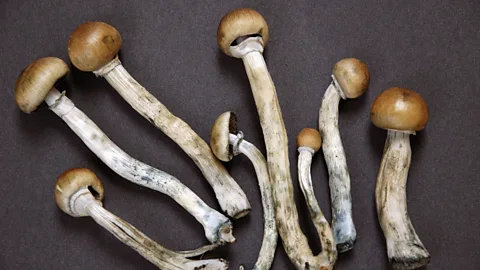
Psychedelics have seen a surge in popularity within the last decade. These mind-altering substances, which include psilocybin (or ‘magic mushrooms’) and LSD, are best known for their hallucinogenic effects. Most notably, they’re associated with 1960s counterculture.
 Colleen Hagerty
But today, they’re fixtures in Silicon Valley’s tech-heavy and success-obsessed culture. The excitement over these psychedelics is less about recreation and more about optimisation – specifically, their alleged ability to help users level up in their careers.
Gillespie subscribes to this idea – and has for years. He credits much of his professional success to his first dose of LSD, taken with his best friend when they were teenagers in the US state of Ohio.
“In that altered state, it became much more real that I didn’t know anything about the world,” says Gillespie. “We realised how ignorant we were and how much growth we had left in our lives. It was, in a strange way, very humbling but also very liberating. That really helped me understand my potential.”
Before his experience with LSD, he thought his future was already written: he would attend a local university and find a job in his hometown of Cincinnati. But after experimenting with the drug, Gillespie decided to pursue a degree in industrial design. He ended up working abroad in Germany and Switzerland before returning to the US to work at a solar energy start-up.
Now, approaching 30 and in the throes of a new entrepreneurial effort, Gillespie has found himself turning to psychedelics for guidance once again. After abstaining from the substances through much of his early career, he became intrigued by microdosing, or the practice of taking a low dose of the drugs in an attempt to improve creativity, productivity and general well-being.
Even though there is little data to back up these claims, the concept of using psychedelics to enhance personal and professional performance has been rising throughout the past few years.
This is particularly the case within Silicon Valley, which has long embraced these ideas. In his book on psychedelics, How to Change Your Mind, Michael Pollan traces this history back to the 1950s, when engineers used LSD’s hallucinogenic effects to visualise new concepts, such as computer chips. Tech titans including Steve Jobs are also known to have dabbled in psychedelics. Jobs reportedly even once disparaged fellow founder Bill Gates as “unimaginative”, noting he would be “broader” if he took LSD (Gates has, actually, alluded to his own LSD use).
A guided trip
For Gillespie, finding an effective way to use psychedelics was difficult – he describes his early attempts at microdosing as “flailing”, saying he had a tough time determining how much of the drugs to take and how to best take advantage of his altered state.
“Finding that right balance and that right place in my life took a little help,” he elaborates. “And that’s where Paul [Austin] comes in.”
Like Gillespie, Austin’s first psychedelic experience happened in his late teens – a psilocybin trip. Later that year, he took LSD “maybe 20 times”. Psychedelics have been a fixture in his personal life ever since, and he sees educating others about them as his professional mission.
 Getty Images
Austin started The Third Wave, an online community for psychedelics education, and offers coaching sessions to help people integrate them into their lives in a safe, meaningful way. Since moving to Oakland last year, he’s developed a roster of regular clients – “almost exclusively founders or entrepreneurs” – guiding their drug trips by setting goals and intentions, often focusing on their professional paths.
“I feel like the reason clients come to me is often times to go into these deeper questions of, ‘Why are we doing what we’re doing? Why does the work that we’re doing matter to us’?” says Austin. “I think psychedelics are really helping people with that process more than anything.”
‘Hike-rodosing’
When Gillespie arrives to today’s session, he’s already taken a microdose of psilocybin. Since psychedelics are illegal in the US, Austin does not provide them to his patients, but he notes that they have become much easier to come by since being decriminalised in Oakland earlier this year.
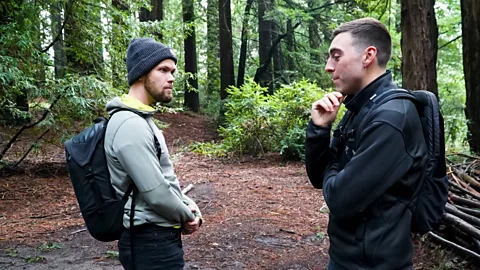
After a short drive away from the skyscrapers of San Francisco and into the towering redwoods of Joaquin Miller Park,the two pick a random path, and the ‘hike-rodosing’ session begins. Austin slips into coaching mode, asking Gillespie to state his goals for the day.
On the surface, much of the conversation seems quite similar to what one would expect from a typical career counselling session. But Austin believes the psychedelics make this process more effective by helping clients achieve a sort of objectivity about themselves.
“It makes it easier to come to awareness about certain things,” he says. “Psychedelics just help us be a bit more malleable. They help us be more honest and open.”
It’s not just Austin’s hunch: in a recent study from the Imperial College of London, researchers scanned the brains of patients on LSD and found the drug does induce a change in how users relate to the world around them. Lead researcher Dr Robin Carhart-Harris describes it as a more “unified” brain, meaning networks that typically function separately start working in a more integrated way. He says this relates to the phenomenon of “ego-dissolution” in the users, which is a feeling of renewed connection within themselves and with their surroundings.
Studies like Carhart-Harris’ are beginning to shed new light on the potential medical uses of psychedelics, which were made illegal and classed decades ago in the US as Schedule 1 drugs with no medicinal value.
Today, the US Food and Drug Administration (FDA) has granted two psychedelics, psilocybin and MDMA, ‘breakthrough’ designations allowing them to be clinically researched after showing promising potential in treating patients with mental health conditions. Other early research has looked at the positive impacts of psychedelics in treating addiction and even easing headaches.
Caroline Dorsen, a substance use researcher and assistant professor at New York University’s Meyers College of Nursing, has focused her work on how people are using psychedelics to heal childhood trauma and improve their physical and mental health. Something important she observed in having a productive psychedelic session is having some sort of figure – whether that’s a doctor, a coach or a spiritual leader – to help the user through this experience.
 Colleen Hagerty
“Having a trained and well-prepared guide is an essential part of ensuring physical and emotional safety during therapeutic psychedelic experiences which can range from blissful to sad; unsettling or scary,” says Dorsen. “After psychedelic ceremonies, guides serve the essential role of helping participants make sense of the experience and integrate what they learned into their everyday lives.”
Anecdotally, Dorsen says she has heard many stories of people experiencing “epiphanies” during psychedelic sessions that lead to a change in careers. But, she cautions, users can’t force these sorts of realisations out of the drugs. “In my research participants often explained that they have minimal control over the experience they are going to have while taking psychedelics,” she says. “The plants are going to give you the experience you need.”
Revealing the best path forward
Since he started working with Austin, Gillespie says he has set fairer prices for his consulting work, and made significant steps forward in launching his business.
“A lot of what Paul helps me with is getting over a lot of these limiting beliefs around my own value and my own competency,” says Gillespie.
He previously tried working with ‘accountability groups’, in which members share goals and report back on progress, but felt the experience wasn’t as beneficial. With Austin it’s “deeper”, he believes, as the coach pushes him to get more introspective and honest about his “why”, or what really drives him in his work and personal life.
Working with Austin isn’t cheap: he requires a minimum three-month commitment for coaching with a $1,000 to $2,000 per month price tag (£765 to £1530). But Gillespie is confident that continuing to work with Austin – and psychedelics – will reveal his best path forward.
Confident enough that, in a few days, he plans to participate in an ayahuasca ceremony for the first time, where he’ll try the potent psychedelic tea known to induce intense visions, and, often, physical sickness. He’s excited about this opportunity, and spends much of the latter half of today’s session with Austin discussing it. Eventually, as they talk, the pair finally finds the way back to their car.
