Hiking Norway's heavily monitored Russian border

 Kirkenes Tours
A series of scenic paths trace the Norwegian-Russian border. But as you trek through the tundra and forests, you may notice watchtowers and cameras hanging in trees.
I'm standing at a hillside clearing in the tundra along the Russian-Norwegian border, watching the Pasvik River ripple and writhe below. Maybe it's the rustle of birch leaves overhead or the buzzing sound of mosquitoes circling all around me, but I have an unshakeable feeling that I'm being watched.
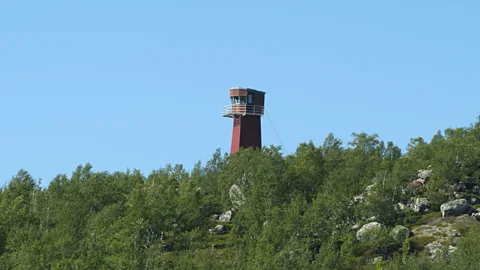
Then again, those hairs on the back of my neck could be triggered by the nearby military watchtower, and the fact that this public hiking trail is under constant surveillance.
Located in the far reaches of north-eastern Norway on a jagged fjord close to where Finland, Russia and Norway meet, the small town of Kirkenes is best known among travellers as the final turnaround port for a number of small Arctic cruise lines. But increasingly, local operators are leaning into another opportunity: leading cruisers on wind-whipped treks along Nato's northernmost land border to the unfenced-but-heavily-monitored 198km-long line separating Norway and Russia.
 Kirkenes Tours
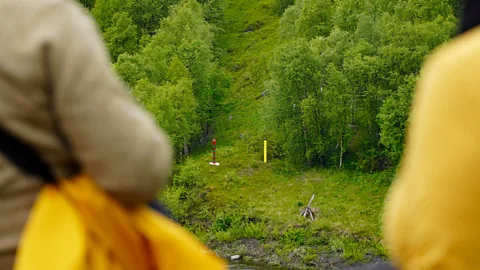
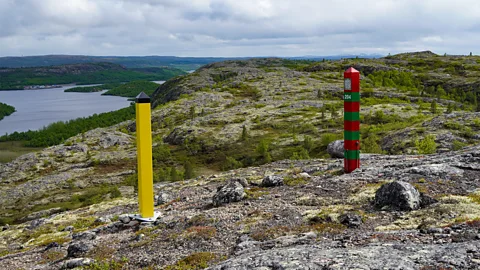
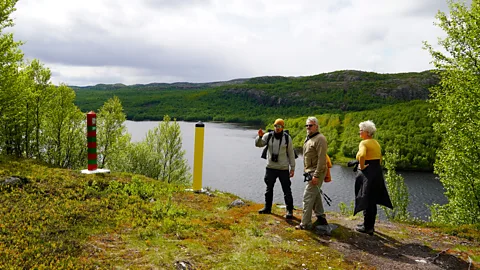
Here, surrounded by taiga forest, travellers can explore a network of public trails where cameras hang in the trees, watchtowers dot the horizon and military patrols ensure visitors are abiding by the periodic pillars (yellow for Norway, red for Russia) marking the international boundary between the two nations.
Drawn by the prospect of exploring the Arctic's most closely watched frontiers, I've set out on a three-hour trek through a birch forest strewn with boggy puddles. The trail runs parallel to the Pasvik River for roughly 1km before it reaches the "border corridor": an 8m-wide (26ft) strip of cleared forest that's a veritable no-man's land where travellers can't go. From there, the trek culminates in a scramble up Russehøgda, a hillside overlooking the Storskog border crossing that is the only legal land border between the countries.
But as we enter the forest, my guide, Henrik Hoffmann, switches off his mobile to avoid connecting to Russian data networks. He instinctively taps a satellite phone in his pocket, and I'm reminded that this is no ordinary walk in the woods.
The lure of Russia's land border
Hoffmann has been leading these border-trek trips since 2025 but relocated to Kirkenes in 2021, just before Russia's invasion of Ukraine a year later. Since then, he says that both Russia and Norway have increased security along their respective borders here. Now, seemingly minor offences, like throwing stones towards Russia, risk heavy fines and wandering beyond the marked international boundaries has resulted in detainments.
 Trym Ivar Bergsmo
Still, he says that after travelling along Norway's coastline, many passengers who arrive in Kirkenes on Hurtigruten and Havila cruises are eager to escape the confines of ships and shuttle buses and get an up-close look at where these two nations meet.
"Many older travellers are particularly interested because they remember the Cold War and have followed relations between Europe and Russia over many decades," Hoffmann explains. "The hike allows them to experience the landscape for themselves while learning about the history and present-day realities of living beside Russia."
More like this:
While Kirkenes Tours is the newest operator to offer border excursions, it's not the first. Havila Voyages has been leading visitors to this area since 2000, while Hurtigruten told the BBC that its Norwegian Border tour – which also leads travellers through a WW2 atomic bomb shelter – recently became the most popular of its eight Kirkenes excursions.
"Interest in the border has definitely increased over the past few years," says Hoffmann. Despite an initial reduction in tourism following Russia's invasion of Ukraine in 2022, he explained that understanding the border is now a driving motivator for those visiting Kirkenes.
 Alamy
AlamyPlan your trip:
Kirkenes Tours , Havila Voyages and Hurtigruten all offer year-round walking excursions along the Norwegian-Russian border. In addition to Kirkenes Tours' standard May-November hike, it also offers treks that take in the Boris Gleb Church and ones set under the midnight Sun (May-July). Travellers can hike independently on the public trails, but given the strict border rules, it's recommended to book through a regulated company. Littering, photographing military personnel and touching or climbing markers are prohibited by law. Hikers must carry passports, as Norwegian military patrols regularly request formal identification.
According to Anja Tellervo Hansen, destination manager at Visit Kirkenes, these border treks allow visitors to "learn more about what everyday life in our region looks like, and how the closeness to the border has shaped the Kirkenes region over the years".
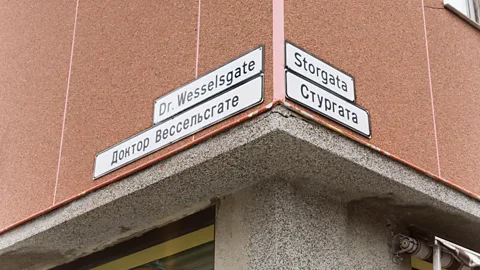
Evidence of this shared history is everywhere in Kirkenes. The town is the only place in Norway where street signs are marked in both Norwegian and Russian. Near the centre, the towering Russia War Monument commemorates the day in 1944 when the Red Army liberated Kirkenes from Nazi occupation. And the nearby Borderland Museum highlights how Norwegians, Finns and Russians have intermixed here for generations.
Along the Pasvik River, the border sharply juts west, surrounding the Boris Gleb Church. The Russian Orthodox church dates to the 12th-Century and helped define the modern border here 200 years ago.
 Kirkenes Tours
Trekking the trail
Soon after landing at Kirkenes Airport, I was whisked into a van that cut through the city, past the port where cruisers had already docked for the day and dropped off at an unassuming layby flanked by dense walls of birch and conifer trees.
"Ready?" said Hoffman, who was waiting in the layby with a rucksack, beckoning for me to follow along a stony track.
An hour later, I'm stepping up a rocky outcrop as Hoffmann nimbly picks the way ahead. As beads of sweat form on my forehead, I pause, taking in the eerie expanse of birch trees dipping down towards the Pasvik River. Soon, the outcrop slopes onto a flattened summit.
Standing on Russehøgda, surrounded by desolate tundra and a horizon of hazy peaks, I momentarily forget that I'm at one of Europe's most scrutinised borders and am consumed by the sheer beauty of the terrain. Then I glance to the right, notice a yellow and red set of markers only a few metres away, and am sharply reminded where I am.
 Kirkenes Tours
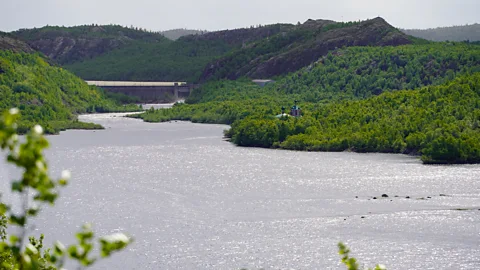
Hoffman and I throw down a blanket on top of a smooth rock and sit for a drink. "There's Storskog," he says, gesturing towards two lakefront checkpoints below. From a few kilometres away, I can just make out the occasional truck driving along the E105 to cross into Russia. He says that recreational crossings have reduced, but a handful of vehicles still make the journey on a daily basis.
He also explains that while more visitors are trekking these border trails, fewer residents are; Hoffmann has seen more military patrols than local hikers. "You don't see many Norwegians here," he says, "Perhaps it's a classic case of not exploring your own doorstep."
As we turn away from Storskog and descend Russehøgda, I find myself silenced by the gravity of the experience. I've spent a lifetime crossing borders and collecting stamps, but I could have sat for hours just looking at Storskog.
From painted markers to the distant outline of Boris Gleb Church, centuries of politics and negotiations have shaped this terrain. It's easy to understand why more and more cruise passengers are disembarking to witness it firsthand.
--
If you liked this story, sign up for The Essential List newsletter – a handpicked selection of features, videos and can't-miss news, delivered to your inbox twice a week.
