Blood tests and ultrasounds: Korea is becoming one of the world's global healthcare hubs

 KMI Medical Institute
Travellers are increasingly adding comprehensive health check-ups to their South Korea itineraries, drawn by affordable prices, fast results and English-language support.
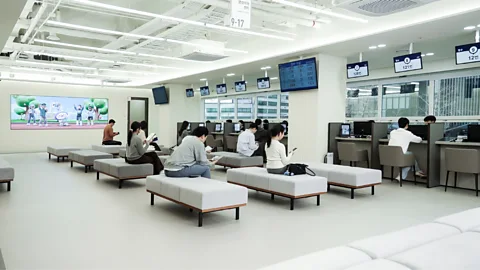
Liping Chao has just arrived in Seoul and beyond his cab window, the city's famous skyscrapers beckon. But instead of hiking up Namsan Tower or browsing Myeongdong's famous shops, he heads to the city's Mapo district, where he enters Medione Medical Center. In the clean, spacious waiting room, he notes more foreign faces than Korean ones. He changes in the locker room and stores his belongings. A nurse brings over his chart and takes him to the first station.
This was no medical emergency; just a part of his travel plan. Chao is one of a growing number of overseas travellers who are adding medical services to their South Korea trips. In between noraebang sessions and street food crawls now come blood tests and ultrasounds. Even colonoscopies.
A contagious trend
It's a trend that shows no signs of slowing. According to South Korea's Ministry of Health and Welfare, 2.01 million foreign patients visited in 2025, up 71.7% on the previous year. Patients mostly come from China and Japan, followed by Taiwan and the US. Donkyo Seo, CEO of Himedi, a Seoul-based medical concierge, explains "for Korea, medical tourism is an export industry", actively supported through legislation designed to promote overseas medical expansion.
 Himedi
But why fly all the way to South Korea for medical care? Haemin Yim, CEO of Seoul-based travel planner Creatrip, says it ultimately comes down to cost and efficiency. While patients in many countries face referrals, insurance approvals and long wait times, many Korean screening centres offer complete comprehensive health checks in a single visit. Even better: healthcare in South Korea, ranked second best in the world by the 2025 CEOWorld Healthcare Index, is highly affordable thanks to its government regulation of medical prices. "The difference is significant," says Yim. "In many cases, the price of a single MRI in the US can cover a comprehensive full-body screening in Korea... Even after factoring in airfare, it can still be more affordable." Apart from the appeal of its high-rated healthcare and lower costs, Hyeonah Hong, Head of Division at Korea Medical Institute (KMI), says "Korea has a well-established prevention-focused healthcare system, providing an environment where diseases can be detected early."
Plan your checkup
Medical concierge services like Creatrip and Himedi help international visitors book packages. Book ahead, and schedule services for earlier in your trip as fasting, sedation or follow ups may be required.
Full body checkups are offered by both hospitals and specialised screening clinics. Clinics are cheaper, but patients with abnormal results may be referred to a hospital.
English-language support varies, so confirm interpreter availability before booking. Results are typically emailed within seven to 14 days, and available in multiple languages. KMI (Korea Medical Institute) and Seoul National University Hospital provide full English services.
Sharing results with your doctor back home and buying travel insurance for medical tourism are recommended.
This was Heather Barlow’s reasoning for adding a doctor's visit into her holiday activities. "I have some underlying health issues and my GP recommended that I get a full health panel," she explains. "A similar health panel in my home country [of Hong Kong] would cost three to four times of what I paid in Korea."
Medical odysseys
Like many medical tourists, Chao and Barlow first learned of South Korea's health screenings through friends who had undergone procedures.
Chao booked his flight from Los Angeles to Seoul in April 2026 and began researching health clinics on Google and social media. Watching videos of so many satisfied travellers undergo successful check-ups inspired his trust. "[South Korea is] a mecca of beauty. Health is somewhat adjacent to that, which made me trust it more," he says. "The sheer amount of exams they perform made me comfortable in trusting the healthcare workers."
 KMI Medical Institute
While the practice is gaining popularity among non-Koreans, for Koreans living overseas, travelling to South Korea for medical check-ups has been common practice for years. Rebecca Gladstone, a Korean American based in New York City, heard about affordable, advanced South Korean checkups through Korean friends and family, and followed up with her own research. "I already had plans to be in Korea, so I knew I'd take the opportunity to book one," she says. "I'm still amazed you can get a full body checkup done in a single visit." She booked a comprehensive women's health panel at CHA University Medical Center for just under 754,951 won (£387/ $516).
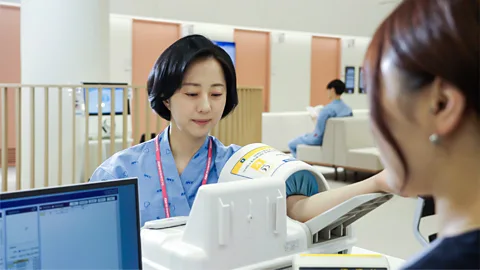
Barlow describes a seamless, fast experience at KMI Gwanghwamun. She had scheduled a mid-tier package that included routine labs, X-rays, ultrasounds and a few minimally invasive procedures. The wait between each station was short. The longest I had to wait was 15 minutes," she says. "You’re allowed to have your phone or book on you at all times, so I was never sitting around bored or anxious. Staff, nurses, and doctors were all kind and patient, and I never felt like I was rushed through a test, despite the whole set-up being highly efficient." Barlow checked in at the clinic at 08:30 and was finished by 13:00.
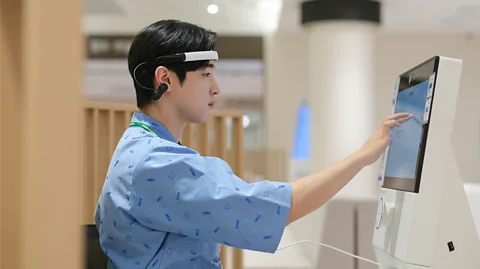
Chao recalls being a little nervous at his screening. He booked a basic package that included a blood test, chest X-ray, ultrasound and endoscopy. "The exam from start to finish took around three hours. This included being sedated for an endoscopy… I was told I couldn't eat for about four hours after the exam because they removed polyps from my stomach." His total bill? 456,706 won (£234/$312).
Even with the surprise stomach procedure, Chao describes his exam as a "smooth and comfortable experience and very foreigner friendly". Done by noon, afterwards he met with a friend in trendy neighbourhood Seongsu-dong, had a hair appointment and then ended the night with dinner in Gangnam.
 KMI Medical Institute
Nothing lost in translation
But potential language barriers and unfamiliar systems can make booking healthcare abroad confusing. Gladstone, who speaks Korean fluently, booked her comprehensive women's health panel through Himedi to help manage the logistics. Even with recommendations from friends, I had to contact the clinics and figure out how to book," she explains. "Whereas, [Himedi] already had contacts and finalised the booking for me and provided an interpreter [to clarify medical terms]."
At the clinic, she recalls, "My designated interpreter, JeeSu, found me and then things went smoothly as she escorted me from one testing room to the next. I also had a brief consultation with one of the doctors to go over any questions before starting my checkup."
More like this:
When she received her password-protected results in English by email a few weeks later, a pelvic ultrasound flagged a finding that required follow-up. Through the clinic and booking provider, Gladstone was able to ask the Korean doctor a few follow-up questions and had her results reviewed by her home doctor as well. The thoroughness and efficiency of the checkup were just as her friends had described and now she herself recommends a South Korean medical experience to other travellers.
Follow-up appointments can also be done in Korea after the exam. "If a health screening identifies a condition that requires further treatment, we refer patients to our network of affiliated tertiary hospitals and medical institutions so they can receive appropriate care," says Hyeonah Hong, Head of Division at Korea Medical Institute (KMI).
Barlow also requested a translator through Himedi and strongly recommends it for travellers. "While most of the nurses spoke basic English and the doctors I encountered all spoke fluent English, some staff did not and I ended up relying on Papago [translating app] to communicate."
But overall, "My experience [at the health centre] was very positive," states Barlow. "I will likely go back to Korea for another screen in one to two years because some of the tests showed areas that need to be monitored, and the cost and efficiency is still worth it for me despite travel and hotel costs."
--
If you liked this story, sign up for The Essential List newsletter – a handpicked selection of features, videos and can't-miss news, delivered to your inbox twice a week.
