How do heat health alerts work?

 Getty Images
Heat health alerts have been issued across all of England, with temperatures forecast to reach 39C in some areas.
The weather alert service is run jointly by the UK Health and Security Agency (UKHSA) and the Met Office.
It warns the public and medical professionals when periods of hot or cold temperatures pose a threat to health.
How does the weather health alert system work?
Heat health alerts are typically published between 1 June and 30 September, and cold health alerts are issued between 1 November and 30 March.
However, the UKHSA can issue alerts if necessary outside these core windows, , as happened in May 2026.
The system is designed to help reduce illness and deaths during periods of extreme temperatures.
As well as warning the public, the system sends guidance directly to NHS England, the government and healthcare professionals during periods of adverse weather.
Alerts are categorised according to severity and include:
- headline weather conditions expected in the coming days
- details of how weather conditions will affect each region
- links to additional information, advice and guidance
What do the alert levels mean?
The level of alert is based on Met Office forecasts and data.
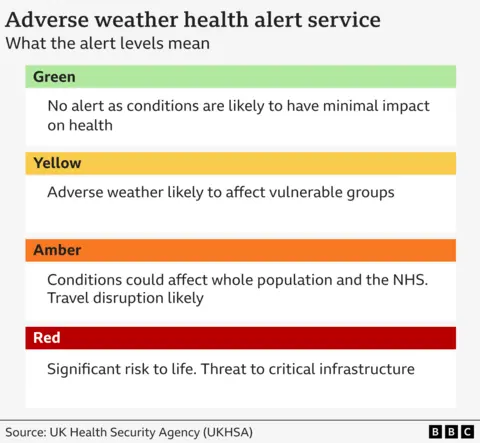
There are four levels ranging from green (least severe) to red (most severe):
Green
Green is the normal level, when advice is given on how people should prepare to respond if temperatures rise or fall.
Yellow
Yellow alerts are issued during periods of hot or cold weather that are only likely to affect those who are particularly vulnerable, for example the elderly, or those with existing health conditions.
Amber
Amber alerts are issued in situations that could potentially put the whole population at risk. The NHS may see increased demand on GPs and ambulances, for example.
Travel disruption is also likely.
Red
A red alert is the most severe.
It is issued in situations when hot or cold weather would be a significant risk to life, even for the healthy population, and could lead to failures of critical national infrastructure, such as power outages or roads and rail lines being closed.
What does hot weather do to the body?
As the body gets hotter, blood vessels open up, causing blood pressure to drop and forcing the heart to work harder at pushing blood around the body.
While vessels widen, some fluid can leak through them causing mild symptoms such as an itchy heat rash or swollen feet.
At the same time, sweating leads to the loss of fluids and salt and, crucially, the balance between them in the body changes.
This, combined with the lowered blood pressure, can lead to heat exhaustion and heatstroke.
Symptoms include:
- dizziness
- nausea
- fainting
- confusion
- muscle cramps
- headaches
- heavy sweating
- tiredness
If blood pressure drops too far, the risk of heart attacks rises.
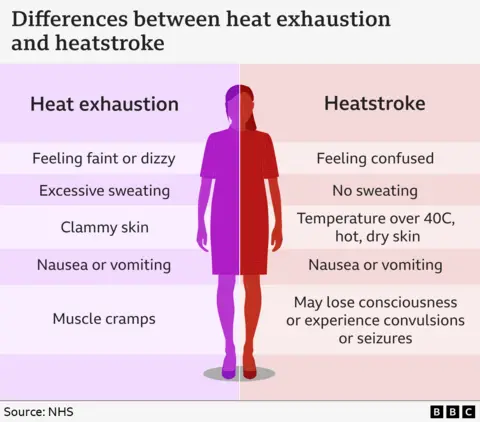
Heat exhaustion is not usually serious as long as you can cool yourself down.
But heatstroke is a medical emergency which requires immediate treatment.
Call 999 if you suspect someone has heatstroke.
