Why have so many people died in the run-up to an election in Pakistan-administered Kashmir?

 AFP via Getty Images
Naqash Zardad was simply in the wrong place at the wrong time.
The education department employee was at his buffalo farm in Rawalakot in Pakistan-administered Kashmir, when violent clashes broke out between police and protesters nearby.
With roads blocked around his farm, Zardad was unable to get home.
Then gunshots were fired.
A stray bullet hit the 30-year-old, killing him instantly, his uncle, Altaf Hussain, told the BBC.
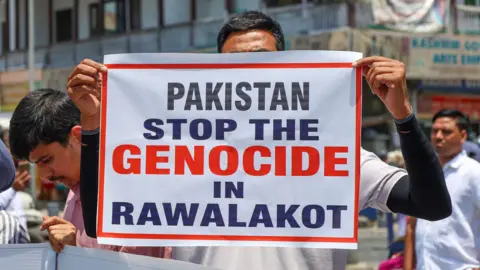
Zardad is one of at least 40 people who have been killed in the run-up to legislative elections in Pakistan-administered Kashmir. Of those, 34 were protesters. Six were police and paramilitary personnel. Rawalakot has seen some of the worst violence.
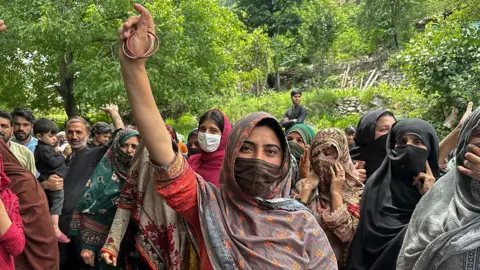
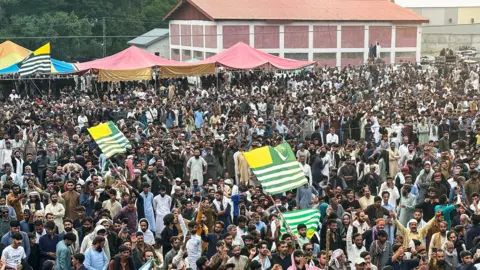
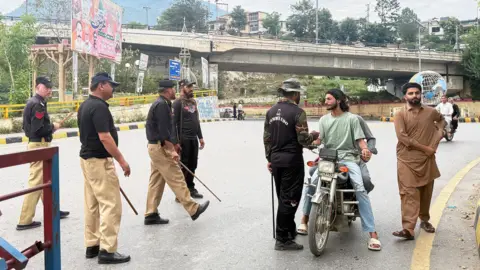
Critics have accused security forces of using excessive violence against protesters participating in long marches and demonstrations called by an alliance of activist groups - the Joint Awami Action Committee (JAAC).
JAAC has called on people to protest against the reservation of 12 legislative seats in the local assembly for refugees who migrated to Pakistan from Indian-administered Kashmir decades ago. The government responded by banning JAAC under anti-terrorism laws and launching a crackdown against protesters.
JAAC itself says it has no interest in contesting the election.
 Getty Images
The controversy over reserving seats for refugees
The reservation of these 12 seats - which make up a large chunk of the 53-member legislature - has long been a contentious issue in the region. The assembly also has 33 directly-elected seats and eight reserved for women and others.
The seats allocated for displaced Kashmiris date back to legislation introduced in the 1970sto ensure people from Indian-administered Kashmir - and who settled in Pakistan hoping one day to return to their homes if a long-standing dispute over the region was resolved - still had a say in the territory's governance.
But many of the people they are reserved for do not actually live in Pakistan-administered Kashmir, which means locals are effectively barred from contesting the seats.
JAAC has called for the abolition of the reserved seats, arguing they undermine local representation and that all the seats in the legislature should be for those who actually reside in the region.
But authorities say reservation is essential. They have also vowed that elections will go ahead - albeit in three stages, with the first phase set to get under way on 27 July.
In the last Legislative Assembly election in 2021, Imran Khan's Pakistan Tehreek-e-Insaf (PTI) won an outright majority. However it was ousted in a vote of no confidence in Pakistan's parliament in 2022, and since then the region has seen four prime ministers in as many years. The result this time is hard to call.
 Getty Images
Private rallies and public violence
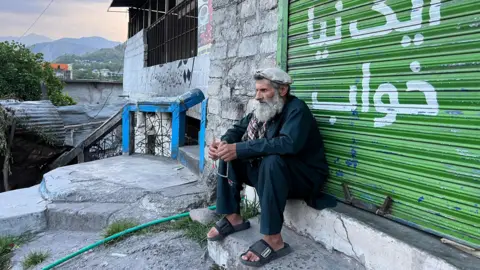
The BBC visited the state capital, Muzaffarabad, in the run-up to the election where there was a visible atmosphere of tension and fear.
Most people were unwilling to discuss the elections.
Some were afraid that expressing support for the elections or for a particular candidate would see them labelled as traitors or "facilitators" by JAAC.
Conversely, those who support JAAC were afraid of facing harassment from law enforcement and intelligence officials.
There has been violence too.
Candidates' vehicles and other property have been set on fire, while some candidates were subjected to violence. JAAC has been blamed for all these incidents.
As a result, candidates have run muted campaigns.
Political rallies have been confined to private drawing rooms or street corners, and many are not willing to comment on the current atmosphere.
Noreen Arif, the only female candidate contesting the election on behalf of the country's ruling Pakistan Muslim League-Nawaz (PML-N) party, told the BBC the protest call by JAAC had made her decide to hold political meetings at people's homes instead of in public.
Sardar Mukhtar Khan, from the opposition Pakistan People's Party (PPP), said the JAAC protest was hugely popular with the youth, which meant he also had no choice but to run a "limited campaign".
"An election candidate has to move according to the mood of the people in his constituency," he told the BBC.
 Naseer Chaudhry
Only in the last week of campaigning did the PPP and PML-N leaders hold rallies in the region, in marked contrast to previous elections.
But despite the tense atmosphere and low-key campaigning, Pakistan's minister for Kashmir Affairs, Ameer Muqam, believes going ahead with elections is the "only solution".
"Whoever people vote for should come into power and make decisions regarding their future and destiny. This authority shouldn't belong to just a few hundred or thousand people; it should rest with the millions of residents living here in Kashmir to decide who they want to bring in," he told the BBC.
But inside the region, there are some who believe this is not the time for a poll.
Zahid Amin, a former head of the Muzaffarabad Development Authority, believes even if elections were held, "they would have no credibility" given the current circumstances.
 Getty Images
Growing calls for investigations
Meanwhile, the violence in the region is causing international concern.
On 17 July, UN Human Rights chief Volker Türk called for "prompt, thorough and impartial investigations into all deaths that have occurred due to the unrest, both amongst protesters and members of security forces".
He also criticised the banning of JAAC under anti-terrorism laws, saying "the criminalisation of a civil society organisation and imposition of strict limitations on gatherings raise serious concerns about infringements on the rights to freedom of expression, peaceful assembly and association."
Pakistan's neighbour India has blamed the violence on "decades-long systemic exploitation and denial of fundamental rights".
The two nuclear-armed neighbours both claim Kashmir in its entirety although they only rule it in parts. India has also regularly accused Pakistan of sponsoring cross-border terrorism inside Indian-administered Kashmir, which Islamabad denies.
PPP chairman Bilawal Bhutto brushed off statements from India, saying he wanted to see an "amicable" resolution to the situation. He called for a truth and reconciliation commission to be set up and said both JAAC and the government were at fault, urging them to stop punishing ordinary people.
"Mobile phone and internet services remain unavailable. It has been 40 days. While I recognise that temporary restrictions may be necessary when the security situation deteriorates, no internet for 40 days in the entire region sends the impression of collective punishment," he told BBC Urdu.
Additional reporting by Roohan Ahmed
