Student spends his nights freediving to film UK's marine life
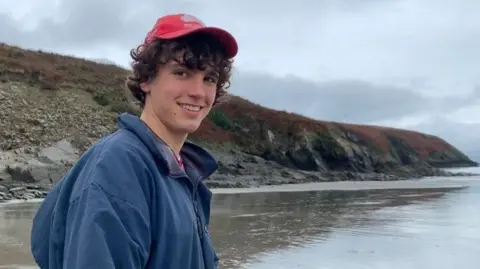
For many, the depths of the sea are a daunting and unfamiliar place - but one freediver has fallen in love with discovering the secrets of marine life after dark.
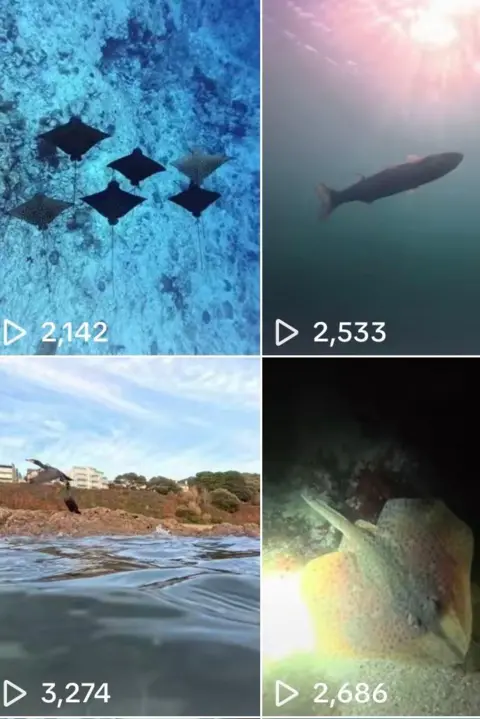
Using his TikTok account to share vibrant videos, Iestyn Morgan, 21, has left viewers in awe of the species frolicking around UK seas.
"It's not everyone's cup of tea," said Iestyn, who has become passionate about putting a spotlight on varied and often unknown species living off Wales' coast.
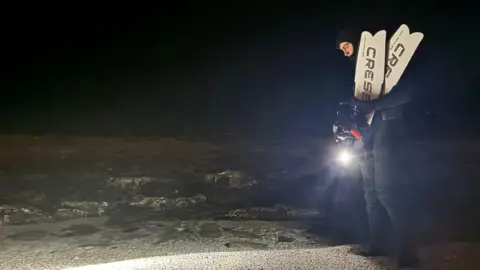
Iestyn has always loved the sea but was inspired to try out freediving after spotting a video online in April 2025: "I was like OK, I need to try this out myself. So I bought a torch and just gave it a go.
"I think the reality is, these animals are probably more scared of me than I am of them.
"It's not often they see a man bopping about in the sea with a torch."

 Iestyn Morgan
Night videos seem to be the one that people are the most drawn to, said Iestyn, from Pembrokeshire, as nocturnal species, including squid, garfish, cuttlefish, stingrays and cat sharks, come out, and are often "bolder" at night.
"People think you need to travel far abroad to experience such diversity, but you don't have to, it's right here on your doorstep.
"The coolest encounter I've had, if I had to pinpoint one, was I was out at night and saw what I thought was a school of about 50 bass and they were coming towards me.
"But as they got closer, I realised they were squid, which were attracted to my torch light. So for about a minute I had about 50 squid circling me, which was super cool
"I had no idea myself there was that much out there to see and that's what I want to showcase in my videos."
What is freediving?
Freediving is a sport where people descend underwater on a single breath of air.
According to the British Freediving Association (BFA), most divers and swimmers would have practised freediving at some time, but professional freediving requires advanced techniques and training.
It is associated with a number of serious health risks, and the BFA warns everyone to undertake a course with a qualified instructor prior to diving and to never freedive alone.
Iestyn, a final year geography student at Aberystwyth University, said he was aware of the risks involved, so always dives with someone else and doesn't swim too far out.
 Iestyn Morgan
Iestyn said he saw thousands of mauve stingers on a dive in the summer - a small but venomous jellyfish typically seen in the Mediterranean.
"I can't express how many there were. I had to get out because I couldn't see, there were so many."
He described it as a "tell-tale sign" of climate change.
Average sea temperatures around the UK and Ireland range from 6-10C (43-50F) in the winter to 15-20C (59-68F) in the summer, according to the Met Office.
But a marine heatwave in summer 2025 saw sea temperatures in parts of the UK up to 3C (37.4F) above normal at times.
Fuelled by climate change, BBC analysis found that the world's oceans broke temperature records every single day over the year of 2024.
"While it's cool for me as I get to see these cool encounters as we have new species that we wouldn't necessarily have before, it is a concern looking forward," said Iestyn.
"In my night dives I see squid all the time, obviously I haven't been doing this for years so I can't say just how common they were before.
"But the sheer amount of squid I've been seeing does suggest the warm waters are having an impact.
"Everybody is going to be affected... I don't think it's talked about enough, it's become a normality.
"I think if we can shift away from that and have discussions about how big of a problem it is, that could be really important."
 Iestyn Morgan
Amid his wondrous discoveries, Iestyn said there was "nowhere untouched" by plastic pollution.
"Every time you go to the beach you see litter, plastic, you pick it up, put it in the bin.
"It definitely makes you feel sad because, as an individual, there isn't much you can do about it.
"But I think if individuals can come together, reach out, talk about it, give it more exposure, it will get people talking, talk about protection a bit more."
