The nurse who ran into flames to rescue newborns

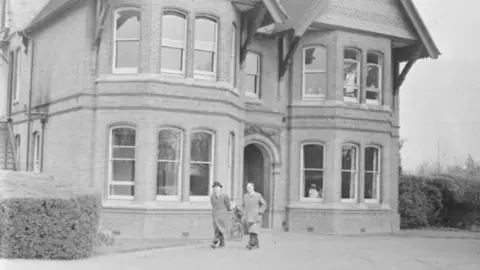 Reading Museum/Reading Borough Council
"It all happened very quickly. The fire broke out pretty quickly."
It was Easter Sunday in 1954 when a blaze started out in a maternity home in West Reading, and smoke filled a room where 15 newborn babies were sleeping.
The fire at Dellwood Maternity Home killed 13 of them, but nurse Freda Holland was able to save other newborns in the hospital after she ran into the flames.
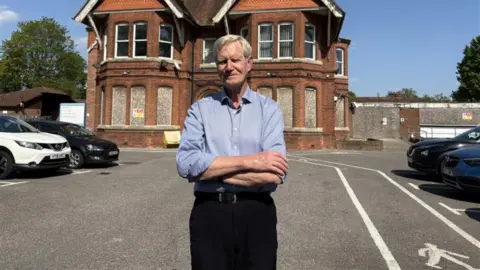
BBC Radio Berkshire's Lorin Bozkurt visited the site of the former maternity unit, where one of the darkest nights in Reading's history took place.
Tim Smith, a retired consultant and anaesthetist at the Royal Berkshire Hospital, and currently curator of the Berkshire Medical Heritage Centre, recalls the tragic events.
"All seemed well. The unit was very full, it had 15 babies, which was a large number, normally far fewer - and the babies were last checked at about 03:15," he said.
"This was on Easter Sunday morning.
"And then the next thing was that black smoke was seen billowing out of the room where they were lying."
Smith said there were two nurses on duty - Freda Holland and her colleague Sister Thomas.
"It was Sister Thomas who spotted the smoke, and it was Freda Holland who went in to rescue the babies," he said.
"It all happened very quickly. The fire broke out pretty quickly.
"She came across one baby who was burnt and then it was a matter of proceeding around the ward, passing each baby out to her colleague.
"Eventually, they all came out and she was then semi-conscious and was taken off to hospital."
Smith said the smoke was "particularly bad".
"What had happened is the flues from the boiler had, over several months apparently, been heating up the floor beneath the nursery," he said.
"So it was tender dry and then reached a point where the fire broke out and then it ignited the linoleum, which produced horrible, thick, black smoke.
"So that was the main problem."
Smith said the first baby Holland came across had already died because of the fire, "but the rest succumbed because of the thick, black inhalation of this smoke".
He said Holland was taken to hospital by the doctor in charge of the unit.
"She had burns of the arms and face, not needing skin grafting. Some reports said she needed skin grafting, but that wasn't true," said Smith.
He added that it was two days before she regained consciousness.
Smith said when Holland was in hospital, some of the parents sent her flowers, which he described as "an extraordinary thing".
"It was after the war, and people were sort of used to death and destruction on that sort of scale and helping each other, and everyone pulled together," he explained.
"One of the two who survived is a man called Paul Darling, and he was amongst those at the funeral of his rescuer when she died in 2009.
"He apparently had met her once or twice since he was born, but he was by then 55 and had a family of his own."
'Very, very brave'
Smith said he did not know Holland very well, but was at one time in the same yoga class as her.
"She was by then in her 80s, and I tried to question her in a sensitive sort of way, but she said, 'oh no, I don't like to talk about it anymore'.
"She said it's something anyone would have done, but it clearly wasn't.
"She was a very, very brave person."
Holland, who received the George Medal for her bravery, will be remembered in a plaque as part of a redevelopment of the building.
Smith said: "The scale of it I think was so awful and the thought of those poor mothers with their baby clothes leaving the hospital empty-handed... so she should be remembered.
"It was an amazing thing that she did."
