Welsh laser firm 'over the moon' to play a part in Artemis II space mission

 NASA
NASAStaff at a Welsh laser company are "over the moon" after their technology was used in the Artemis II space mission.
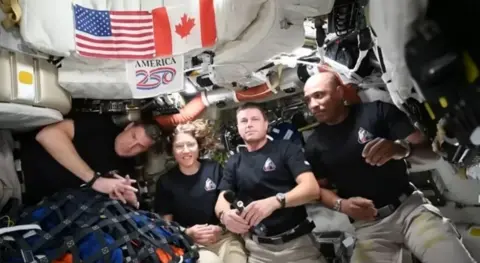
The four astronauts on board the Orion spacecraft achieved a historic lunar flyby that saw them travel further from Earth than any other humans.
It also represented a small step for the Welsh space industry, and a giant leap for Bridgend-based Spectrum Technologies.
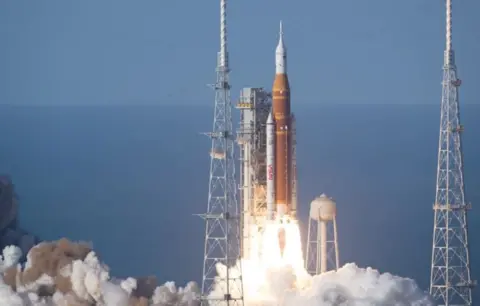
Machines designed and built in Wales were used on the 20 miles (32km) of complex wiring on the mission's Orion space capsule.
"It's incredibly exciting - hopefully it'll be used on many more projects in the future," said company chairman Dr Peter Dickinson.
The four astronauts on board have now completed their mission around the Moon and are expected to splash down off the coast of San Diego on around 20:00 Friday US EST (01:00 BST Saturday).
Involvement in the mission is just the start for Dr Dickinson and the team, and they hope to boldly go where no Welsh engineers have gone before.
The company is also working with Elon Musk's SpaceX company preparing the wiring for craft to go into space.
 NASA
NASASpace is becoming big business in Wales.
Dr Rosie Cane is from Space Wales, the trade association for the space sector, and she said: "We'll see a lot more international collaboration.
"It's easy to forget with NASA missions, people think it's just a US mission but actually it's international.
"There are companies in Wales taking part in that - supplying parts and components and supporting that mission.
"Wales will see more recognition - we have Wales' first satellite in orbit at the moment which was launched in June last year by Space Forge, which is based in Cardiff."
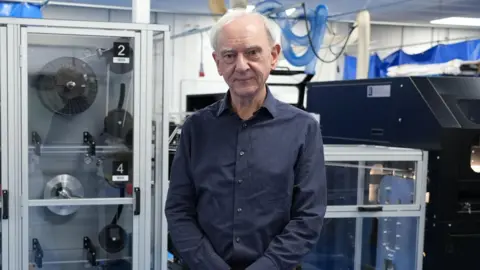
Spectrum Technologies' machines use lasers to print numbers and letters on to the wires used in spacecraft.
For the Artemis II mission, these were printed on to the wiring inside the Orion space capsule.
"All the wires are basically white, there are too many to colour code, so therefore each wire has a unique alpha-numeric identity code printed on it," Dr Dickinson added.
A love of space begun when he was a boy, and he cited the 1969 Moon landing as an inspiration.
He said: "As a 15-year-old teenager I was absolutely riveted by the Apollo programme and watched the Moon landing at half past three in the morning - it put shivers up your back.
"That was a once in a lifetime, really quite amazing."
Rhys Roberts has worked at the company for more than 30 years, and built the software that controls the laser.
"It's a pride - you don't realise the impact of what we're doing in the aerospace industry - but now with Artemis II it's a real pride," he said.
Last year the UK Space Agency said the Welsh space sector contributed £345 million to the economy.
It provided more than 1,700 jobs across more than 100 organisations.
