Muck-spreading: The smellier the better as farmers ask for patience

 BBC
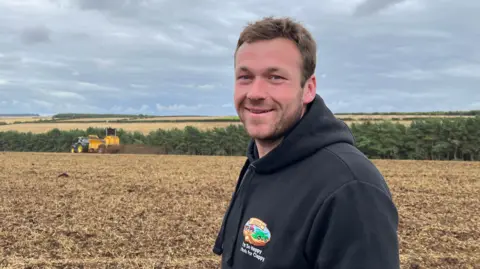
BBCFarmers are asking people to be patient with the smell of manure as they spread it on their fields to prepare the land for next year's crops.
Muck-spreading is the process of distributing animal manure across farmland as a natural fertiliser and typically takes place twice a year, in spring and late summer.
Although "it might smell a bit", according to farmer Ben Clappison, from Cowlam, East Yorkshire, he says it is important as it helps improve the land and reduces the amount of chemical fertilisers.
He says: "[It helps] to make everything a lot healthier and improve soil organic matter and really push towards more organic fertilisers rather than inorganic."
Ben adds: "Our inorganics are manufactured fertilisers and a lot of raw products come from abroad. There's a lot of mileage on it, a lot of CO2 emitted in manufacturing it and it's expensive. Whereas this is coming out of the farm where it's produced."
Ben, who also spreads on other farmland as a contractor, says the process is carefully mapped out using the latest technology.
Manure from cattle, pigs and poultry is scooped from heaps in the fields and carefully weighed to be spread evenly.
Ben also uses human waste, known as sludge and taken from sewage works, to enrich the soil.
However, there are strict rules that farmers must follow when spreading sludge and Ben says he uses GPS to ensure it is only placed in the correct areas.
According to DEFRA, it can only be spread on crops that cannot be eaten directly from the land, such as wheat, barley and oil seed rape.
"We have a spreading app which has everything mapped out and all of the buffer zones and strips where you can't go anywhere near.
"We have to look after the fields, the soils, the environment because it has to be sustainable for not just my generation but generations to come."
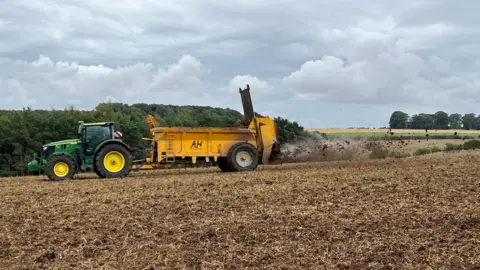
The process can generate complaints from residents because of strong odours, although farmers say the smell is short-lived and an unavoidable part of food production.
Those unhappy with the smell can complain to the Environment Agency or their local authority.
However, as a rule, East Riding of Yorkshire Council says it is only likely to investigate if the smell is "particularly excessive or prolonged", adding "spreading manure on farmland is recognised as standard agricultural practice and odour can be expected from time to time".
The process, which takes place after a harvest, is seen as the first step in preparing the land for the next crop.
Angela Kirkwood, of the National Farmers' Union, says a strong smell is a sign of healthy soil.
"What we're trying to do is make the weeds grow so that we can get rid of those weeds but also incorporate that nutrient back into the soils to make the soil really good and healthy.
"We have a lot of soil testing that we do in order to look at what nutrients are already there and how we can improve the nutrients to make our crops grow and to make sure that we can continue producing food for everybody," she says.
"People just think of it as being a stinky process. And all farmers live it as well. Actually, the stinkier the muck, the better it is for the soil."
Angela advises residents to close their windows if they see muck-spreading taking place and not to put any washing out.
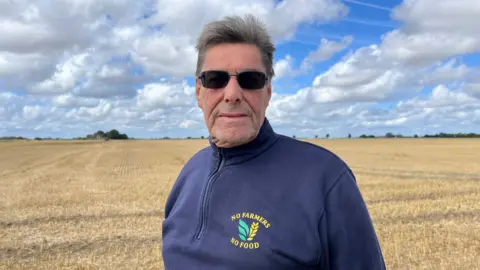
Although the smell cannot be helped, farmers say they do understand the complaints.
On Sunk Island in rural Holderness, arable farmer Jono Dixon says he is careful to reduce the impact of spreading chicken muck on his land near Patrington Haven Leisure Park.
He says: "We have the anxiety of spreading it because we know we're going to get the odd complaint, here there and everywhere, or from everybody.
"But this is a quick operation. We've seen in the other field, over there, where within 12 hours the lads are in behind ploughing all the chicken manure in.
"We are trying to do the best we can to not inconvenience people with what can be described as one hell of an odour."
Listen to highlights fromHull and East Yorkshire on BBC Sounds, watch the latest episode of Look North.
Download the BBC News app from the App Storefor iPhone and iPad orGoogle Play for Android devices
