What time can I watch the solar eclipse in Wales?

 Getty Images
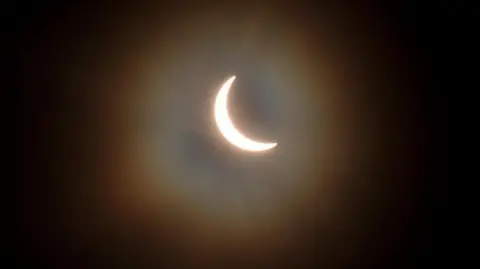
Skygazers are set to witness a partial solar eclipse - the most dramatic in nearly three decades - on Wednesday.
The rare celestial event will be visible from Wales, with more than 90% of the Sun obscured by the Moon during the early evening.
It will be the largest solar eclipse visible until September 2090.
The event will begin at approximately 18:10 BST, although timings will vary depending on location.
While the UK will miss out on a total eclipse, astronomers say this will be the most impressive solar eclipse visible from Britain since the much-remembered event of August 1999.
What is a solar eclipse?
 Getty Images
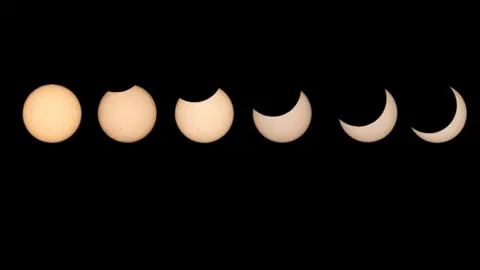
A solar eclipse happens when the Moon moves between the Sun and Earth, blocking the Sun's light either partially or fully when viewed.
Although the UK will see a partial solar eclipse, other countries, such as parts of Spain and Portugal, will enjoy the spectacle of a total eclipse.
Where can I watch the solar eclipse?
Wales is among the best places in the UK to watch the solar eclipse on Wednesday, with the celestial event seen between 18:17 and 20:06.
Because the eclipse takes place during the evening, a clear view of the western horizon will be key.
Pembrokeshire is expected to see between 94% and 96% of the Sun covered, according to the Met Office, with Strumble Head being ranked second in the UK as one of the best individual viewing locations.
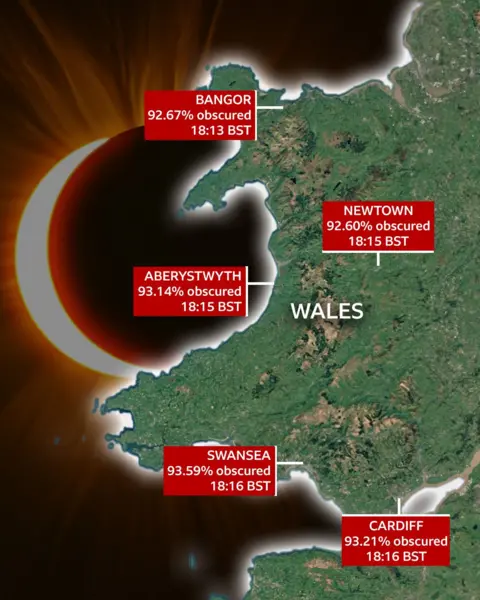
The rest of Wales can expect to see 92% to 94% solar coverage.
Rhossili Bay on Gower, south Wales, has also been named a top spot, and in Cardiff 93.24% of the Sun will be covered by the Moon. The eclipse is forecast to peak in the capital at 19.13.
Mid Wales is also likely to offer some of the clearest views, with Craig Goch Dam in the Elan Valley highlighted as another prime spot in Wales, as it offers wide views of the surrounding landscape and sky.
Gower Peninsula, Swansea, and Rest Bay Beach in Porthcawl are also among the top locations to spot the eclipse.
For most people in the path of the total eclipse, the Sun will be hidden for less than two minutes.
Why can't I look at the eclipse?
Astronomers have warned people never to look directly at the Sun during a partial eclipse.
Even when most of the star is covered, the visible section remains bright enough to cause damage to the eye.
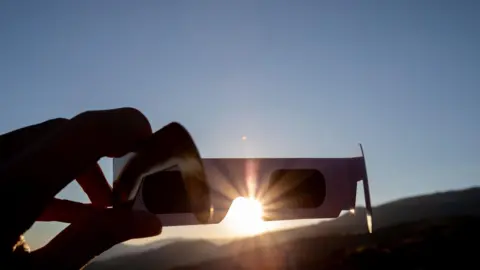
You can use special eclipse glasses to look at the eclipse. It is not safe to just view it through sunglasses, or binoculars or a telescope.
 Getty Images
If you do not have a pair of eclipse glasses you will need to follow the eclipse indirectly using a pinhole projector.
You can make a simple one with a single sheet of card or something more ambitious using a cardboard box - or you can use a colander to project multiple images all at once.
Further information can be found here.
