Thousands of offenders not wearing electronic tags, report says

 BBC
BBCAlmost 9,000 people in England and Wales required to have an electronic monitoring tag did not have one, a report by the National Audit Office (NAO) has found.
They are likely to include violent offenders and prisoners released from jail who need to be checked on.
The NAO said, as of March 2026, prison authorities were reviewing around 8,900 cases of individuals recorded as having an active monitoring order but no tag.
However, the Ministry of Justice has disputed the figure, saying its own review puts the number of unmonitored individuals at 5,450.
It said the NAO figure referred to the total number of cases they are checking to see if they need monitoring.
The NAO called the current system "inefficient".
Electronic monitoring, also known as tagging, is used in England and Wales as a way of monitoring curfews and conditions of a court or prison order.
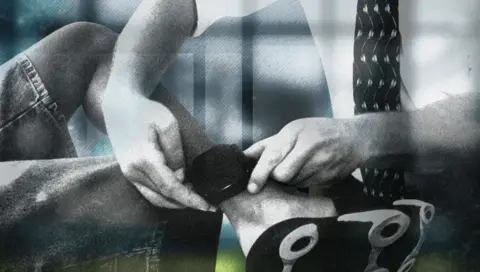
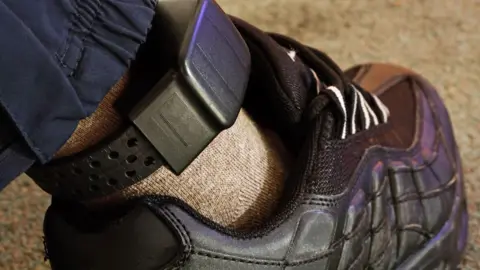
Criminals and people deemed to pose a potential risk are sometimes fitted with an ankle tag so that their movements can be monitored. These individuals can include serious offenders such as rapists and murderers.
There are three types of tags: curfew tags, location tags, and alcohol tags.
A total of 28,700 people were recorded as being tagged in England and Wales as of March 2026.
The NAO said some of the 8,900 cases in its report would include people who were registered as being tagged by mistake.
But it also said the real number of those slipping through the system could be "significant".
 Getty Images
People can be identified as being "unmonitored" for a number of reasons. These can include errors in the system, refusal to wear a tag, a delay in the fitting of the tag, or an arrest where the tag is removed.
But it can also include people who haven't been tagged when they should have been.
Responding to the NAO's report, the Ministry of Justice said: "Public protection is our priority, which is why we're investing £100m in electronic monitoring, tagging offenders before release for the first time and strengthening victim protections via new alert systems – all of which will help cut the number of unmonitored offenders."
The National Audit Office argues the current monitoring system is not fit for purpose.
"Electronic monitoring is central to managing pressures on prisons, but it is not working effectively, creating risks to public protection," NAO chief Gareth Davies said.
"Improvements are required to ensure that those who should be monitored are monitored and that breaches are responded to effectively," he added.
The report also says police and probation staff often lack information or capacity to respond quickly to breaches.
People tagged are placed under strict conditions as part of their punishment.
This can include having to remain in a specific area or sticking to a curfew. If someone breaches their conditions, it can result in a formal warning, being taken back to court, or an immediate return to prison.
Earlier this year, the Ministry of Justice announced plans to significantly expand electronic monitoring as part of the Sentencing Act 2026, which aims to ease prison pressures by managing more offenders in the community.
Thousands more prisoners may be released early from autumn this year as part of the new law. Reports suggest killers, rapists and sex offenders could be among them. Most will require tagging.
Several probation officers have told the BBC they are worried about how they will cope.
Probation officers are responsible for checking offenders are following the terms of their release from prison. This could include things such as wearing ankle tags or not taking drugs.
"The report makes clear we're overworked. And it's only going to get worse with more people set to do their punishment in the community," one probation officer said.
"There aren't enough of us, and we have no idea how the government is going to make it work so that nobody is at risk. Because something bad will happen, someone who is dangerous and isn't monitored will kill someone," the probation officer added.
The NAO says that part of the problem is a shortfall of around 2,200 full time probation officers, which the government expects to reduce to around 1,500 by September of this year.
The watchdog also says even though the security contractor Serco - which manages the tagging system for the government - met its 95% timeliness target for tag fitting visits, "it was only successful in fitting tags on 62% of the individuals it visited within its two attempts".
In a statement, Serco told the BBC it had made "significant improvements" and was "tagging a record number of people" and "consistently" meeting key contractual measures, as recognised by the Ministry of Justice and NAO report.
It added that efforts to fit tags "rely on us receiving the correct information" from relevant authorities and partners.
"We attempt to fit a tag to every person who should be wearing one. Where, for reasons beyond our control, we are unable to do so, we report those breaches to the relevant authorities."
The NAO is calling on the government to improve data quality and management of the monitoring system.
It added the government had been working with Serco to improve performance and reduce the backlog in fitting tags.
Ministers estimate a further 22,000 people per year will need to be tagged from 2027.
"The government needs to improve the service's resilience and efficiency, otherwise expanding electronic monitoring risks wasting public money and puts public safety at risk", said Sir Geoffrey Clifton-Brown, chair of the Committee of Public Accounts.
The Ministry of Justice said the government inherited "a failing tagging system with record backlogs".
"As this report shows we have worked hard to fix this, with install rates up by nearly 50% since 2024," it said.
"This is in addition to our record £700m investment in probation, recruiting 2,300 trainee probation officers over the last two years, and recruiting a further 1,300 this year - making sure the Probation Service has the resource it needs to keep dangerous offenders under closer surveillance than ever before."
