Should seasonal dog bans be enforced on beaches?

 BBC
BBCIt is postcard-perfect May weather in Scarborough and among the most enthusiastic beachgoers are dogs, who do not think twice about plunging into the North Sea.
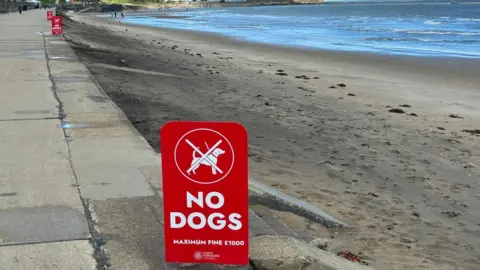
Spaced at intervals along North Bay promenade, which hugs the coastline, are bright red signs warning dog owners this part of the beach is a canine-free zone during the summer season.
From 1 May to 30 September, stretches of North Yorkshire's beaches, including Scarborough, Whitby and Filey, enforce seasonal dog control restrictions.
Although sections of the beach are still accessible, fines of up to £100 can be issued by North Yorkshire Council to those straying into restricted areas.
Further fines can be enforced for dog fouling and other offences, and the maximum amount can reach £1,000.
The council's view is that the ban offers "a balanced approach that supports responsible ownership while still providing plenty of opportunities for dog walking", according to councillor Richard Foster, executive member for managing our environment.
"Beaches and coastal areas are also home to sensitive habitats and limiting dog access in key locations between May and September helps reduce disturbance and supports conservation efforts," he said.
However, with an estimated 15.5m dogs now living in UK households, some have argued it works against residents and visitors to the coast.
Caroline Buchanan and beagles Bertie, Worcester and Penny are stretching their legs on the dog-permitted section of the beach.
"I think it's kind of fair," she says about the ban.
"Sometimes people don't pick up poo and if people want to keep their children safe, I understand it for that reason."
There's plenty of beach left for dog owners, she adds, and besides: "I couldn't let these dogs off, they'd be eating people's picnics."
The beagle trio neither confirm nor deny the allegations.
Along the same stretch of sand, Angie Rigle is throwing a ball for cavapoo Misty.
For her, visiting from Skegness, humans rather than dogs pose the greater problem.
"When you go on the beach at the height of the season when everybody's left, it's not dog faeces that you see, it's litter," she explains.
"But I agree not all dog owners are responsible, same as not all holidaymakers leave rubbish."

North Yorkshire Council has conducted several public consultations about the restrictions, which are renewed every three years.
Scarborough resident Barbara Skelton can be counted among those in agreement with the seasonal ban.
"I don't think there's anything wrong with how it is now," she says.
"It's a difficult one because it's down to the owner but I think they [dogs] should be restricted."
Suzanne Bishop runs The Doggy Den, a canine daycare and boarding business in Scarborough.
As a Filey resident, which is also subject to restrictions, she feels the ban is "very unfair".
"While I understand the need for a dog-free area for picnics, I really do not understand why this must be for the entire day, seven days a week," she says.
"It does feel unfair that dog owners are forced to walk the ends of the beach as soon as the weather starts to warm up."

A compromise would be to have central beach areas dog-free between certain hours, she suggests.
"That would allow everyone the opportunity to enjoy the entire beach during the best months of the year."
Further up the North Sea coast, South Tyneside Council have introduced a time restriction, rather than an overall ban.
Beaches such as Sandhaven in South Shields do not permit dogs on the beach between 08:00 and 18:00 BST.
A South Tyneside Council spokesperson said the approach "helps balance the needs of residents and visitors, supports responsible dog ownership and allows for shared use of the coastline throughout the year."

North Yorkshire councillor Foster said restricting access only during peak tourist hours "would make the rules harder to understand and enforce, risk confusion and increase the chance of breaches and conflict between beach users".
"We believe that by keeping the rules simple and consistent, we can support responsible use and protect the enjoyment of our coastline for all," he added.
At Scarborough South Bay, nestled into a row of shops connected to the theatre, Ruth Bagley runs the Spa Emporium.
The shop sells a range of dog accessories among its traditional fare of ice cream and souvenirs.
"I think [the ban] is quite valid," she says.
"When my children were younger, it was safer for them to play on the beach where there was no risk of any dog waste."
The designated dog area serves two purposes, she adds, keeping both people and dogs safe, as the "noise pollution" in busier areas can be "quite extreme".
"I think it's actually a good thing to keep dogs to the quieter areas because you've got to protect the dogs as well," she says.

Climbing sharply away from the seafront, Scarborough town centre is bustling with activity.
Lurcher cross Ben has just been bought a harness by new owners Peter Barr and Vivian MacPherson.
They're in favour of Ben and his four-legged peers being kept to certain areas during the summer months.
"We think it's valid, with the amount of people that come here and congregate towards the north end of South Bay, where all the shops are," Peter says.
"We don't have children but I think children should be allowed to enjoy the beach and not worry about dogs running around or bothering them," Vivian adds.
Oblivious to the entire debate, Ben wags his tail - hoping perhaps, for a head scratch and a treat.
Listen to highlights from North Yorkshire on BBC Sounds, catch up with the latest episode of Look North.
