'I thought it was love - until I feared for my life'

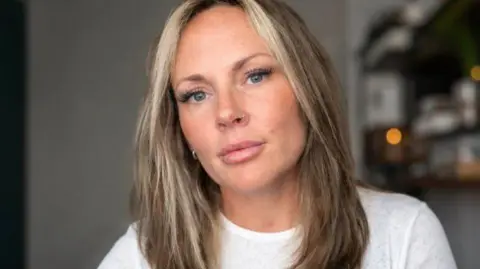 Lucy Winter
A "strong and confident" woman said she was tormented and abused by her ex-partner for two years before he stamped on her head and beat her with a banister pole, leaving her covered in blood.
Lucy Winter, 41, from Bristol, said the relationship saw her isolated by her ex, who was eventually jailed for the attack.
On average, one woman is killed by an abusive partner or ex every five days in England and Wales, according to research from Refuge.
A spokesperson for the government said it was "treating violence against women and girls as a national emergency".
Winter has written a book called Tough Love, sharing her account of what happened during the abusive relationship.
She described herself as a confident person and said domestic abuse could "happen to anyone".
Winter met her ex-partner online when she was 33 and said she said she noticed "red flags" early on but "chose to ignore them".
During their relationship she said it was the constant rejection from him that held the strongest "power" over her.
"It kind of pulled you back in every time," she said.
"He made unhinged accusations - that I was cheating, talking to other people online, looking at other men.
"If I was on WhatsApp to my sister he would make me prove it.
"My behaviour was being checked all the time."
Winter said she was still processing why she stayed.
"I had a lot of trauma when I was a child and I think that had a part to play in it," she said.
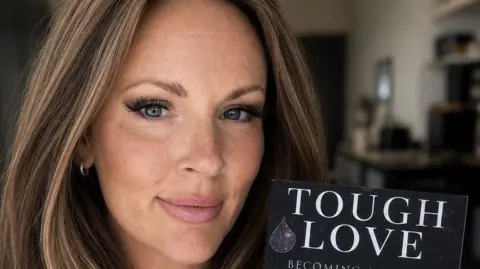 Lucy Winter
In her book, Winter said her partner would use strangulation and suffocation before the final attack.
"I ended up in hospital for four days with concussion and eight stitches in my head," she said.
"I never quite recovered from the trauma of that. It changes you as a person."
Her ex has since been released from prison.
"I refuse to let that fear control me anymore," she said.
"The reason I've written the book - it's not for justice or revenge - it's about the awareness around domestic violence.
"I'm a really strong, confident woman and if it can happen to me it can happen to anyone."
Why younger people are at higher risk of abuse
According to the Office for National Statistics, nearly four million people aged 16 years and over experienced domestic abuse in the year ending March 2025.
The Crime Survey for England and Wales also estimated that 2.2 million females and 1.5 million males experienced domestic abuse in the past year.
The Make it Mandatory campaign, which lobbies for compulsory Relationships and Sex Education (RSE) up to the age of 18, highlighted that 16 to 19 year olds faced the highest rates of domestic abuse of any age group in Britain.
Make It Mandatory co-founder Ithar Ghalifa said this was often when young people were experiencing their first serious relationships but were not necessarily "equipped enough to recognise healthy and unhealthy and coercive behaviour".
She said: "Make It Mandatory calls on the government to take preventative measures through mandating RSE education to better equip young people with the knowledge and understanding which aims to break the cycle of abuse."
What the government is doing
"We are treating violence against women and girls as a national emergency with a clear commitment to halve it in the next decade," the government has said.
"That's why we have announced almost £500m to help councils provide support in safe accommodation for survivors, including refuges and Sanctuary Schemes, so they can get the safety and stability they deserve."
Where can you get help and support?
Winter said it was important for those suffering domestic abuse to reach out to someone trustworthy.
She also highlighted the need for friends to not always jump to making someone leave their partner but to instead be a "safe place" or person in times of crisis.
"It's better to say I can't support the relationship but I can support you," she said.
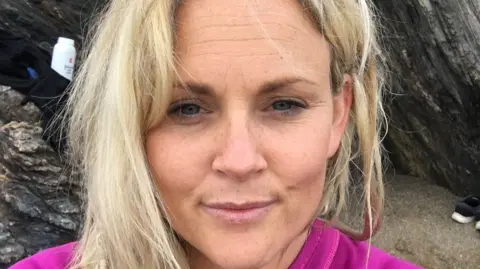 Lucy Winter
Avon and Somerset Police said domestic abuse was not always physical and explained that coercive and controlling behaviour could be "subtle, cumulative and often hidden behind claims of care or protection".
A police spokesperson said: "Perpetrators may isolate victims from family and friends, monitor communications, control finances and create dependence.
"We know the risk often increases when a survivor tries to leave, which is why access to specialist support and safety planning is so important.
"As a force we are working hard to improve our response to domestic abuse.
"We have a leading initiative in Project Bright Light in which we are transforming and improving our response to domestic abuse."
- Details of help and support are available at BBC Action Line.
Follow BBC Bristol on Facebook, X and Instagram. Send your story ideas to us on email or via WhatsApp on 0800 313 4630.
