Two protests, two elections: How Nepal's Gen Z succeeded where Bangladesh's stumbled

 Getty Images
Last month, as Nepal inaugurated its new prime minister Balendra Shah, along with a parliament stacked with youthful lawmakers, Bangladeshi activist Umama Fatema felt a pang of disappointment as she watched from afar.
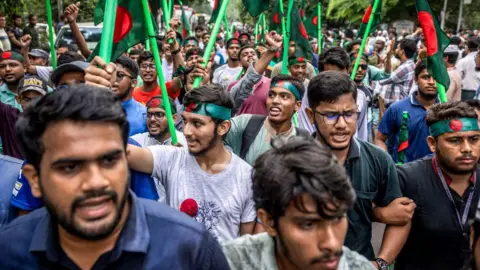
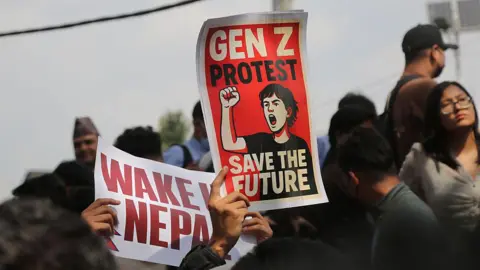
Fatema was among the thousands of Gen Z protesters in Bangladesh who took to the streets in 2024. Like their Nepalese counterparts, they brought down their government in explosive demonstrations.
But nearly two years on, Bangladesh's youth movement has yet to gain any meaningful political power. In the country's first post-protest elections held in February, the established Bangladesh Nationalist Party (BNP) won a historic majority while the new youth-led National Citizens' Party (NCP) - which grew out of the student revolution - did dismally.
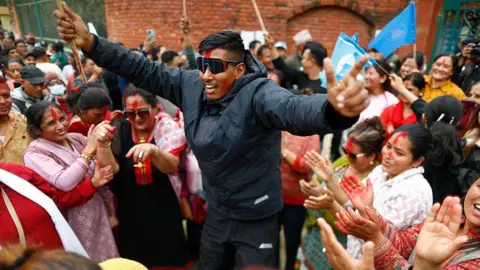
It stands in marked contrast to Nepal, which just a month later held a historic election where the four-year-old Rastriya Swatantra Party (RSP) won by a landslide. The victory sent scores of Gen Z politicians to parliament and made former rapper Shah, who made an alliance with the RSP, the leader of Nepal.
It is a rare success story in Asia, which has seen numerous Gen Z protest movements in recent years but none resulting in young protesters gaining power the way Nepal's youth have.
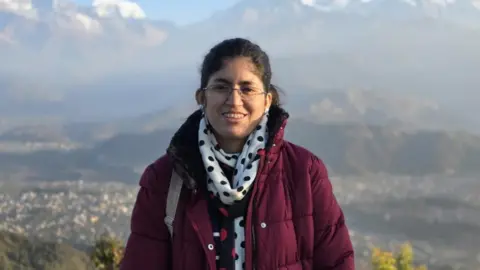
"Personally, I felt disheartened. When I saw how effectively [the Nepalese youth] were able to organise themselves, I could not help but feel disappointed about the situation in our own country," said Fatema.
"Bangladesh has not been able to deliver a such a change… it is naturally disheartening to realise that we have not been able to organise and rebuild our country in the same way."
So why did the youth triumph in one country but fall so short in another?
Nepalese youth leaders have attributed their victory to their movement's ability to resonate with ordinary citizens.
The Gen Z protests "tapped into a deep, long-standing frustration with the way things have been run", said KP Khanal, who was fielded by the RSP and won a seat in the Kailali district. "At the same time, the sacrifices and voices of Gen Z stayed with the public - they haven't been forgotten.
"Consistency was also a key factor. We kept raising our voices around accountability and justice, over and over, and gradually that message reached far and wide. It stopped being just a reaction [to the status quo] and started to feel like a genuine, credible movement that people believed in and wanted to be part of."
But analysts have also pointed to the unique political landscape of Nepal and canny decisions by the youth movement.
With an electoral system designed to favour coalition governments, no single party has ruled Nepal by majority in years.
The country cycled through 14 governments in 17 years, dominated by the shifting alliances of a few established parties and a handful of politicians taking turns to helm Nepal in what critics deemed to be political musical chairs.
The public's seething anger over corruption, as exemplified in the Gen Z protests, was thus directed at the establishment, making the RSP - a relative newcomer - seem more attractive.
"In Nepal's case, since all three established parties, none dominant, were discredited, the main beneficiary has been the youthful RSP and its leader," noted Professor Nitasha Kaul, the director of the Centre for the Study of Democracy at the University of Westminster.
 Reuters
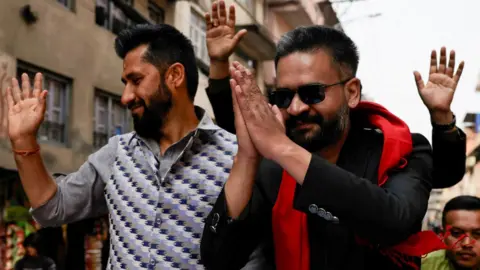
The alliance between Balendra Shah and the RSP, and the decision by many youth activists and protest leaders to join the party, aided their success as the RSP provided the resources and wide reach for an electoral campaign.
Arguably, the alliance also helped the RSP, the leader of which - Rabi Lamichhane - had been accused of embezzlement. The party appeared to overcome this controversy by joining hands with Shah, a charismatic politician around whom voters could rally, but who had no organised party structure to rely on.
"In a larger South Asian context, where party organisation is extremely important, a youth-led party would likely have to build an extensive party structure before it could achieve widespread electoral success, especially in its first outing," said Nepalese political analyst Amish Mulmi.
This was exactly what youth activist Purushottam Suprabhat Yadav had in mind when he was asked by friends to join them in starting a new party following the Gen Z protests last year.
Yadav said no. "Winning an election is not a joke. Organising a movement and emerging victorious in an election are two different things," he told the BBC.
"A political party cannot be formed out of nowhere… you require a very big machinery. There were also problems of finance and organisation-building, which was not easily available to us at that time."
Instead, the 27-year-old decided to join the RSP in December. He saw it as a credible alternative to the established parties, one that had a wide organisational network across the country and many new faces in its political roster.
It was a decision that paid off. Last week, Yadav was sworn into parliament as one of the RSP's lawmakers on its proportional representation list.
 Bijay Gajmer
Kaul noted that winning elections requires long-term mobilising work.
"A movement that is driven primarily by passion, frustration, anger, or the politics of purity may be better at challenging the status quo - but not necessarily at winning elections," she said.
In South Asia in particular, a culture of deference, traditional social norms and gender hierarchy often prevent youth movements from succeeding. But Nepal was a "good example of success", she said.
"A youth movement will be more effective when internal divisions are minimal, there is ideological plurality without antagonism, and there are few established parties that can easily hijack the movement's results."
Some analysts believe these crucial factors were missing in Bangladesh's case.
Until it was deposed by the Gen Z movement, the authoritarian Awami League had dominated politics in Bangladesh for years.
This meant that the "second and third parties were seen as 'victims'," said Kaul, noting that the BNP and the Islamist party Jamaat-e-Islami ended up "reaping the benefits of anti-establishment sentiment" in the elections.
These parties touted themselves as reform-minded and associated closely with the youth movement, and thus "were often better able to absorb and channel the energy of the protests than the newer youth-led organisations themselves", noted Dr Imran Ahmed, a research fellow at the Institute of South Asian Studies at the National University of Singapore.
The decision by the NCP to join a coalition led by the controversial and conservative Jamaat-e-Islami was particularly disastrous, alienating its core youth supporters - particularly women. In the end, the NCP won just six out of the 30 seats it contested.
"By aligning with a regressive force in Bangladesh, the NCP became more about political power than about the Gen Z cause", squandering their "golden chance" to appeal to more voters, said Dr Rishi Gupta, assistant director of the Asia Society Policy Institute in Delhi.
Timing mattered as well. Gupta pointed out that the youth movement's momentum could have been sapped in the one and a half year gap between Bangladesh's Gen Z protests and elections. Nepal, in contrast, took only six months to hold its elections.
 AFP via Getty Images
What the Bangladesh protesters succeeded in doing was moving the needle.
The demonstrations "reshaped national discourse", noted Ahmed, by focusing the conversation on the need for reforms. It led to a referendum, held alongside the election, where most people voted for sweeping changes to the constitution, parliament and legal system.
The new BNP government also outlined a 31-point plan for structural reforms. But some remain sceptical.
"In many ways, they have followed the same conventional pattern of programmes that the Awami League used to undertake," said Fatema, adding that the new government needed to focus more on improving job and economic opportunities for Bangladesh's youth.
A sense of disillusionment has settled in among Bangladesh's youth, with many now looking to leave for better work opportunities overseas, she said. Many are also disenchanted with politics following the elections.
"The tendency among young people to look abroad has grown to an alarming level… even those who once intended to remain in the country are no longer thinking that way.
"With young people no longer seeing their future within this country, how will they find a place for themselves within the political landscape? It has become a major problem," she said.
 Usama Noor Safkat
Some, however, hope that the NCP will rejuvenate the youth movement by building on its small foothold in parliament and rehabilitating its image.
The party is fielding candidates for the upcoming local city elections without any coalition partner. Since it is contesting on its own, "I think the people will accept the party more than they did in the national elections", said Rahat Hossain, a Gen Z protester who is now a local NCP leader.
"If the NCP continues to stand with the people on the streets, fighting alongside them and upholding its promises, then it can achieve better outcomes in the future."
One goal remains clear for the young protesters of both Nepal and Bangladesh - they will not stop fighting for change.
For the new Gen Z lawmakers of Nepal, they vow to hold their new government accountable to an electorate with huge expectations and hungry for change.
"We are now entering parliament from the streets - our place [in society] has changed, but not our agenda," said Yadav.
"Anti-corruption and an end to appointments on the basis of political affiliation and nepotism are our key demands. If we have to fight against our own party regarding this, we will do so."
And if Bangladesh's new government does not uphold the results of the referendum, "then we will, if necessary, return to the streets in protest", warned Hossain.
This time they may not be alone. "Those who are 10 years younger than us will eventually organise movements of their own," said Fatema.
"The next phase [of protests in Bangladesh] will likely be led by Generation Alpha."
 Getty Images