What to know as Trump visits Xi in China

 EPA
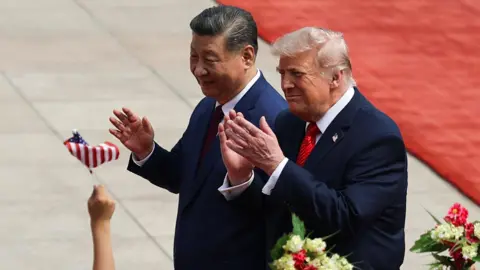
EPAUS President Donald Trump is in Beijing on the first trip to China by an American leader since his own previous visit, during his first term in 2017.
He was given a spectacular welcome at the Great Hall of the People. The two leaders shook hands on the red carpet before entering a room for their bilateral meeting.
The talks lasted around two hours, longer than expected. Trump called the talks "great", but there are few details on whether any progress was made on key issues.
The trip was originally meant to be held in March but rescheduled after the US and Israel launched attacks on Iran.
Why has Trump gone to China?
The main focus of the talks is expected to be the current tense trade relationship between the two superpowers.
Trump said he would ask Xi to "open up" China's economy to major tech companies.
He added that he also expected a "long talk" about Iran, though he insisted he did not need China's help to end the conflict.
He said Xi had been "relatively good" on Iran, adding that it would be an "exciting trip" and "a lot of good things are going to happen".
Xi meanwhile is expected to press for an end to US arms sales to Taiwan, and an extension of the trade truce agreed in October that halted tariff escalation between the US and China.
Commentary in Chinese media also suggested Beijing was looking for a "better future" with the US, and a relationship that would "add more stability and certainty" to a turbulent world.
What was said about Taiwan?
At the bilateral meeting, Xi told Trump that Taiwan was the most important issue in their relationship and warned that if it was not handled properly, there would be "clashes and even conflicts, putting the entire relationship in great jeopardy", according to state media.
He also raised the issue of "Taiwan independence", warning that the US must "exercise extra caution" when it comes to the self-governed island.
China claims self-governed Taiwan as part of its territory - but the island sees itself as distinct.
The US has formal ties with Beijing rather than Taiwan, and has walked a tight diplomatic rope for decades. But it remains a powerful ally of Taiwan and is the island's biggest arms supplier.
There's no indication that Trump talked about Taiwan during Thursday's meeting.
Butlast week, US Secretary of State Marco Rubio said Taiwan would be a topic of conversation at the summit, with a view to preventing the issue becoming a source of tension between the US and China.
What is the Thucydides Trap Xi talked about?
In his opening remarks to Trump at the bilateral meeting, Xi mentioned the Thucydides Trap.
It's a political term popularised by American scholar Graham Allison that has been used to describe the US-China relationship.
Referencing the ancient Greek historian Thucydides, who wrote about the war between Athens and Sparta, the term describes a situation where an established country becomes anxious about the rise of a developing power, leading to rivalry and eventually conflict.
In recent years the Chinese government has latched onto this analogy, with Xi himself invoking it when urging for co-operation with the US.
When Xi told Trump on this trip to "overcome the Thucydides Trap", he was essentially appealing to the US leader not to fear China's rise but instead, as he said later, become "partners not rivals", according to our Asia Digital Reporter Tessa Wong.
What will happen during the trip?
Trump arrived in Beijing on Air Force One on Wednesday evening local time, before the main part of the visit starts on Thursday.
Apart from the arrival ceremony and the bilateral talks at the Great Hall of the People, the two leaders also took a tour to The Temple of Heaven.
A state banquet will be held later on Thursday.
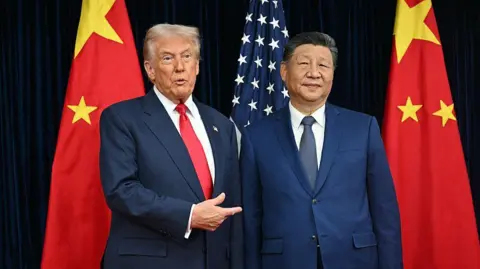
On Friday, Trump will pay a visit to Zhongnanhai, a rarefied compound where China's leaders live and work. The visit will feature a "friendship photo" and handshake with Xi.
After another bilateral meeting with Xi and a working lunch, Trump will return to the airport for a departure ceremony before heading back to the US.
Who else is travelling with Trump?
 AFP/Reuters
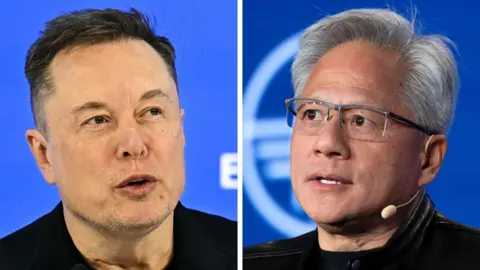
Trump is being accompanied on the visit by CEOs of major US businesses and tech companies.
Among those joining the president on his official trip to Beijing are Nvidia's Jensen Huang, Tim Cook of Apple, Elon Musk of Tesla and SpaceX, Larry Fink of BlackRock, as well as other executives from Meta, Visa, JP Morgan, Boeing, Cargill and more.
The late addition of Huang to the group is noteworthy as Nvidia's advanced artificial intelligence (AI) chips are a major focus of the rivalry between the US and China.
He was not on the original list but was personally invited by Trump, and was spotted boarding Air Force One during a stopover in Alaska.
What is the latest on tariffs?
 Getty Images
The issue has receded somewhat since 2025, for much of which China and the US seemed on the verge of a trade war.
But the two sides will still have plenty to talk about, however, as a permanent resolution has remained elusive.
Trump is expected to push to increase Chinese purchase of goods from vital US industries, including soybeans and aircraft parts.
Beijing is coming from a position of strength, with record export levels, but it still needs the US consumer market.
Also, Xi is sure to pressure the US to drop a recently announced trade probe into unfair business practices.
What else will they discuss?
Despite Trump's insistence that he did not need China's help with ending the conflict with Iran, he is widely expected to encourage Beijing to convince Tehran to make a deal.
China is eager for an end to the war and is trying to step in quietly as a peacemaker, reports BBC China correspondent Laura Bicker, as the conflict is causing pain to a sluggish Chinese economy heavily reliant on exports.
Another major issue for the two superpowers is artificial intelligence, where rivalry has been compared to a nuclear arms race and both sides are seeking channels of communication to avoid conflict.
A deal could be done, according to BBC North America correspondent Anthony Zurcher, with China offering rare earths in return for high-end computer chips for programming the brains of its new robots.
