'Unique piece of women's football history' restored

 BBC/Ricochet Ltd
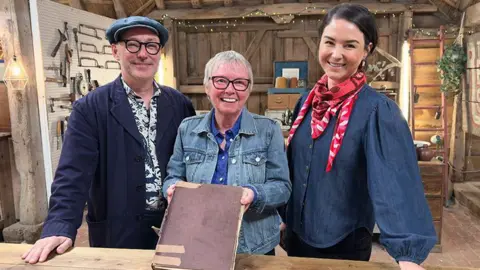
A women's football historian who had a scrapbook repaired on BBC One's The Repair Shop said it was "the most wonderful experience of my life".
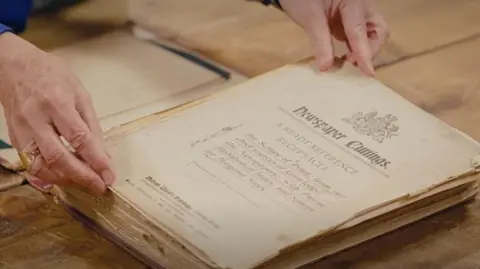
Gail Newsham visited the barn with her scrapbook of newspaper cuttings, photographs and letters from 1917, compiled by Alfred Frankland who was manager of the Dick, Kerr Ladies football team.
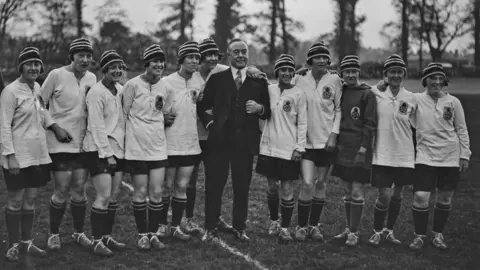
The team got its name from the munitions factory in Preston, Lancashire, where most of the team worked during World War One - and chalked up more than 200 games without defeat.
"They are the most important team in the history of women's football," Gail said. "They weren't the first, but they were the best."
 BBC/Ricochet Ltd
Dick, Kerr Ladies was founded at Dick, Kerr & Co. munitions factory in 1917 to raise money for wounded soldiers.
They raised £600 in their first game on Christmas Day that year, which took place at Preston North End's Deepdale ground before 10,000 spectators.
Newsham's unique scrapbook was given to her by former manager Kathleen Latham and charts "the origin of the Dick Kerr's Ladies", she told BBC Radio Lancashire.
"I was a football lass myself," she said.
"As soon as I could walk I was kicking a ball about and I grew up in the same streets that they did and somebody had to tell their story before it was too late."
She said the book was "a unique piece of women's football history", but it had got to the point where she was "scared of touching it".
"I couldn't pick it up without it falling apart, so consequently it had been stored away in a dark corner so that it didn't deteriorate all together, so you couldn't really show it anybody," she said.
 BBC/Ricochet Ltd
Book restorer Chris Shaw said repairing it was "a fascinating delve into the women's achievements".
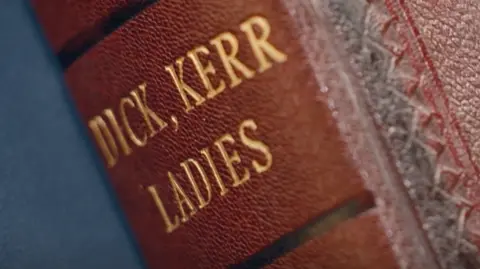
He worked his magic, making the pages stronger, re-binding them and tooling "Dick, Kerr Ladies" in gold to the leather spine.
The finished scrapbook was "beyond anything I could have imagined", Gail said.
"I was over the moon, it was the most wonderful experience of my life.
"It's my favourite show on the telly and to actually go there and be in that barn, it was just magical."
Dick, Kerr Ladies
 Getty/Topical Press Agency
- Dick, Kerr Ladies were founded at Preston's Dick, Kerr & Co. munitions factory in 1917 to raise money for wounded soldiers
- They were the first women's team to play wearing shorts and the first to go on an overseas tour
- Entertained about 10,000 spectators in the first game on Christmas Day 1917, which took place at Preston North End's Deepdale ground and raised £600 for wounded soldiers
- Three years later, 53,000 fans watched them play at Everton's Goodison Park
- Went on to record a whole series of firsts for the women's game, including having the first female manager and taking part in the first women's international game - a match against a French XI which they won 2-0 in front of 25,000 fans
- However, in 1921, the Football Association (FA) banned the women's game, on the grounds that football was "unsuitable for females and ought not to be encouraged"
- Despite the ban, the side continued to play across the world and played more than 200 games without defeat
- They disbanded in 1965, four years before the Women's Football Association was formed, due to a lack of players
Listen to the best of BBC Radio Lancashire on Sounds and follow BBC Lancashire on Facebook, X and Instagram. You can also send story ideas via Whatsapp to 0808 100 2230.
