Burning of mosque replica on bonfire 'sowing hate in society'

 PA Media
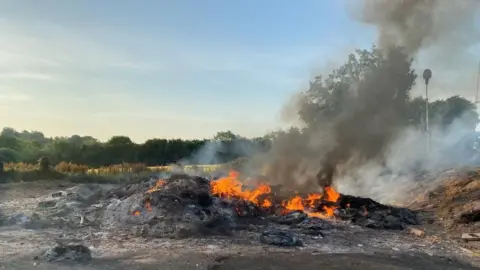
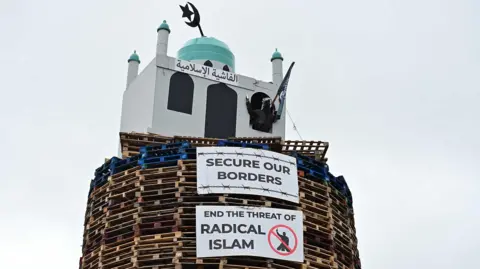
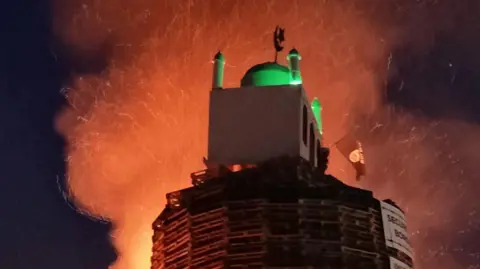
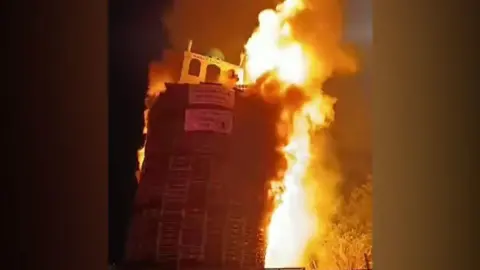
There has been widespread condemnation after a bonfire with a replica mosque on top was lit before police could remove it.
The replica, which appeared on the bonfire in Moygashel, County Tyrone, has been described as a "horrible racist display" and as "sowing hate".
Bonfires are lit across Northern Ireland as part of celebrations in some unionist areas, ahead of the Orange Order's 12 July parades.
The Police Service of Northern Ireland (PSNI) said its "significant and complex policing operation" to remove a "hate display" was at an "advanced stage when the bonfire was lit".
 Pacemaker
One man has been charged with incitement to hatred in connection with the replica mosque.
Brian Conrad Neill, 56, from Hollow Mills, New Mills, Dungannon, appeared in court charged with incitement to hatred in connection with the replica on Friday.
The Moygashel bonfire has featured other controversial displays in the past, including an effigy of refugees in a boat.
Bonfire lit ahead of police swoop
The PSNI had planned a significant operation in Moygashel, involving a few hundred officers.
Public order units were to have given cover to other officers using specialist equipment to remove the replica of a mosque from the top of the 20m high bonfire.
It is believed they were on standby, waiting for the crowd at the site to reduce in size before moving in during hours of darkness.
But anticipating police action, the bonfire was lit in advance.
The PSNI had been in contact with community representatives during Thursday, urging the removal of the replica and its handover as part of an investigation into a hate crime offence.
Senior officers have told BBC News NI they did not tell them an operation was planned if talks got nowhere.
Sources stated they are "frustrated" that the replica was torched before they could seize it.
There is to be increased engagement with ethnic minority communities in Northern Ireland over coming hours.
This has been described as providing "reassurances" going into the Twelfth.
'Complex challenge'
The former senior PSNI officer Roy McComb said the risks for officers trying to "access something at the height" would have taken time and created tension in the community.
"It's not something that police would have been able to react to with any great amount of speed given the complexity and logistical challenges," he said.
The replica was placed on top of the pyre on Wednesday and the bonfire was due to be lit on Friday.
In its statement, Moygashel Bonfire Association said the display might "shock, offend or outrage", but said those involved in making it were exercising their right to freedom of expression.
'Horrible racist displays'
 Handout
There has been widespread condemnation of the replica among political representatives across the island of Ireland.
The Democratic Unionist Party's (DUP) Community Minister Gordon Lyons said bonfires play an important role in the culture of Northern Ireland but added "there is no place for the burning of flags or effigies" and they should always be respectful.
He also warned against "demonising" all cultural celebrations as he said the overwhelming number of bonfires in Northern Ireland will pass off without concern.
Sinn Féin Economy Minister Caoimhe Archibald said it "was not the first time we have seen horrible racist displays on this bonfire".
She added that there is no place for such displays.
Taoiseach (Irish prime minister) Micheál Martin said those responsible are "sowing hate in society" and he warned that this "dangerous" type of behaviour can have further consequences.
 Social media
SDLP councillor Karol McQuade said the organisers were "attention seeking" while Alliance assembly member Peter McReynolds said he had received "messages of fear from the Muslim community".
The Church of Ireland Archbishop of Armagh, the Most Rev John McDowell, called the effigy "an expression of deep hostility", not a protest.
Speaking on Good Morning Ulster, he said it wasn't "constructive" to react to immigration in this way and added that people should "try to build up a society which accepts the contribution from all sorts of people because we need it in a small society like Northern Ireland".
Catholic Archbishop of Armagh Eamon Martin said his thoughts were of "sadness".
He added that the replica would add to the fears, concerns and anxiety of people from other traditions and faiths.
"If people search their hearts and say 'what are we actually doing here, what are we saying to our community, to our families, our neighbours' about how we feel and how we think. I was deeply saddened by this," the head of the Catholic Church in Ireland told Evening Extra.
Loyalist activist Jamie Bryson, who was present when the Moygashel bonfire was set alight on Thursday night, told BBC NI he had "no doubt" there would have been violent clashes between police officers and locals had the bonfire not been lit.
He also said nobody in the unionist or loyalist community "should be targeting anybody".
He added: "I want to reassure the Muslim people that this is not about them as people. People disagree with their ideology, with their viewpoint, but it's not about them."
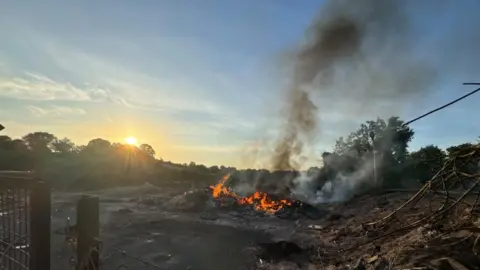
Previous Moygashel controversies
It is not the first time Moygashel's annual bonfire has featured a contentious display.
In 2025, an effigy of refugees in a boat was placed on top of the bonfire and was set on fire when the bonfire was lit.
In 2024 a replica of a police car was burnt, while in 2023 a picture of the then Taoiseach (Irish prime minister) Leo Varadkar and an Irish flag were placed on the bonfire.
Bonfires are lit annually in some unionist areas across Northern Ireland in July to usher in the Twelfth of July, the main date in the parading season.
The majority are lit on 11 July, known as the Eleventh night.
The Twelfth commemorates the Battle of the Boyne in 1690 when the Protestant King William III defeated Catholic King James II.
