What we know about White House plans for an 'Arc de Trump'
US President Donald Trump's plan to build a 250-foot-tall arch in Washington, DC, has inched one step closer to reality after passing a key hurdle in the approval process.
The US Commission of Fine Arts (CFA), an agency that reviews design plans for government projects, voted on Thursday to approve a revised design for the structure, according to US media.
The so-called Arc de Trump, the latest in the US president's efforts to remake the capital city in his style, would commemorate the country's 250th anniversary this summer.
"We're the only important and major city that doesn't have" a triumphal arch, Trump told reporters on Thursday after hearing that the new design was approved.
What does Trump want to build?
Trump has pursued a number of projects during his second term to revamp the US capital, including a gilded makeover of the Oval Office, constructing a White House ballroom estimated to cost around $400m, paving over the White House Rose Garden, and renovating the Lincoln Memorial Reflecting Pool.
The triumphal arch is one of the biggest projects Trump has set his sights on.
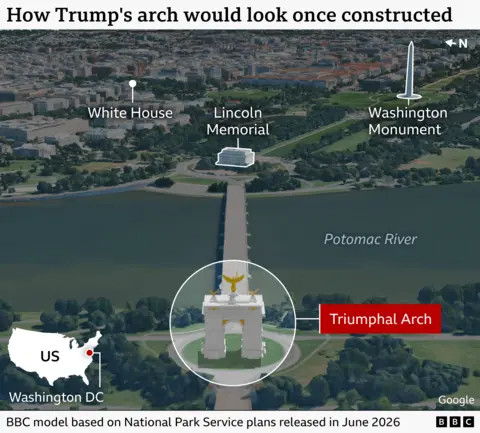
He wants the arch to be based on the Arc de Triomphe in Paris and to welcome people into the nation's capital as they cross the Memorial Bridge from Arlington National Cemetery.
"It was meant to be built for many years. The circle going up to the bridge... people pass that circle, they say, 'Why isn't something built here?'" Trump said on Thursday, referring to a grassy area at the end of the bridge.
The newly approved design reduces the arch's height by about 8 feet compared to previous plans and removes four golden lions from around the base of the structure, the Associated Press reported.

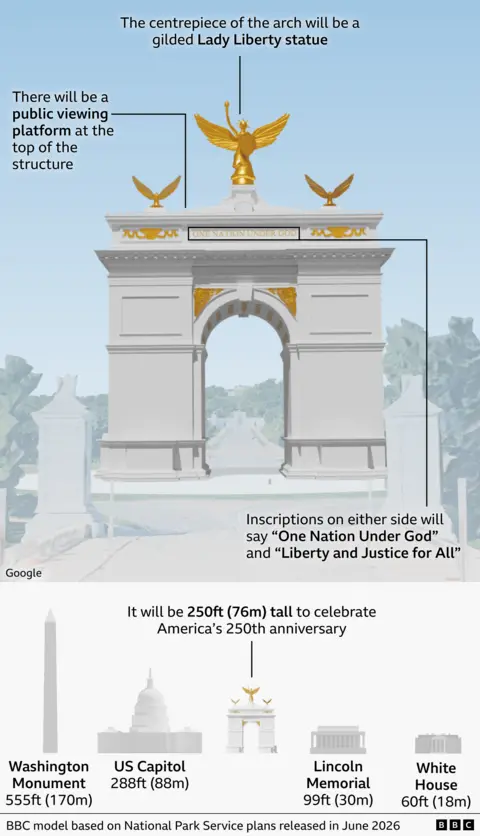
A rendering of the design includes a golden, winged Lady Liberty on the top of the arch, flanked by two gold eagles, and with the phrases "One Nation Under God" and "Liberty and Justice for All" inscribed in gold on either side of the structure. It will stand 250-feet (76m) from its base to the top of the golden lady statue.
At that height, the structure would dwarf the 99-foot Lincoln Memorial nearby and be half as high as the Washington Monument.
Some taxpayer money would pay for the arch's construction, according to a spending plan from the National Endowment for the Humanities released in April.
The BBC has reached out to the White House and CFA for comment.
Where will he build it and how long will it take?
Current plans for the arch show it would be located on federal land near the Potomac River.
It's not yet clear when construction will begin or how much it will cost.
After the CFA approval, the National Capital Planning Commission (NCPC) will review the proposed design, with a meeting scheduled on 4 June.
Developing a memorial in the District of Columbia is complex given its status as the capital city, according to Dr Christine Henry, director of the Center for Historic Preservation at the University of Mary Washington in Fredericksburg, Virginia.
New commemorations typically need congressional approval as part of a 24-step plan developed by the NCPC.
But Trump has repeatedly said he does not plan to seek approval from Congress for the arch.
Federal law prohibits new construction on the National Mall, which is typically the most desirable real estate for monuments.
Preston Bryant, a former chairman of the NCPC who was appointed by President Barack Obama in 2009 and served until 2018 during Trump's first term, said he frequently heard from organisations that wanted to design a monument or memorial on the National Mall.
"The Mall is increasingly crowded and unable to accommodate all who want to have a monument or memorial somewhere on, adjacent to, or otherwise near it," he told the BBC.
Congress gave an exemption most notably in 2003 to make way for the National Museum of African American History and Culture, which opened in 2016.
The location that Trump has his eye on appears to be a designated area that allows for new memorials, but only if they are of "preeminent historical and lasting significance to the United States".
But building a new memorial typically takes years and would not be ready before the nation's semiquincentennial.
"You have to look at the environmental impact of anything as well as all of these concerns about the aesthetics and the engineering so it usually takes several years to go through a process of designing a new memorial," Dr Henry said.
The approval process alone would take at least a year, according to Mr Bryant.
"If federal law is followed and the design goes through the NCPC and CFA review and approval process, to then be followed by construction, I have a hard time seeing how this arch will be designed, approved and constructed by July 4th of next year."
As for who will pay for the new memorial, the sponsors of an approved memorial have to raise the funds for it and federal law prohibits the use of government funds for such purposes. But that hasn't always been the case.
In 2005, Congress approved $10m for the Martin Luther King Jr Memorial to match what had been raised from private donors, according to a 2023 report from the Congressional Research Service.
What are Trump's other renovation plans?
According to Axios, Trump has had models and dioramas built for other projects he is considering and has directed how and where new marble-tiled floors would be laid in the White House.
He has also taken world leaders, including Finnish President Alexander Stubb, Israeli Prime Minister Benjamin Netanyahu and a delegation of Florida lawmakers on tours of the White House to show them his changes, some of which mirror the aesthetic of his Mar-a-Lago estate in Florida.
He unveiled a "Presidential Walk of Fame" along the West Wing colonnade in September, displaying gold-framed portraits of himself and the 44 other presidents along the white exterior wall.
In place of former President Joe Biden's headshot, Trump instead hung a photo of an autopen signing his name. The move appeared to refer to Trump's claim that Biden's use of the autopen signalled his decline at the end of his presidency, although it is common for US presidents to use such a tool.
Critics, including a guest essayist for the New York Times, have called his Oval Office remodel a "Gilded Rococo Nightmare".
