My wife died from a flesh-eating bug. I blame NHS delays for her death

 BBC
BBCThe husband of a woman who died after contracting a rare flesh-eating infection says he feels "cheated, let down and failed" by the NHS.
Stephen Alexander believes his wife, Sharon, would still be alive if they had not encountered a series of delays when he tried to raise the alarm.
He initially called NHS 24 and as her condition deteriorated an ambulance was called - but they still had to wait several hours for an emergency response.
The Scottish Ambulance Service and NHS 24 have written to the family and apologised for not meeting expected standards of care.
Stephen contacted BBC Your Voice to share his story after reading about other excessive waits for an ambulance.
His experience highlights the real-life consequences of overcrowded emergency departments and delayed ambulance response times.
Across Scotland the typical delay in handing over an ambulance patient at a hospital is nearly 50 minutes - more than three times the target duration - and waits of four hours or more are common.
Stephen said he thought he was "doing the right thing" by calling NHS 24, but he wished he had ignored guidance to only call 999 when someone's life is at risk.
"NHS 24 told me a doctor's coming, they've told me medical assistance is coming. It didn't turn up," he said.
"People that really need help are dying because they can't get the service."
Health Secretary Angela Constance told BBC Scotland News she would raise the Alexander's experience with the ambulance service and NHS 24.
"Whilst I recognise there are pressures across the system, we must be able to respond as quickly as possible to emergencies and the status quo is not good enough," she added.
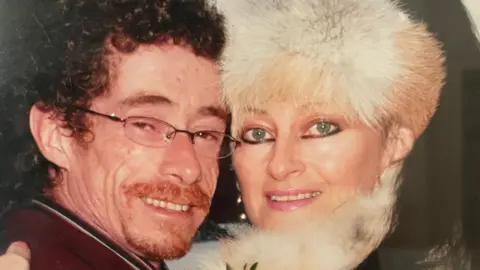 Stephen Alexander
Stephen called NHS 24 shortly after 08:00 on 15 February, when Sharon, 72, woke up with pain in her lower back and hip.
He was advised that a GP would visit their home in Girvan, South Ayrshire, within four hours.
A medic did not arrive and at 11:00 he called back after Sharon's pain had worsened, she had developed a fever and he had fears about her consciousness.
His call was passed to the ambulance service but no vehicle was dispatched. Instead, at 13:00, he received a call from an advanced practitioner to discuss Sharon's condition.
As the couple waited for help to arrive, six ambulances were parked outside Crosshouse Hospital in Kilmarnock, where they were waiting to hand over patients.
One ambulance was there almost five hours that day - unable to respond to emergencies elsewhere.
The first vehicle that was sent to the Alexander's home was diverted to another patient deemed more urgent.
Sharon finally arrived at Crosshouse Hospital in Kilmarnock just before 17:00, almost nine hours after Stephen's initial call to NHS 24.
"I can't even begin to imagine the amount of pain she was in when she actually arrived at the hospital," Stephen said.
'Stuff of horror movies'
Medics at the hospital immediately recognised Sharon was suffering from necrotising fasciitis, a rare but extremely dangerous infection.
Rapid surgery to cut away infected tissue, intensive care and antibiotics are "critical for patient survival" according to research from Addenbrooke's Hospital in Cambridge.
Stephen said he had five minutes with his wife after they realised her condition was "the stuff of horror movies" before Sharon was rushed to surgery.
Doctors cut away her skin, tissue and muscle from the knee right up to her right-hand shoulder.
Stephen described staff as "angels" who did everything they could but the infection had spread to both sides of her body.
He said that following Sharon's death, the consultant hugged him and told him she wished they could have seen her sooner.
 Stephen Alexander
Stephen received apologies from both NHS 24 and the Scottish Ambulance Service but he felt they were "just empty words on a piece of paper".
He hopes health leaders and the Scottish government can work together to improve emergency care.
In its letter of apology, NHS 24 said "a different outcome should have been reached" after Stephen's first call and that going to A&E would have been "more appropriate".
Correspondence from the ambulance service explained the impact of "wider system pressures" led to several ambulances being queued up outside hospitals in Ayr and Kilmarnock, unable to get back on the road to other patients.
University Hospital Crosshouse routinely has some of the longest delays outside emergency departments waiting to handover patients.
The latest figures from the Scottish Ambulance Service show ambulances were delayed at the hospital for an average of one hour, one minute and 53 seconds in the week beginning 13 July.
Some crews faced much longer delays, with one in 10 waiting more than four hours, seven minutes and 55 seconds.
The Scottish average was 49 minutes and 42 seconds.
One of the causes of ambulance queues outside hospitals is overcrowding in emergency departments.
Targets to see to patients in A&E within four hours have not been met since 2021.
The Royal College of Emergency Medicine (RCEM) has warned delays to treatment leads to patients dying or coming to harm.
Dr Fiona Hunter, vice president of the RCEM in Scotland, said A&E departments are so busy that all available space is used with patients "stacked up" on beds in corridors or waiting in ambulances.
She said: "People are losing their loved ones from being stuck in these inappropriate, non-clinical areas that were never designed to hold patients for any length of time."
NHS Ayrshire and Arran said that, like other health boards, it was experiencing "significant pressures" across the health and care system.
It said it tried to forecast demand to minimise delays and that it worked to mitigate risks where delays were identified.
NHS 24 said it was continuing to engage with Sharon's family while a review of the case was ongoing.
The Scottish Ambulance Service said lengthy hospital turnaround times were preventing crews from getting out to treat other patients.
"We continue to work closely with health boards to support their efforts to reduce hospital handover delays," a spokesperson added.
Health Secretary Angela Constance said she would shortly set out a "new national plan" to directly address A&E pressures and delayed discharge.
"Whilst the situation in Scotland is not unique and A&E departments across the UK continue to face significant demand, I am clear that our system requires reform and I am determined to shorten waits for patients, reduce people going to hospital unnecessarily and ease A&E pressures," she added.

