ExxonMobil fined £267,000 over chemical leaks at Mossmorran

 PA Media
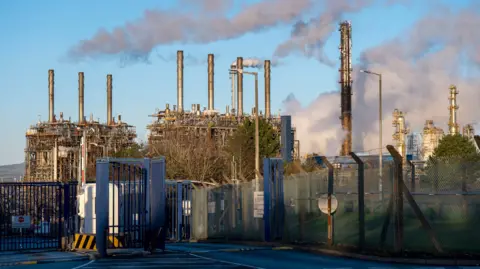
Petrochemicals giant ExxonMobil has been fined £267,000 over leaks of dangerous substances caused by corroded piping at its plant in Fife.
The Health and Safety Executive (HSE) said dimethyl sulphide and ethane was released from overhead pipes at the Mossmorran facility near Cowdenbeath in 2018 and 2019.
An investigation found the company had been aware of one pipe leaking the substances, which are irritable to the eyes and harmful if ingested, for four months while workers were on site without taking action.
ExxonMobil said it accepted "full responsibility" for the failures following the hearing at Kirkcaldy Sheriff Court, but claimed no workers or members of the public were at risk.
One HSE inspector said the firm was fortunate the leaks did not result in a "catastrophic event".
The firm shut down production at Mossmorran in February this year after claiming it was losing a million pounds a week by operating the site.
A full decommissioning process is expected to be completed by early 2028.
 HSE
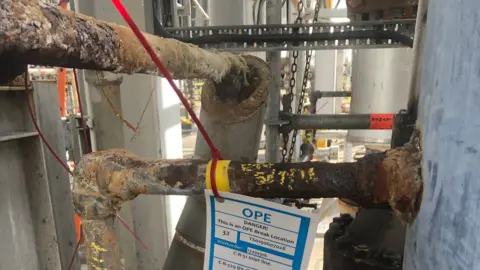
HSEHSE said they found five occasions where the highly flammable chemicals were released between February 2018 and September 2019.
The initial leak was discovered during a routine inspection in May 2019.
HSE inspectors said they were told by one worker that a combination of dimethyl sulphide and ethane had been leaking from the pipe since that January.
It later emerged a "pinhole leak" on the same dimethyl sulphide line had been detected in February 2018, but that it had taken about four months to be fixed.
Further investigation found an ethane leak on a separate pipe in December 2018, which was discovered by a worker "by chance".
The HSE said that leak, caused by corroded cladding, lasted about six weeks and resulted in an estimated 82 tonnes of hydrocarbons escaping into the atmosphere.
Two other pinhole leaks were later found on an inlet line and an overhead line in June and September 2019 respectively.
'Good fortune'
Testing of the piping, including X-ray imaging, later found it had "corroded below its safe minimum thickness".
Inspector Lindsey Stein said the firm's inaction in dealing with the leaks "beggared belief".
Stein said: "The failure of ExxonMobil to properly inspect insulated pipework led to five separate leaks of highly flammable hydrocarbons, and while none of these leaks resulted in a catastrophic event, this was down to good fortune rather than good management.
"The arrangements in place to detect and prevent corrosion were woefully inadequate, and the consequences could have been far more serious."
The HSE noted the company had since made the required repairs.
Stein added: "Systematic risk management isn't just best practice, it's a legal duty, precisely because these are high-hazard operations where the margin for error is minimal.
"In its simplest terms, process safety is about keeping hazardous substances where they belong: inside the pipes, not in the atmosphere."
An ExxonMobil spokesperson said it had complied with all HSE notices served and made required adjustments.
They added: "We have accepted responsibility and resolved a matter relating to historical corrosion under insulation (CUI) issues at Fife Ethylene Plant between 2018 and 2019.
"We accept full responsibility for the failures identified and have since made significant changes to how we inspect and manage corrosion risk across our operations."
ExxonMobil has previously faced fines and criticism over flaring at the plant.
It was fined £176,000 over flaring offences last year following the conclusion of an investigation into flaring in April 2019.
The firm said it had made improvements in both "elevated and ground flares" since.
