From mouthwash to hair dye: How weight-loss jabs are changing shopping habits

News imageBBC An illustration of a pink credit card, next to an unfurling green measuring tape, against a grid-style backdrop with a green bar chart. BBC

Weight-loss medications have surged in popularity over the last few years, with more than two million people in the UK now using them.

But while drugs like Wegovy and Mounjaro have helped people reduce their weight, they also seem to be reshaping some users' spending habits.
Below, the BBC looks at some of the latest research on the trend, using graphics to illustrate the findings.

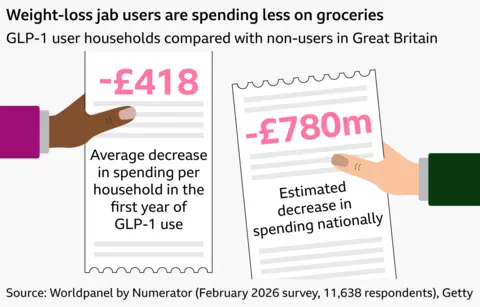
News imageA graphic showing how weight-loss jab users are spending less on groceries. The data compares GLP-1 user households with non-users in Great Britain, in the year after GLP-1 adoption. There are two bits of receipt paper being held by hands emerging from either side of the graphic. The receipt on the left has -£418 written in pink bold text, which is the average annual saving on grocery bills for per household. The receipt on the right has -£780m written in pink bold text, which is the total saving across all households.

Mounjaro and Wegovy - the UK's most popular weight-loss medications - work by mimicking a natural hormone, GLP-1, which regulates hunger, and those who use then say they find their appetite is reduced.

In June, market research company Worldpanel by Numerator published a study looking at how this affects grocery spending among UK users. The research was based on survey responses and observed purchase data from more than 11,000 households in February.

A key finding was that households with at least one GLP-1 user spent on average £418 less on groceries in the year after they began their medication, compared with non-users.

This amounted to a fall of £780m in grocery spending nationally, it estimated.

It chimes with a peer-reviewed study from Cornell University published last year, which found that US households with at least one member using weight-loss drugs spent 5% less on groceries within six months of starting the medication, with that rising to 8% among higher income families.
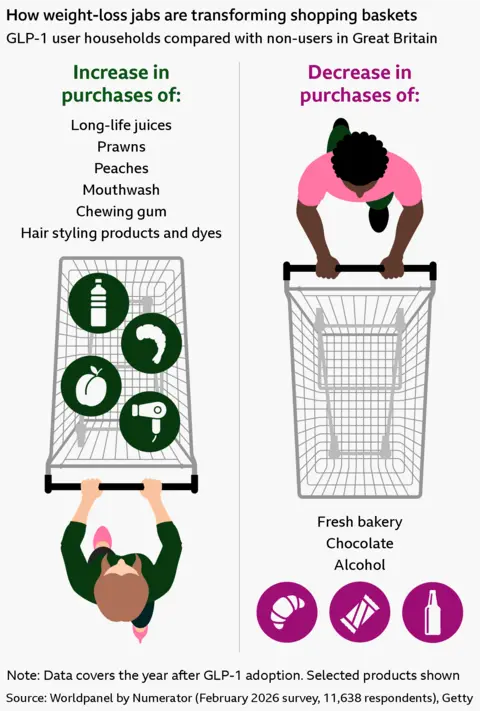
News imageA graphic showing how weight-loss jabs are transforming shopping baskets. The data compares GLP-1 user households with non-users in Great Britain, in the year after GLP-1 adoption. Selected products that have seen an increase and decrease in buying among users compared with non-users are shown. Fresh juice/smoothies, prawns, peaches, mouthwash, chewing gum, and hair styling products and dyes have all increased, while fresh bakery, chocolate and alcohol have all decreased. The increases are show as green icons in a shopping trolley being pushed upwards, while the decreases are shown as pink icons below an empty trolley being pushed down. The source is a Worldpanel by Numerator survey conducted in February 2026, with 11,638 respondents.

People also cut back on buying some items and started spending more on others when taking weight-loss medications, Worldpanel found.

As the chart above shows, the control group reported spending less on chocolate and pastries and more on fruit and protein-rich foods like prawns - a likely result of feeling fuller for longer and being less prone to eat out of boredom. They also consumed less alcohol.

But they bought more chewing gum, mouthwash and hair dyes - products that counter common GLP-1 side effects like thinning hair and bad breath.
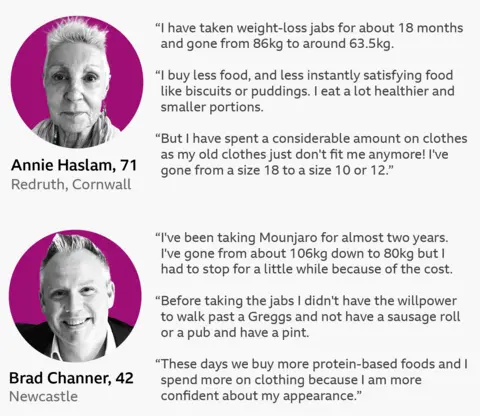
News imageTwo case studies of weight-loss jab users - Brad Channer (aged 42 from Newcastle) and Annie Haslam (aged 71 from Redruth, Cornwall). We see pictures of both next to comments about their experiences of GLP-1 jabs. Annie Haslam, 71
from Redruth, Cornwall
"I have taken weight-loss jabs for about 18 months and gone from 86kg to around 63.5kg. "I buy less food, and less instantly satisfying food like biscuits or puddings. I eat a lot healthier and smaller portions. "But I have spent a considerable amount on clothes as my old clothes just don't fit me anymore! I've gone from a size 18 to a size 10 or 12." Brad Channer, 42
from Newcastle
"I've been taking Mounjaro for almost two years. I've gone from about 106kg down to 80kg but I had to stop for a little while because of the cost. "Before taking the jabs I didn't have the willpower to walk past a Greggs and not have a sausage roll or a pub and have a pint. "These days we buy more protein-based foods and I spend more on clothing because I am more confident about my appearance."

Nishita Pattni, a senior consultant at Worldpanel by Numerator, told the BBC that weight-loss jabs weren't "simply reducing spending" but "reshaping it".

"This isn't simply a story of shrinking demand. It's also a story of shifting demand."

Cornell's research found users cut back most on calorie-dense, processed foods, spending 10% less on savoury snacks, for example.

They also bought less cheese, butter, soft drinks and eggs but more yoghurt.

However, it found households "revert to their pre-adoption grocery spending patterns" when they stop taking their medication, and even shift toward slightly less healthy grocery baskets.
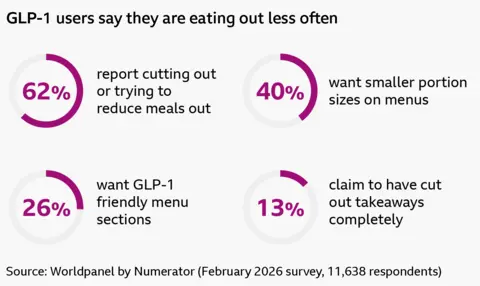
News imageA graphic with four donut charts showing how GLP-1 users are eating out less often. The top two donut charts show 62% of users who report cutting out or trying to reduce meals out, and 40% wanting smaller portion sizes on menus. The bottom two charts show 25% wanting GLP-1 friendly menu sections, and 13% claiming to have cut out takeaways completely.

Weight-loss jabs also appear to be affecting how much people spend on eating out.

Nearly two-thirds of those surveyed by Worldpanel reported cutting out or trying to reduce meals out since starting their jabs.

According to Worldpanel, over half of weight-loss jab users surveyed describe their approach to eating as "mindful", meaning they are guided by hunger cues rather than habit or routine.

Cornell's research, meanwhile, found an 8% decline in spending at fast-food chains and coffee shops.
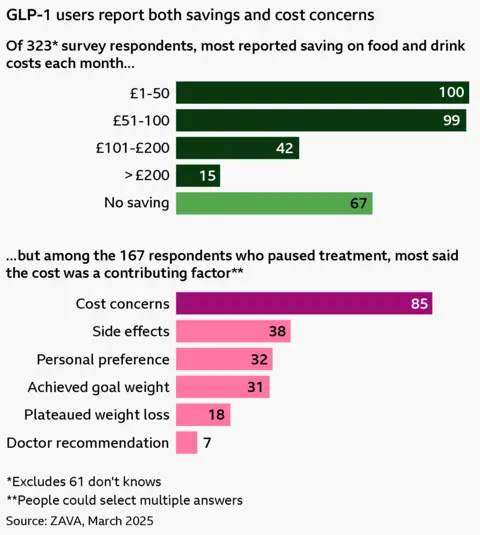
News imageTwo horizontal bar charts showing the results of a survey of GLP-1 users in March 2025. The top bar chart shows green bars of reported monthly savings among 323 respondents: 100 reported saving up to £50 on monthly food and drink costs, 99 reported saving £51 to £100, 42 reported saving £101 to £200, and 15 reported saving more than £200. The remaining 67 reported no savings. 61 don't know responses are excluded from the chart. The bottom bar chart shows pink bars of the most common reasons for pausing treatment among 167 respondents: 85 cited cost concerns, 38 cited side effects, 32 personal preference, 31 achieved goal weight, 18 plateaued weight loss and 7 doctor recommendation. People could select multiple answers.

Despite potential savings for weight-loss jab users in some areas, the cost of the drugs is a concern for some.

The vast majority of UK patients pay for their medications privately and prescriptions can cost more than £300 a month.

A survey of 167 users by Zava, an online doctor and pharmacy service that sells weight-loss drugs, found the number one reason people stopped taking their medication was cost.

Meanwhile, the Health Foundation, a charity, has said affluent areas of the UK see higher rates of prescriptions on average, despite lower obesity prevalence, based on data from one private provider.