Tommy Robinson says he 'got it wrong' over man he falsely accused of filming children

 Getty Images
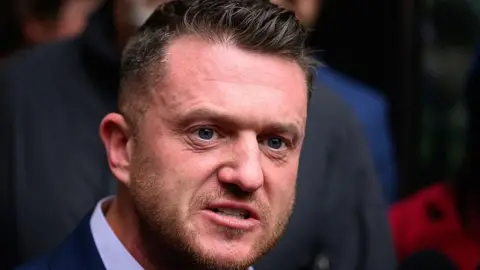
Far-right activist Tommy Robinson has admitted he "got it wrong" when he falsely accused a man on social media of filming children in a Glasgow park.
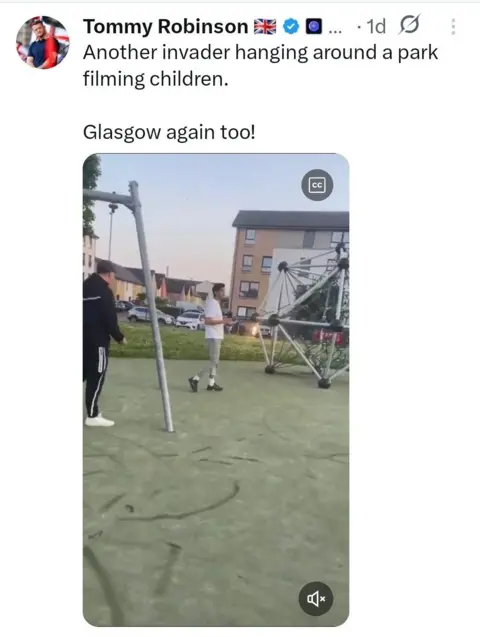
Footage of UK-born Quoroum Beg with a mobile phone in his hand began circulating last Sunday, with Robinson labelling him an "invader".
Beg was in fact filming an anti-immigration demonstration which had earlier forced him and his children, along with other families, to leave the park in the city's Gorbals area.
Robinson, whose real name is Stephen Yaxley-Lennon, has now issued a correction on X, saying: "In this instance I got it wrong, as did many others, so for that I apologise and have deleted that post."
However Beg told BBC Scotland News that Robinson's correction appears to fall far short of an apology.
"Is he apologising because he can't get his facts right or is he apologising for the hurt he's caused me?" he said.
Beg - who has three children and works full-time in Glasgow - now fears for his safety. He has been given an emergency police number to call in case he feels threatened.
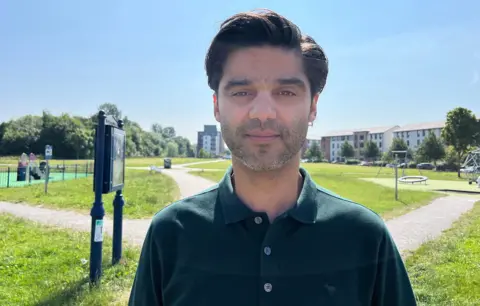
Beg had taken his children to the park on Sunday evening, but at about 21:00 he became aware that an anti-immigration demonstration was heading his way.
He said: "Just past 21:00 we heard a bit of a commotion, a helicopter flying above us, a lot of people walking towards the park with banners in their hands, a balaclava on.
"People started panicking and leaving with their children."
He quickly walked his children back to their flat but returned to the park to collect his car.
"They were chanting and saying stuff about close the borders, save our children, and it was all directed at me," he said.
Beg said he then decided to "confront them with part of that anti-racism Glasgow spirit".
He filmed the protesters on his mobile phone but later, after police advised him that it might inflame the situation, he moved away and sat down on some children's swings.
It was at this point that he was filmed by some of the demonstrators who then posted the video online, where it was shared by Robinson to his two million X followers.
In the footage people can be heard asking Beg "why are you filming kids?" and describing him as a "nonce".
"I was in disbelief when I first saw the post shared by him, I was in disbelief he painted me like this," said Beg.
"My reputation has been tarnished through the world. I am fearful for my safety. I've seen videos where people around him attack people."
Glasgow has seen a number of anti-immigration demonstrations in recent weeks including one where the windows of a house were smashed. Police later said it was a case of mistaken identity after disinformation was spread online.
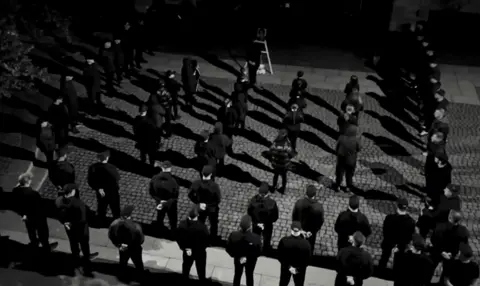
Videos have also been circulating of people dressed all in black, standing in military-style formation as they stage "silent vigils" in Glasgow and Edinburgh in memory of a white teenager who was murdered in 2004.
 YouTube
On Friday right wing Glasgow-based video blogger, Craig Houston, was stopped and questioned under anti-terror laws at Edinburgh airport as he returned from holiday in Greece.
Officers seized his mobile phone and laptop, according to Houston who has subsequently posted a new video about his detention.
Beg, who is a fourth generation UK citizen, said the current political climate had made him fearful for the safety of his children.
"My children are off for the summer and I can't explain to them why they can't go out," he said.
Glasgow has traditionally prided itself on its friendly and inclusive ethos.
In 2021, hundreds of people turned out for a largely spontaneous protest in Kenmure Street to prevent two men being taken away in a van by Home Office Immigration officers.
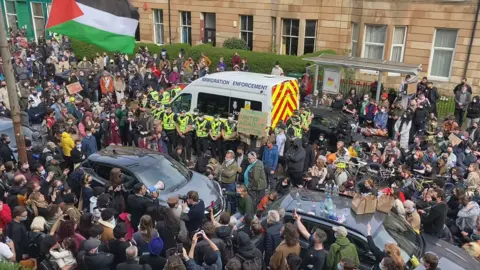 PA Media
In recent years, however, Glasgow has become one of the main dispersal locations for asylum seekers, and the number being accommodated has increased to one of the highest rates per head of population in Britain.
Dr Judith Sijsterman, a politics lecturer at Aberdeen University who is researching the far right in Scotland, told the BBC's Scotcast podcast that recent protests have attracted two very different groups of people.
She said: "There's a local group of people, who come out to maybe one or two protests when they are in their area, and they're about maybe a specific issue they care about, or they're expressing a wider feeling of discontent.
"And then there's a group of people for who this type of organising and protesting is a massive part of their life.
"They're maybe travelling across Scotland to these protests, they're maybe spending time online posting in 10, 20 different groups, they're creating AI images to advertise these protests."
