How will your council candidates tackle SEND woes?

 BBC
BBCSupport for school children with special educational needs and disabilities (SEND) is a key issue for voters in the run-up to the local elections in May.
The number of education health and care plans (EHCPs) issued in England - which allow children with SEND to access support - increased by 140% between 2015 and 2024, according to the Office for National Statistics.
Some parents say the system is now so stretched that they are being forced to keep their children at home because schools cannot meet their needs.
As the local elections draw closer, we quizzed the candidates standing for East Sussex County Council on what they would do to address the problem.
'Structural flaw'
An EHCP identifies a child's needs and sets out the support they should receive. Local councils are responsible for ensuring these plans are followed.
Firstly, let's look at what is actually behind the rise in EHCPs being issued.
Dr Paty Paliokosta, an associate professor in inclusive education at Kingston University, told the BBC it is not due to an increased number of SEND pupils.
"The educational health and care plan has become the perceived default route for help because the layers [of support] beneath it are not credible or consistently delivered," Dr Paliokosta said.
"This is a structural flaw, not a reflection of need suddenly surging. Of course, there are some other intersectional needs that operate at the same time, and of course you will have differences within different localities.
"But this structural issue, I believe, is very much a part of the issue we have been facing the past few years."
In February, the government announced its planned changes to the SEND system in England.
The Department for Education said its reforms were "ensuring children get the right support earlier, in their local school, without having to fight for it" and would be "co-designed with parents".
"We will invest in new training for all staff, better buildings and equipment and make sure that every setting has access to expert professional support when it is needed," a spokesperson said.
Emily lives in Crowborough. Her 12-year-old son, Ethan, is autistic, has a learning disability and ADHD. He has always attended a specialist school, but his needs have recently developed.
"In the last year we've had concerns that his current school isn't suitable for him, he requires a lot more intensive support," said Emily.
"They agreed at the end of last year that they couldn't meet his needs, and since then we've been going through the local authority to look at other schools for him."
Every school the family applied for said it was fully subscribed, so does not have a place for Ethan. It means he is rarely at his current school as the staff cannot care for him for a full day.
"There's a lot of specialist provisions, but there are too many children and not enough resources," said Emily.
"We've seen the funding cuts that schools are having to manage. The downside is that by cutting funding in education, it means that when our children become adults they're more reliant on the state because they need to rely on benefits, adult social care.
"We need to be looking at early intervention, and maybe spending more money in some areas will reduce costs down the line."
Georgina, whose nine-year-old daughter Poppy has microcephaly, as well as bowel, bladder and spinal problems, said: "In terms of getting services out of school, it's really challenging and you really have to fight for your child.
"For years, we didn't have any provision with personal assistance for holiday or any like sort of respite cover."
Dawn, whose 11-year-old son Joey has cytomegalovirus, quadriplegic cerebral palsy and epilepsy, said: "Resources and finances are always really difficult, money is always incredibly difficult.
"Training isn't necessarily as difficult.
"Peer mentoring and school to school mentoring already happens, but I think more of that is needed."
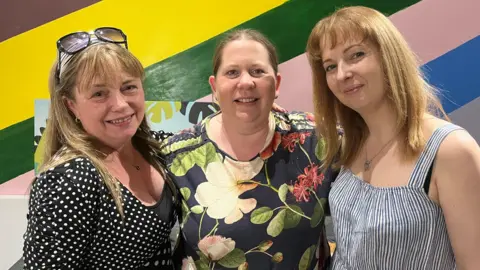
All three families are supported by the Children's Respite Trust in Uckfield, a charity which provides specialist respite care and events for children with disabilities.
What parties say
So what do the candidates standing for election to East Sussex County Council say they would do to fix the problem?
The Conservatives, which currently lead East Sussex County Council, say they "try to get involved with families at an early stage". They say they understand the difficulties parents face, and believe there is "always room for improvement, but we've done a pretty good job". They say they do not have the resources to make the improvements they would like due to a lack of funding from the government.
The Liberal Democrats say they want to see a medical professional in every single primary and secondary school across East Sussex. They say funding is limited, but it is important to ensure the money goes to "the right child, at the right time".
The Greens say SEND provisions are "absolutely shredded", calling the system "intolerable". They blame the government for failing to properly fund SEND support. They say local councils must work with and listen to parents, and want to see "bureaucratic mechanisms" removed.
Reform UK are pledging to end "wait and see culture" and delays in processing ECHPs. They say getting support right "the first time" saves a child's education and the taxpayer money. They also say they will work more closely with parents and schools.
Labour say upcoming reforms to SEND provisions are "not something to rush". The Labour government recently set out its plans for a major overhaul of the system. Locally, they say that would mean recruiting more educational psychologists and therapists, which will improve small group supervision and boost teacher training.
Residents in East and West Sussex will go to the polls on 7 May. They can vote for the 120 county councillors who are in charge of the most vital local services for the first time in five years.
Follow BBC Sussex on Facebook, on X, and on Instagram. Send your story ideas to southeasttoday@bbc.co.uk, or WhatsApp us on 08081 002250.
