Sculpted stone study could shed new light on lost kingdoms

 Christina Cowart-Smith
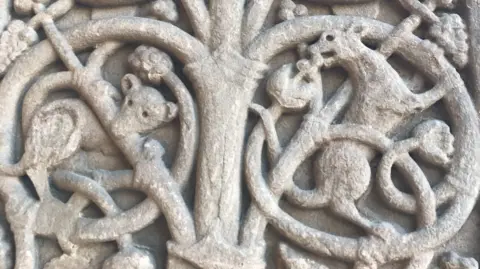
A study of sculpted stones in south-east Scotland hopes to shed new light on the lost kingdoms of the area.
The Society of Antiquaries of Scotland (SAS) will fund initial fieldwork as part of plans for a project documenting about 200 fragments south of the Forth-Clyde line, most of which have not been studied for over a century.
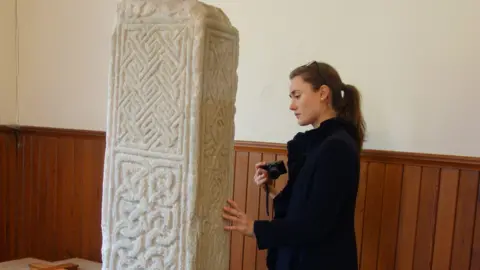
The Sculpting Southern Scotland project, co-ordinated by archaeologist Dr Christina Cowart-Smith, seeks to collect images and data in order to examine the story of the historically contested border zone.
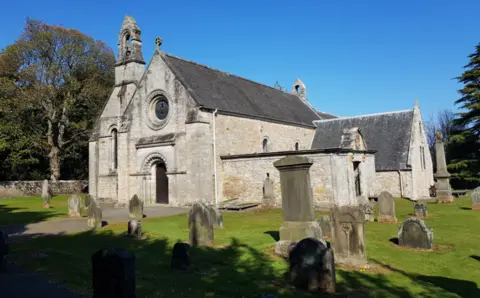
Some of the sculpted stones are considered "at risk" as they are housed in, or near, churches earmarked for closure and sale - or already sold.
 Christina Cowart-Smith
From about AD 600 to 700, parts of southern Scotland were an integral part of the Kingdom of Northumbria - also known as Bernicia.
Following its collapse in the wake of Viking raids, the Clyde-based Kingdom of Strathclyde was resurgent, extending its control even into Cumbria.
The Sculpting Southern Scotland project will investigate sculptures made over a period of 600 years - between AD 500 and 1100 - a time when the boundaries of various kingdoms shifted repeatedly.
Dr Cowart-Smith will look at how monumental sculpture contributed to the creation of these kingdoms' identities and their changing relationships with each other.
In this round of initial fieldwork she will target recording at sites including Abercorn, Coldingham, Melrose, Auldhame, Tyninghame, Aberlady, Morham and Jedburgh.
 Rachel Pickering
The society's grant - together with funding from the Pictish Arts Society, and from the Hunter Historical and Archaeological Trust - will enable Cowart-Smith to create 2D and 3D images of these sculptures and record details about their design.
She said: "Stone sculpture from early medieval southern Scotland is one of the country's most under-exploited, at-risk historical resources.
"It presents a unique witness to a crossroads of cultures in the period between AD 500 and 1100, showing us how individuals and communities constructed identity, expressed political affiliation, organised worship, and negotiated differences."
Dr Helen Spencer, SAS head of research, added: "At a time when many of the churches which house early medieval carved stones in southern Scotland are changing use, it is essential that these beautiful and intricate pieces of heritage are properly recorded and available for study in the future."
