Banned by Beijing, this comedian is taking his act to Chinese speakers abroad

 Supplied
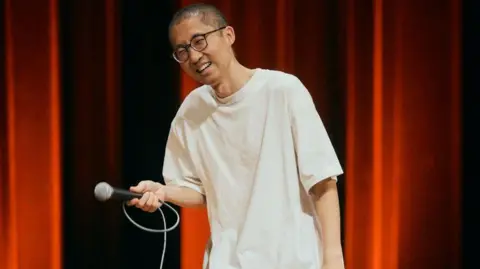
When one of China's biggest stand-up comedians opened his show with a joke about the extraordinarily long rule of the country's leader Xi Jinping, it drew a cheer, alongside a smattering of approving profanities.
"This is fire," a man shouted in Mandarin.
Few in China would dare to joke about Xi, who has increasingly centralised power in his nearly 15 years in office.
But this was the National University of Singapore, where hundreds had packed into the auditorium, mostly Singaporean Chinese and those who had moved or were visiting from China.
And the young man on stage, Chizi, knew the risks.
In 2023, China banned him from performing in the country after a series of appearances abroad that touched on issues the government is particularly sensitive about, although there has never been an official statement saying why.
Chizi does not live in China anymore and his name, once hugely popular, is a whisper now.
"In China my face is treated like a sexual organ. It's not something that can be freely shown or circulated," he wrote in a recent Threads post after learning that a fan's social media account was suspended because they had shared his photo.
After a hiatus, he returned to the stage in April, kicking off a tour spanning Tokyo, Taipei, Kuala Lumpur and Singapore, selling out every show.
At 30, Chizi, whose real name is Wang Yuechi, has been doing stand-up for more than 10 years. But this tour felt like his first "real piece", he told the BBC in a sit-down interview the day after the show.
Many see his comeback as defiance, but he said, "I wanted to perform for people who speak Chinese, to introduce myself, showing them how I live, or think as someone who lived in China for 30 years."
'If it feels risky, I find it interesting'
Chizi said he was always drawn to the challenge, and that shaped his comeback: "If something feels risky or dangerous, I find it interesting."
Like performing in Taiwan, a hot button for China, which has long claimed the self-governed island.
"No Chinese comedian had ever performed in Taiwan," he explained. "People speak the same language and the cultures are so similar. But there are so many tensions. So why not? Even if it turns into an argument, that's okay. We could argue face-to-face."
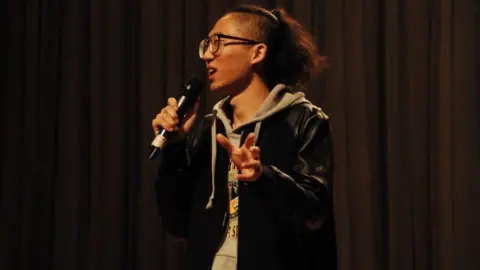
In his hour-long set, he mostly talked about his own story: an "overly talkative" kid who often frustrated the adults in charge, he discovered comedy in his late teens.
 Supplied
Now that he is performing outside of China, his jokes could push further but he said he "intentionally limited political humour" in his material for this tour.
When he joked about Xi, he avoided his name, calling him "Peng Liyuan's husband", a reference to Xi's wife, a famous singer.
He told the audience about his performances in North America that led to the ban in 2023. He had been on tour as the opening act for Chinese-American comedian Joe Wong.
In those shows, he joked about things he could never speak about at home: the state's expansive censorship, the rise of nationalism and populism online, the diminishing rights of ethnic minority groups.
He skirted close to red lines, talking about his hope that people in both Hong Kong, where Beijing has crushed opposition to its rule, and Taiwan, can live a happy life.
In February 2023, while he was still on tour, Chizi learned about the ban.
He told the BBC his first reaction was relief because the show was based on "reflections and realisations I'd had over the past few years, and I wanted to express how I truly felt".
Once he realised his career in China was over, he performed his next show in Toronto with more candour.
Chizi said he has no regrets because the space for stand-up in China has become "much more confined" and the subjects are often "very shallow".
'The things I can't say'
A high-school dropout, Chizi began doing stand-up at open mics in 2015. "I was always the chatty one, happy to make people laugh… I was like a fish in water."
He caught a break when he was invited by one of China's best-known comedians to appear on a popular talk show, which was the first to feature stand-up on air.
He became a regular and within a year, he was the face of two hit streaming shows, racking up billions of views as "the superstar of stand-up".
He sometimes rapped his jokes, thrived at improvising and roasted celebrities with sharp punches, leaving them in splits.
Speaking on any given topic, he developed a trademark style built around a "key point", often a piece of trivia, and asked the audience to take note, like a teacher addressing students, which impressed them.
He was one of the few who wove what was happening in the country into his material.
In one episode featuring pianist Lang Lang, he joked that the musician practised piano only at home as a child because "teachers would prick him with needles" - a jibe at a major kindergarten scandal then. The clip went viral.
Even as he complied with the rules to change scripts and delete lines, he kept every forbidden joke, adding them all to a folder called "Things I can't say" - and wondering if, some day, he could say those things.
 Getty Images
Through it all, he said, he doubted if he "wasn't actually good, just popular". As the questions grew, he quit the show and then left his agency after an open feud.
During the pandemic - in late 2021 - he published his final post to his 4.7 million followers on Weibo about the need to take a break from a hostile social media environment.
"It's not that I don't want to bring everyone joy. Of course I want everyone to be happy. But this place doesn't carry joy," he wrote.
He had become frustrated with the limits of his influence, he told the BBC.
During China's sweeping lockdowns, he received messages asking for medicine, food, other essentials. He reposted most but they were often deleted by censors, who warned that his account could be closed.
"It was a helpless feeling," he recalled. "The so-called privilege wasn't that meaningful."
So he took a step back, which he learned from his father, an oil painter: "He taught me that when you paint, you can't keep staring at one spot. You need to step back to see whether it's any good."
Now that he is back, he wants to take the tour further, to Australia, New Zealand and North America. He does not know how long he will do this but for now he enjoys it.
"Usually you make friends one by one, but on stage, I feel like I'm making 500 friends at once. That feeling - where there is a mutual understanding between me and the audience - I really like that."
